< previous chapter < | THE MYSTERIES OF LONDON [Vol. II] | > next chapter >
[-7-]
CHAPTER CXXXIX.
THE CONFIDENCE.
So
astounded was Markham by this information, that for some moments he was unable
to utter a word.
"I see that you are surprised, sir," said the
policeman; "but couldn't you guess where you was when you saw the room
filled with gibbets, real or in pictures?"
"It never struck me who the owner of these terrific
symbols might be," answered Richard. "I conduced that some man of
morbid taste dwelt there; but not for one moment did I imagine that I was in the
presence of the public executioner."
"Did you ever see such a horrible-looking object as
his son is?" asked the policeman.
"Poor creature — he is greatly to be pitied! Surely
his father cannot in reality have conferred upon him the name by which you
called him?"
"I don't suppose that Gibbet is his real name, sir,
but it is the only one I ever heard him called by. You see, sir, Smithers wishes
to bring the lad up to the same line: he wants an assistant, and he thinks that
Gibbet is old enough to help him. Besides, there's plenty of work always after
Assizes in the country; and the London hangman may get the jobs if he likes.
He's considered more skilful than any one else; and, after all, practice makes
perfect. As it is, he is forced to refuse a good many offers, because he can't
be here, there, and everywhere Now if Gibbet would only take to the business
kindly, he might help his father to earn a fortune!"
"But if the poor lad have a loathing for the
horrible avocation — as well he may," observed Markham, with a shudder,
"why should he be forced to embrace it?"
"Because he can never do himself good
elsewhere," answered the constable. "Who will employ the son of Jack
Ketch? Why, will you believe it, sir, that not a soul visits Smithers' family?
Although he lives in this neighbourhood, where, God knows, people ain't over
nice and partickler, not a human being would cross his threshold."
"Does that aversion arise from disgust or
superstition?" demanded Markham.
"From both, sir," was the reply. "The
people that live in this district are of two kinds — the poor and ignorant, and
the rogues and vagabonds. The poor and ignorant are afraid of the public
executioner; and the rogues and vagabonds hate him, although he's merely an
instrument. Miss Kate goes to market for him; and the shop-keepers that know who
she is, are scarcely civil to her. They seem as if they'd rather she'd keep
away."
"And you say that she is the executioner's
niece?" observed Markham.
"Smithers says so himself," was the reply;
"and of course I know nothing to the contrary; but it does seem strange
that so amiable, genteel, and clever, a young gal should belong to such a
family!"
"Her own parents are dead, I presume?"
"Yes, sir, — she is an orphan. When Smithers is very
dull and miserable with his lonely situation, he sometimes comes down to the
station and has a chat with us constables; and then he's pretty communicative.
He told me one day that Katherine's parents had died when she was very young,
and so he was compelled to take care of her. All the while she was a child
Smithers let her do pretty well as she liked; and it is a wonder that she has
turned out a good gal. But she regularly frequented the School established in
the parish of Saint David's by the Rev. Mr. Tracy; and in that way she picked up
a tolerable smattering of knowledge. Since then she's instructed herself as much
as she could, and has bought books with the little money that her needle has
produced her."
"But who employs her as a sempstress, if, as you I
say, so terrible a stigma affixes itself to each member of the hangman's
family?" inquired Richard.
"The old housekeeper at Mr. Tracy's is very [-8-]
friendly disposed towards the poor creature, and gives her work," answered
the policeman. "Katherine does all she can to console that poor humpback
Gibbet; and she has taught him to read and write — aye, and what's more, sir, to
pray."
"Policeman," said Richard, after a pause,
"the manner in which you have spoken relative to that poor girl, shows me
that you have a good heart. Is there any mode of ameliorating her wretched
situation? I feel the deepest compassion for her miserable lot; and all you have
told me of her excellent character makes me anxious to see her removed from the
vile society of that ruffian under whose roof she lives."
"I believe she is anxious to go out to service,
sir, or open a little school," answered the constable; "but her family
connection is against her. Or else I don't think that Smithers would care about
parting with her."
"What induces you to suppose that such are her
wishes?" asked Markham.
"Because she told me so, sir," was the reply.
"One evening I went to Smithers' house, with a certain message from the
Sheriff of London — you can guess what, I dare say — "
"To acquaint him with the day fixed for some
wretch's execution, no doubt?"
"Precisely, sir; but Smithers wasn't at home, and
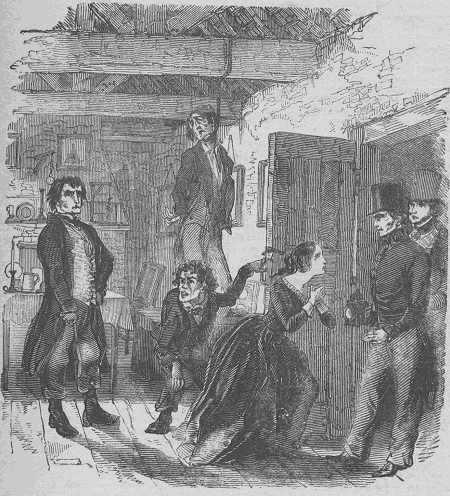
so I sate down and waited for him. It wasn't in Jack Ketch's own room up stairs
where we went just now, and where he teaches his son how to hang by means of
that puppet; but it was in a little parlour they have got down stairs, and which
Miss Kate keeps as clean and comfortable as if they saw no end of company. Well,
I got talking to the young gal; and though she never said a single word against
her uncle, but spoke of him in a grateful and kind manner,. she let out that if
he could spare her, he should like to earn her own bread by her own
exertions. And then the poor creature burst out crying, and said, that no one
would take her as a servant, and that she should get no scholars even if she was
to open a school."
Markham made no answer; but he reflected profoundly on
all that he had just heard.
"Poor gal!" continued the policeman, after a
few moments' silence; "she don't deserve to suffer as she does. My beat is
about this quarter: and I know pretty well all that's going on. I see more than
other people about here, because I've opportunity and leisure. Besides, it's my
business. Well, sir, I can assure you that there isn't a more charitable or
generous-hearted gal in all London than Miss Katherine. If a poor neighbour's
ill, it's ten to one but some female muffled up in her shawl knocks at the door
of the sick person's house, leaves a parcel, and runs away; and then there's
tea, and sugar, and gruel, for the invalid — and no one knows who brought it, or
where it comes from. Or if a family's in want, the baker calls with bread that's
paid for, but won't say who sent it. Or may be it's the butcher with a small
joint — but always sent in the same quiet manner. Then, while the poor creatures
whose hearts are made glad by this unlooked for charity, are wondering whether
it was the parson, or the parson's wife, or this benevolent gentleman, or that
good lady, who sent the things, Kate I buries herself in her room, and doesn't
even think that she has done any thing out of the way."
"Is this possible?" cried Markham.
"I know it, sir — for I've seen her do it all,"
answered the policeman, "when she couldn't see me and little thought that
any body noticed her."
"And she the niece of the public executioner!"
exclaimed Richard: "a pearl concealed in this horrible swamp!."
The conversation between Markham and the good-hearted
constable was cut short by the sudden appearance of the other two policemen, who
had undertaken to visit the low houses in Plumptre Street.
"Well, what news?" asked Richard's companion.
"None," was the reply. "We have been in
every flash crib down yonder, and can't hear or see any thing of the
Resurrection Man."
"Then we must abandon the search for to-night, I
presume," said Richard. "The clock has struck one, and I begin to be
wearied of this fruitless ramble."
"We will exert ourselves to discover the miscreant
that blew up our comrades in Bethnal Green," observed the constable who had
been our hero's companion that night. "Should we succeed in capturing him,
sir, where can I wait upon you to communicate the tidings?"
"My name is Markham," was the reply, "and
I live at Holloway. If you discover the villain Anthony Tidkins, lose not a
moment in making me acquainted with the circumstance."
Richard then rewarded the three constables liberally for
the trouble they had taken; and ere he parted from them, he drew aside the one
who had been his companion.
"My good fellow," he said, slipping an
additional sovereign into his hand, "you have too kind a heart for the
situation which you fill. Should you ever require a friend, hesitate not to come
to me."
"And should you, sir, ever need the humble aid of
Morris Benstead, you know the Division I belong to, and a note to the chief
station will always command my attention."
Markham thanked the officer for his civility, and then
struck into the nearest street leading from the Holy Land to Tottenham Court
Road, where he hoped to find a vehicle to take him home.
But scarcely had he proceeded twenty paces, when he
heard hasty footsteps behind him; and, turning round, was accosted by a man
whose slouched hat almost entirely shaded his countenance.
"I beg your pardon, sir," said the man;
"but I heard you mention two names a few moments ago that are familiar to
me."
"Indeed!" cried our hero, surprised at this
strange mode of address.
"Yes: — I was lurking in a court, and I heard you say
that you were Mr. Richard Markham," resumed the man: "and you
mentioned a certain Anthony Tidkins."
"I did. Do you know him?" demanded Richard.
"But too well," answered the man bitterly.
"Who are you?" inquired Markham.
"No matter who I am: I know you — and I know him.
I was in a certain place at the same time that you were there; though we were
not in the same ward. But I heard all about you then; and when you mentioned
your name just now, I felt sure you was the same person. Has Tidkins ever
injured you?"
"Cruelly," replied Richard. "But I am not
influenced by petty motives of revenge: I am anxious to deliver a monster into
the grasp of justice." [-9-]
"And what should you say if you heard that Tidkins
was beyond your reach in this world?"
"I should rejoice that society was relieved from
such a fiend."
"Then I think that I can make your mind easy on
that score," said the man.
"What do you mean?" cried Richard, eagerly.
"I mean that this hand has done the law's
work," responded the stranger.
"You mean — you mean that you yourself have acted the
part of an avenger?" said Markham.
"Precisely what I do mean: in plain terms,
I've killed him."
"My God! and you tell me this so coolly!"
exclaimed Richard. "Whatever that man's crimes may be, you are not the less
a murderer!"
"Pooh — pooh! I should have thought you'd more pluck
than to talk in this way. What does it matter whether Jack Ketch or a private
enemy did the job?"
"Where did this happen? when? — how long ago?"
inquired Markham, not knowing whether to believe the statement thus strangely
made to him, or not.
"If you really wish to know all about it" said
the man, "step up this court, where we can talk in peace, and I will tell
you. What! you think I am going to hurt you too? Well, be it so. Good night —
or
rather good morning."
At that moment Saint Giles's Church struck two.
"Stay," cried Richard, catching the man by the
arm: "I will accompany you."
They walked together into a dark court, our hero keeping
himself in readiness to assist any sudden hostility, were such a proceeding
intended.
But the man appeared to have no such aim in view, for,
leaning himself tranquilly against the wall, he said, "Can you keep a
secret?"
"If I promise to do so," answered Richard.
"Then promise not to betray what I am going to tell
you."
"I promise," said Markham, after some
hesitation.
"You must know," continued the man, satisfied
with this assurance, "that I have lately partaken [-10-]
of the hospitality of a race of persons, at whose head-quarters — not a hundred
miles from where we are now standing — I met Anthony Tidkins — "
"When?" demanded Richard impatiently.
"About two hours ago."
"Ah! then it may be true — "
"True! what interest have I to tell you a lie! I
have been some time in search of that villain; and accident threw us together
to-night. This dagger — " here he took Markham's hand, and made him feel the
point of the elastic poniard, — " this dagger drank his life's beet
blood!"
Richard could not suppress an ejaculation of horror.
The assassin laughed.
"Unhappy man," said our hero, "are you
not aware that your life may be forfeited on account of this deed!"
"And this good blade should reach the heart of any
one that attempted to take me," was the resolute and indeed significant
reply.
"I promised to betray nothing that you might
communicate to me, and I shall keep my word," rejoined Markham, in a firm
tone, and without retreating a single step. "Did I wish to forfeit my
pledge, your dagger would not intimidate me."
'You are a brave fellow," cried the stranger;
"and all brave men my be trusted. Would you like to satisfy yourself, with
your own eyes, that Anthony Tidkins has received his death wound?"
"I should," answered Markham; "both on my
own account and on that of society."
"And you will not betray the place that I shall
take you to, or the people that you may see there!"
"Most solemnly will I keep your secret."
"Come with me, then. I will leave you at the door;
and your own ingenuity must obtain you admittance. But, one word more: you will
not state to any one there that you have met me?"
"I will not even allow my motive for visiting the
place you speak of to transpire."
"I believe all you say. Come!"
The man led the way out of the court, accompanied by our
hero.
They threaded several narrow streets and alleys, and at
length stopped at the door of a large house.
"Knock, and demand shelter: admittance will not, I
fancy, be refused."
"Is there any danger to be encountered?" asked
Markham: "not that I fear it — but I am unarmed."
"There is no danger. This is the head-quarters of
the Gipsies, or Zingarees: they never use the dagger or the pistol. And, once
more, remember your promise."
"I shall not forget it," said Richard.
"But, before we separate, answer me one question."
"Speak — and be speedy," returned the man.
"In one word, then, why, when you overheard in
conversation with the policeman, did you resolve upon making me the confidant of
a deed which might send you to the scaffold?"
"Because I am proud of that deed," replied the
man, grasping Richard forcibly by the wrist, and grinding his teeth in horrible
triumph; — "because it is the result of four years of pent-up yearning after
vengeance; — because, in avenging myself. I have avenged all who have suffered
through that miscreant; — because I am anxious that those who have been injured by
him should know the fate that has overtaken him at last."
With these words, Crankey Jem (whom the reader has
doubtless already recognised) disappeared precipitately from the spot.
< previous chapter < | THE MYSTERIES OF LONDON [Vol. II] | > next chapter >