< previous chapter < | THE MYSTERIES OF LONDON [Vol. II] | > next chapter >
[-39-]
CHAPTER CLI.
A MYSTERIOUS DEED.
KATHERINE
tripped lightly along towards Saint Giles's; but as she drew near her uncle's
door, she relaxed her speed, and her heart grew somewhat heavy.
She was afraid of experiencing an unkind reception.
It was, therefore, with a pleasure the more lively as it
was unexpected, that the poor girl found herself welcomed by a smile on the part
of her dreaded relative.
"Come in, Kate," said he, when he perceived
his niece; "I felt myself dull and lonely, and was just thinking of you as
you knocked at the door. I'm almost sorry that I ever parted with you; but as
you're now in a place that may do you good I shall not interfere with you."
"I am very much obliged to you for thinking so
kindly of me, uncle," said Kate, wiping away a tear, as she followed
Smithers into the little parlour, which, somehow or another, did not look so
neat as it had been wont to do in her time.
"I can't help thinking of you now and then,
Kate," continued Smithers. "But, I say," he added abruptly,
"I hope you've forgotten all about the manner in which we parted t'other
day?"
"Oh! indeed I have, uncle," answered the girl,
more and more astonished at this unusual urbanity of manner.
"I am not happy — I'm not comfortable in my mind,
somehow," said Smithers, after a short pause. "Since the night before
last I have n't been myself."
'What ails you?" asked Kate, kindly.
"I think my last hour's drawing nigh, Kate,"
returned the public executioner, sinking his voice to a low and mysterious
whisper; but, at the same time, his countenance grew deadly pale, and he cast a
shuddering look around him.
"You are low-spirited, uncle — that's all,"
said Kate, surveying him attentively — for his peculiarity of manner alarmed
her.
"No-that's not it, Kate," continued the
executioner; then, drawing his chair closer towards that on which his niece was
seated, he added, "I have had my warning."
"Your warning, uncle! What mean you?"
"I meal, what I say, Kate," proceeded Smithers,
in a tone of deep dejection: "I have had my warning; and I s'pose it will
come three times."
"Uncle — dear uncle, I cannot understand you. You
mast be unwell. Will you have medical advice? Say — shall I fetch a
physician?"
"Do n't be silly, Kate: there's nothink the matter
with my body; — it's the mind. But I'll tell you what it is," continued
Smithers, after a few moments of profound reflection. "It was the night
before last. I had been practising — you know how — "
"Yes — yes, uncle," said Katherine, hastily.
"And it was close upon midnight, when I thought I
would go to bed. Well — I undressed myself, and as there was only a little bit
of candle left, I didn't blow the light out, but put the candlestick into the
fire-place. I then got into bed. In a very few minutes I fell into a sort of
doze-more asleep than awake though, because I dreamt of the man that I hanged
yesterday week. I did n't, however, sleep very long; for I woke with a start
just as Saint Giles's was a striking twelve. The light was flickering in the
candlestick, for it was just dying away. You know how a candle burnt down to the
socket flares at one moment, and then seems quite dead the next, but revives
again immediately afterwards?"
"Yes, uncle," answered Katherine; "and I
have often thought that in the silent and solemn midnight it is an awful thing
to see."
"So it struck me at that moment," continued
the executioner. "I felt a strange sensation creeping all over me; the
candle flared and flickered; and I thought it had gone out. Then it revived once
more, and threw a strong but only a momentary light around the room. At that
instant my eyes were [-40-] fixed in the direction
of the puppet; and, as sure as you are sitting there, Kate, another face
looked at me over its shoulder!"
"Oh! my dear uncle, it was the imagination,"
said the young girl, casting an involuntary glance of timidity around.
"Is a man like me one of the sort to be deluded by
the imagination?" asked Smithers, somewhat contemptuously. "Haven't I
been too long in a certain way to have any foolish fears of that sort?"
"But when we are unwell, uncle, the bravest of us
may perceive strange visions, which are nothing more than the sport of the
imagination," urged Kate.
"I tell you this had nothing to do with the
imagination," persisted the executioner. "I saw another face as
plain as I see yours now; and — more than that — its
glassy eyes were fixed upon me in a manner which I shall never forget. It was a
warning — I know it was.
Kate made no reply: she saw the inutility of arguing
with her uncle upon the subject; and she was afraid of provoking his irritable
temper by contending against his obstinacy.
"But we won't talk any more about it, Kate,"
said the executioner, after a pause. "I know how to take it; and it does
n't frighten me; it only makes me dull. It has n't prevented me from sleeping in
my old quarters; nor will it, if I can help it. But you want to be off — I
see you are getting fidgetty."
"I only received permission to remain out one
hour," answered Kate. "Is my cousin at home?"
"The young vagabond!" ejaculated the
executioner, whose irritability this question had aroused in spite of the
depression of spirits under which he laboured; for he could not forget the
unwearied repugnance which Gibbet manifested towards the paternal
avocations: — "the young vagabond! he is never at home now of
an evening."
"Never at home of an evening!" exclaimed Kate,
surprised at this information.
"No," continued the executioner; "and at
first I thought he went to see you."
"He can only visit me on Sunday evenings,"
observed the young maiden.
"So he told me yesterday. Howsumever, he goes out
regular at dusk, and never comes back till between nine and ten — sometimes
later."
"Then I am not likely to see him this
evening?" exclaimed Kate, in a tone of disappointment.
"That you are not," replied the executioner.
"But I must put a stop to these rovings on his part."
"Oh! pray be kind to him, uncle," said
Katherine, rising to depart.
"Kind indeed!" grumbled the man, some of his
old surliness returning.
Katherine then took leave of her uncle, and hurried
towards Mr. Tracy's residence.
She reached her destination as the clock struck nine,
and entered the house as usual, by the back way.
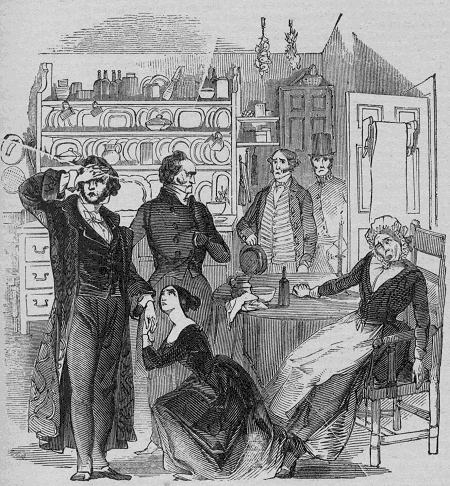
She proceeded to the kitchen, where, to her surprise,
she observed Mrs. Kenrick sitting in her armchair, but apparently fast asleep.
The old housekeeper's arms reposed upon the table, and formed a support for her
head which had fallen forwards.
"Strange!" thought Katherine; "this is
the first time I have known her sleep thus."
The young maiden moved lightly about the kitchen, while
she threw off her bonnet and cloak, for fear of awaking the housekeeper.
Then she sate down near the fire, and fell into a
profound reverie concerning the strange tale which her uncle had told her.
Presently it struck her that she did not hear the
housekeeper breathe; and an awful suspicion rushed like a torrent into her mind.
For some moments she sate, motionless and almost
breathless, in her chair, with her eyes fixed upon the inclined form of the
housekeeper.
"My God!!" at length Kate exclaimed; "she
does not breathe — she does not move; — and her
hands — oh! how pale they are!"
Then, overcoming her terror, the young maiden bent down
her head so as to obtain a glimpse of Mrs. Kenrick's countenance.
"Oh! heavens — she is dead — she
is dead!" cried the horror-struck girl, as her eyes encountered a livid and
ghastly face instead of the healthy and good-humoured one which was familiar to
her.
And Katherine sank back in her seat, overcome with grief
and terror.
Suddenly the thought struck her that, after all, the
housekeeper might only be in a fit.
Blaming herself for the delay which her fears had
occasioned ere she administered succour, Kate hastened to raise the old lady's
head.
But she let it fall again when she had obtained another
glance of that ghastly countenance; — for the eyes were fixed and
glazed — the under jaw had fallen — and the swollen
tongue was lolling, dark and livid, out of the mouth.
Then Kate rushed into the yard, screaming for help.
The rector's groom (who also acted as coachman) was in
the stable adjoining; and he immediately hastened to the spot.
"What is the matter?" he demanded, alarmed by
the wildness of Katherine's manner and the piercing agony of her cries.
"Mrs. Kenrick is dead!" replied Katherine,
sobbing bitterly.
"Dead!" ejaculated the man; and he instantly
rushed into the kitchen.
In a few moments afterwards the rector made his
appearance, and inquired the cause of the screams which had alarmed him.
"Mrs. Kenrick is dead, sir," said the groom.
Katherine had flung herself into a chair, and was giving full vent to her grief
for the loss of her benefactress.
"Dead!" cried the rector. "No — let
us hope not. Run for the nearest surgeon — it may only be a
fit!"
"I'm afraid it's too late, sir," said the
groom, who had now raised the housekeeper from her precumbent posture, and laid
her back in the chair.
"Who knows? Run — run," exclaimed
the rector impatiently.
The groom instantly departed; and during his short
absence the rector was most assiduous in bathing the housekeeper's forehead with
vinegar and water, and chafing her hands between his own.
In a few minutes the groom returned, accompanied by a
surgeon; and the rector was found in the midst of his vain attentions.
The surgeon's examination was brief; but his [-41-]
words
were decisive, as he said, "All human aid is vain, sir; and those
appearances are most suspicious."
"What do you mean?" demanded Reginald.
"That your servant is poisoned," replied the
surgeon.
"Poisoned!" exclaimed the rector. "Oh!
no — you must mistake. She would not take poison herself, and I do
not believe she has an enemy on the face of the earth."
"Nevertheless, Mr. Tracy," said the surgeon
positively, "she is poisoned."
At these words Kate's sobs became more convulsive.
"But is it too late?" cried the rector:
"can nothing be done? Is she past recovery?"
"Past all human succour, I repeat."
"My poor servant — my faithful
friend," exclaimed Reginald Tracy, burying his fate in his hands — "what
could have induced her to commit suicide?"
"Suicide!" echoed Katherine, starting from her
meat, and coming forward: "Oh! no, sir — do not wrong her
memory thus! She was too good — too pious — too much
bent upon the mercy of her Redeemer, to commit such a crime."
"Alas! suicide it must have been, my poor
girl," said the rector; "for who could have administered poison to so
harmless, so charitable, so humane a creature! Some secret grief, perhaps — "
At this moment Thomas returned from his mission to
Markham Place. The poor fellow was deeply affected when the dreadful spectacle
in the kitchen met his eyes, and when the few particulars yet known concerning
the death of the housekeeper, or rather the first discovery of her death — were
communicated to him.
"I never shall forgive myself as long as I
live," exclaimed Thomas, "for having spoken cross to her, poor lady,
this morning."
"Spoken cross to her!" cried the rector.
"Yes, sir," answered the man; "I said
something to her — but I forget exactly what — because
she told Katherine that she should send her away from London."
"Send Katherine away!" said Reginald, in
unfeigned surprise. [-42-]
"Yes, sir; and because I saw the girl didn't like
it, I took her part against Mrs. Kenrick; and I'm now heartily sorry for
it," rejoined Thomas, wiping away an honest tear.
"Young woman," said the surgeon, who had been
attentively examining Katherine for some moments, "did you not visit my
shop last evening!"
"I, Sir!" exclaimed the young girl, who was
too deeply absorbed in grief at the death of her benefactress to have her ideas
very clearly distributed in the proper cells of her brain.
"Yes," continued the surgeon: "the more I
look at you, the more I am convinced you came last night to my establishment and
purchased a small phial of laudanum."
"Oh! yes — I remember, sir," said
Katherine: "Mrs. Kenrick sent me for it, and told me that it was for my
master."
The surgeon threw an inquiring glance towards Reginald.
"For me!" ejaculated the rector.
"So Mrs. Kenrick said, sir," returned
Katherine: "and the moment I brought it in, she went up stairs with
it."
"You can in one moment set at rest that point,
sir," said the surgeon, with another glance of inquiry towards the rector.
"The laudanum was not for me," answered Mr.
Tracy, calmly: "nor did I order my poor housekeeper to obtain any."
"O Katherine!" ejaculated Thomas;
"surely — surely, you have not done this dreadful deed!"
"I — a murderess!" almost shrieked
the poor girl: "Oh! no — no. God forbid!"
And she clasped her hands together.
The surgeon shook his head mysteriously.
"Merciful heavens!" exclaimed the rector, who
was evidently excited to a painful degree, "you do not suspect — you
cannot suppose — you do not — cannot imagine that — this
young person — "
"I regret to state that the matter is to my mind
most suspicious," observed the surgeon, with true professional calmness.
"This morning the housekeeper informs that young person she must leave your
establishment — "
"But, according to your own admission, the laudanum
was purchased last night," interrupted the rector.
"Your humanity in pleading on behalf of that young
woman does honour to your heart, Mr. Tracy," said the Surgeon; "but
was it not likely that she knew yesterday of some circumstance which
would induce the housekeeper to give her warning so-day? and — "
"Oh! my God!" cried the rector, striking his
forehead forcibly with the open palm of his right hand.
"To a virtuous mind like yours I know that such a
suspicion must be abhorrent," said the surgeon.
He then whispered a few words to the groom.
The groom immediately went out.
"Mr. Tracy — sir — you
cannot surely entertain a suspicion against me!" cried Katherine, in a tone
of the most piercing anguish. "Oh! that poor creature was my benefactress;
and I would sooner have, died myself than have done her wrong!"
"I believe you," exclaimed the rector, — "believe
you from the bottom of my heart!"
'Thank you, Mr. Tracy," cried the poor girl,
falling upon her knees before him, and grasping his hands convulsively in her
own.
"You are too good — too generous,"
muttered the surgeon. "Be not deluded by that tragic acting. At all events
I must do my duty."
"What do you mean!" cried the rector.
"You cannot say that suspicion attaches itself to this young girl. I would
stake my existence upon her innocence!" he added emphatically.
"You know not human nature as I know it,"
returned the surgeon coolly.
At this moment the groom returned, followed by a
police-officer.
"A person has met with her death in a most
mysterious manner," said the surgeon; "and strong suspicions point
towards that young female."
Then followed one of those heart-rending scenes which
defy the powers of the most graphic pen to delineate.
Amidst the wildest screams — and with cries
of despair which pierced even to the stoic heart of the surgeon, who had acted
in a manner which he had deemed merely consistent with his duty, the unhappy
girl was led away in the custody of the officer.
"My God! Who would have thought that it would have
come to this!" exclaimed Reginald Tracy, as he precipitated himself from
the kitchen.
"The surgeon is right," observed Thomas to the
groom; "master is too good a man to believe in guilt of so black a
nature."
< previous chapter < | THE MYSTERIES OF LONDON [Vol. II] | > next chapter >