< previous chapter < | THE MYSTERIES OF LONDON [Vol. II] | > next chapter >
[-79-]
CHAPTER CLXV.
THE TRACE.
IN
order to avoid unnecessary details we shall now concisely state that Smithers
and his son paid the visit agreed upon to Katherine Wilmot.
Smithers communicated to her, when they were alone
together for half an hour, so much of his own history as involved all the
particulars with which he was acquainted concerning her parentage.
The grateful girl expressed a deeper sense of obligation
than she had ever yet experienced towards the individual who had supported her
for so many years, although she had no claims of relationship upon him.
After one of the most agreeable days which the late
executioner and his son had ever passed in their lives, they took leave of
Katherine and the worthy people of the farm, and returned to London.
Poor Katherine Wilmot! she had that day learnt more
concerning her parentage than she had ever known before; but she would have been
happier, perhaps, had her original impression on that subject never been
disturbed!
Still Markham had conceived it to be a duty which was
owing to the young maiden, to permit Smithers thus to reveal to her those
circumstances which seemed to fix her with the stigma of illegitimacy.
That night her pillow was moistened with abundant tears,
as she lay and reflected on her lamented mother!
On the appointed evening Smithers and his son called at
Markham Place.
They were conducted by Whittingham to a parlour, where
the table was spread with a handsome collation, places being arranged for three
persons.
"Sit down, my friends," said Richard Markham,
who received them with a warmth far more encouraging than mere courtesy:
"after supper we will transact the business for which I have requested your
presence here."
"What, sir!" ejaculated Smithers; "can
you condescend to have me at your table?"
"Not as you lately were," answered Richard:
"I receive you as a regenerated man."
John Smithers (for we shall suppress his nickname of
Gibbet, as his father had already done so) cast a glance of profound gratitude
upon our hero, in acknowledgment of a behaviour that could not do otherwise than
confirm his father in his anxious endeavour to adopt a course of mental
improvement.
Smithers' confidence increased, when he had im[-80-]bibed
a glass or two of generous wine; and he related to Markham the particulars of
his interview with Katherine.
Then was it for the first time the hump-back learnt that
Katherine was not his cousin.
He said nothing; but, as he drank in all that fell from
his father's lips, two large tears rolled down his cheeks.
When the supper was over, Richard addressed Smithers in
the following manner: — "The narrative which you revealed to me
the day before yesterday materially alters the position in which Katherine
stands with respect to you. When I first proposed that she should advance you at
once a small sum, I believed her to be your near relative. But as she is in no
way akin to you, it results that you have for years supported one who had no
claim upon you. Accident has made her rich; and it is but fair and just that you
should be adequately rewarded for your generosity. I have communicated with
Katherine's trustee upon the subject; and we have agreed to furnish you with
five hundred pounds at once, to enable you to embark in a respectable and
substantial line of business. This pocket-book," proceeded Markham,
"contains that sum. Take it, my worthy friend — it is your due;
and, should you succeed in the career that you are now about to enter upon, you
can with satisfaction trace your prosperity to the humanity which you showed to
a friendless orphan."
After some hesitation, Smithers received the
pocket-book. He and his son then took leave of Richard Markham, with the most
sincerely felt expressions of gratitude, and with a promise from the father to
write to him soon to state where and how they had settled themselves.
Scarcely had those two individuals, now both made happy,
taken their departure, when Whittingham informed his master that a person with a
dark complexion, and who gave the name of Morcar, requested to speak to him.
Richard ordered the gipsy to be instantly admitted to
his presence.
Morcar was accordingly shown into the parlour.
The moment he found himself alone with Markham, he said
in a low and somewhat solemn tone, "We have traced him!"
"I expected as much, the moment your name was
announced," said Richard. "Where is he?"
"He has taken refuge in a barge on the river,"
answered Morcar. "That is all I have been able to learn; but I am confident
he is there."
"And do you know where the barge is moored?"
asked Richard.
"Close by Rotherhithe. But there are several other
barges off the same wharf; and I cannot single out which he is in. I, however,
know that he is concealed in one of them."
"It is important to discover which," said
Markham. "Were we to make our appearance in that vicinity with a body of
police, he might escape us altogether."
"And therefore it will be better to take him by
means of stratagem," observed Morcar.
"What can have induced him to seek refuge
there?" said Richard, in a musing tone. "Some new crime,
perhaps?"
"Or else some fresh scheme of villany,"
returned Morcar. "But, perhaps you are not aware, sir, that river piracy
still flourishes to some extent?"
"I certainly imagined that with our system of
Thames police, that species of depredation was completely ruined."
"No such thing, sir!" exclaimed Morcar.
"The man who gave me the information about Tidkins, told me more than ever
I knew before on that subject."
"You may as well acquaint me with those
particulars, Morcar," said our hero. "They may assist me in devising
some scheme to entrap the Resurrection Man, and enable justice to receive its
due."
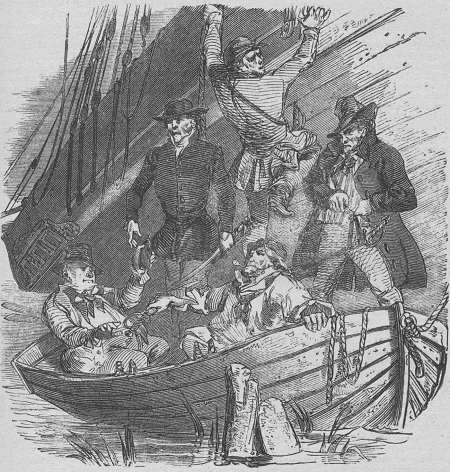
"River piracy, sir," continued Morcar,
"is carried on by a set of vagabonds who for the most part have been
sailors, or in some shape or another engaged amongst barges and lighters. They
are all leagued with the marine-store dealers and people that keep old iron and
junk shops on both sides of the river below London-bridge. The river pirates
usually possess a barge or lighter, which every now and then makes a trip up and
down the river between Greenwich and Putney, but with no other freight than
bales of sawdust, old rags, or even dung. This they do to keep up appearances
and avoid suspicion. But all day long they maintain a good look out in the pool,
and take notice of particular ships which they think can be easily robbed. For
instance, sometimes a steamer is left with only a boy on board to take care of
it; or else a lighter has only one man to look after it Then these pirates go on
board in the night, master the boy or the man, and plunder the steamer or
lighter of anything worth carrying away."
"I begin to understand how these villains may reap
a profitable harvest in this manner," observed Richard.
"Oh! you don't know half their pranks yet,"
said Morcar. "Sometimes two or three of the gang will go and hire
themselves as bargemen or lightermen; and then they easily arrange with their
pals how to plunder the vessels thus entrusted to them, while the owners never
suspect that their own men are at the bottom of the robbery. When times are bad,
and these fellows are driven to desperation, they think nothing of cutting away
great pieces of ships' cables, or even weighing the anchors of small craft; and
with these heavy materials they will get clean off in their boats to their own
barge; and next morning they convey them as coolly as possible to the marine
store dealers. Sometimes they cut lighters adrift, when the tide is running out,
and follow them in their boat; then, under pretense of helping those on board,
they out away bales of cotton or any other goods that are easily thrown into
their boats in dark nights."
"The villain Tidkins has no doubt transferred his
operations from the land to the river," observed Markham; "seeing
that, by means of a little address and a great deal of courage, such
depredations can be effected."
"These river pirates are of several kinds,"
continued Morcar. "There's the light-horsemen, or men on board the
unprotected vessels in the night. Then there's the heavy-horsemen, who
wear an under-dress called a jemmy, which is covered by their smocks: the
fellows obtain employment as lumpers, — that is to load or
discharge ships in the pool, during which they contrive to stow away everything
portable in the large pouches or pockets of their under-dress. Afterwards, the heavy
horsemen give information to their pals, and put them [-81-]
on
the scent which ships to rob at night. Next there are the mud-larks, who
get on board stranded lighters at low water, and carry off what they can when
the vessels are unprotected, or ask some question to lull suspicion if they find
any one on board. This mode of river-piracy is very profitable, because numbers
of lighters and barges are often left for hours alongside the banks, without a
soul on board. Game lightermen are those pirates that are in league with
dishonest mates and sailors belonging to vessels that come up the river to
discharge: and they receive at night from their pals on board, through the
port-holes or over the quarter, any thing that's easy to move away in this
manner. Last of all there's the scuffle-hunters, who put on smocks, and
obtain work as porters on the wharfs where a ship is loading: then, if they
can't contrive to steal any thing by those means, they can at all events carry
some useful information to their pals — so that the ship is
generally robbed in one way or another."
"With so well organised a fraternity and such means
of operation," said Markham, who had listened with interest and
astonishment to these details, "Tidkins is capable of amassing a fortune in
a very short time. But we must stop him in his criminal career. At the same
time, let us do nothing without mature consideration. Are you willing to assist?
Your reward shall be liberal."
"The Zingaree may not of his own accord deliver up
any one to justice," answered Morcar; "but he is allowed to serve an
employer who pays him. Moreover," he added, as if ashamed of that
sophistical compromise with the rules of his fraternity, "I shall gladly
help to punish the miscreant who treated us with such base ingratitude."
"Then you consent to serve me?" said Richard.
"I do, sir," was the reply.
"To-morrow, at mid-day, I will meet you somewhere
in the eastern part of London," continued Richard. "I have already a
project in my head but I must consider it more maturely."
"Where shall we meet, sir?" asked Morcar.
Markham reflected for a moment, and then said "On
the Tower wharf."
"I will be punctual, sir," answered the gipsy;
and he took his departure.
< previous chapter < | THE MYSTERIES OF LONDON [Vol. II] | > next chapter >