< previous chapter < | THE MYSTERIES OF LONDON [Vol. II] | > next chapter >
[-103-]
CHAPTER CLXXIV.
CASTELCICALA.
The
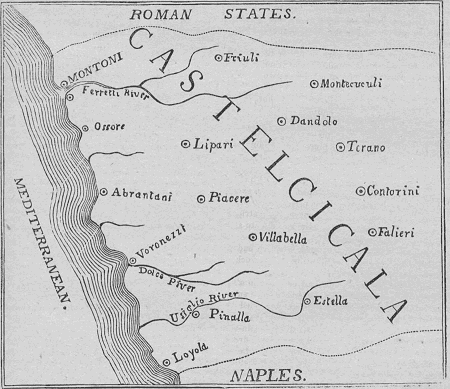
Grand-Duchy of Castelcicala is bounded on the north by the Roman States, on the
south by the kingdom of Naples, on the east by the Apennine Mountains, and on
the west by the Mediterranean Sea.
It is the most beautiful, the best cultivated, and the
finest portion of the Italian Peninsula. The inhabitants are brave, enlightened,
and industrious. Castelcicala is divided into seven districts, or provinces, the
capitals of which are Montoni (which is also the metropolis of the Grand Duchy),
Abrantani, Veronezzi, Pinalla, Estella, Terano, and Montecuculi. Each province
is governed by a Captain-General (the chief military authority), and a Political
Prefect, (the chief civil authority).
The principal city, Montoni, stands at the mouth of the
Ferretti, and contains a hundred thousand inhabitants. It is built on both sides
of the river, has a fine harbour, spacious dockyards, and extensive arsenals,
and is one of the principal trading-ports of Italy. It Is strongly fortified on
the system of Vauban.
The entire population of the Grand-Duchy of Castelcicala
is two millons. Its revenues are three millions sterling; and the annual income
of the sovereign is two hundred thousand pounds.
From these details the reader will perceive that
Castelcicala is by no means an unimportant country In the map of
Europe.
We
shall now continue our narrative.
It was the middle of November, 1840, and at an early
hour in the morning, before sun-rise, when three vessels (two large brigs and a
schooner) ran in as close as the depth of water would permit them with safety,
on the Castelcicalan coast a few miles below Ossore.
The boats of these vessels were immediately lowered; and
by the time the sun dawned on the scene, nearly twelve hundred armed men were
landed without molestation.
This force was divided into two columns: one of seven
hundred strong was commanded by General Grachia; the other of five hundred was
led by Colonel Morosino. Richard Markham, as Secretary-General of the
Constitutional Chiefs, and attended by Morcar, accompanied General Grachia. The
chiefs and their staff were all provided with horses.
The army presented a somewhat motley aspect, the
officers alone appearing in uniforms. The entire force was, however, well
provided with wea-[-104-]pons; and every heart beat high
with hope and patriotism.
The banners were unfurled; an excellent brass band
struck up an enlivening national air; and the two columns marched in the
direction of Ossore.
It was deemed most important to possess this seaport
without delay; as its harbour would afford a safe refuge for the three ships to
which the Constitutionalists (as the invaders termed themselves) could alone
look for the means of retreat, in case of the failure of their enterprise.
But of such a result they entertained not the slightest
apprehension.
And now the peasants in the farm-houses and hamlets near
which they passed, were suddenly alarmed by the sounds of martial music: but the
rumour of the real object of the invaders spread like wild-fire; and they had
not marched three or four miles, before they were already joined by nearly a
hundred volunteer-recruits.
The hearts of the Constitutionalists were enlivened by
this success; for while the male inhabitants of the district through which they
passed hastened to join them, the women put up audible prayers to heaven to
prosper their glorious enterprise.
Ossore was in the province of Abrantani, which had for
nearly a year groaned under the tyranny of the Captain-General, who governed his
district by martial law, the jurisdiction of the civil tribunals having been
superseded by the odious despotism of military courts. The Constitutionalists,
therefore, entertained the strongest hopes that Ossore would pronounce in their
favour the moment they appeared beneath its walls.
The Constitutionalists were now only three miles from
Ossore, which was hidden from their view by a high lull, up the acclivity of
which the two columns were marching, when the quick ear of General Grachia
suddenly caught the sound of horses' feet on the opposite side of the eminence.
Turning to one of his aides-de-camp, he said,
"Hasten to Colonel Morosino — tell him to take that road to the
left and possess himself of yonder grove. Our landing is known — a
body of cavalry is approaching."
These words were delivered in a rapid but firm tone. The
aide-de-camp galloped away to execute the order; and General Grachia
proceeded to address a few brief but impressive words to the patriots of his
division, telling them that the moment to strike a blow was now at hand.
"Markham," said the General, when he had
concluded his harangue, "we shall have hot work in a few minutes."
Scarcely were these words uttered, when a large body of
cavalry made its appearance on the summit of the hill. A general officer,
surrounded by a brilliant staff, was at their head.
"That is Count Santa-Croce, the Captain-General of
Abrantani!" exclaimed Grachia, drawing his sword. "Parley with him
were vain — he is devoted to the Grand Duke. My friends, before us
lies death or victory!"
The Constitutionalists gave a deafening cheer in answer
to the words of their commander.
Then, like an avalanche bursting from its rest on the
Alpine height, and rolling with dread and deafening din in its precipitate path,
the ducal cavalry thundered down the hill.
But they were well received; and a terrific contest
ensued.
The ear was deafened with the report of musketry and the
clang of weapons. Bullets whistled through the air; and as the serried ranks on
either side poured forth volumes of smoke, — the Constitutionalists
with their muskets, and the cavalry with their carbines, — the
shouts of the combatants and the groans of the dying announced the desperate
nature of the conflict.
But, alas! the Constitutionalists were doomed to
experience a sad blow!
General Grachia, — a patriot whose memory
demands our admiration and respect, — was slain at the commencement
of the battle. He died, fighting gallantly at the head of his troops; and not
before the enemy had felt the weight of his valiant arm.
Almost at the same moment the ensign who bore the
Constitutional banner was struck to the earth; and an officer of the ducal
cavalry seized the standard.
But scarcely had he grasped it, when Richard Markham,
who had vainly endeavoured to protect his chief and friend from the weapons of
the enemy, spurred his steed with irresistible fury against the officer, hurled
him from his seat, and snatched the banner from his grasp.
Then, waving the flag above his head with his left hand,
and wielding his sword in the right, Richard plunged into the thickest of the
fight, exclaiming, "Vengeance for the death of our general!"
The moment that Grachia fell, a sudden panic seized upon
the Constitutionalists of his division; and they were already retreating, when
that gallant exploit on the part of Markham rallied them with galvanic effect.
"Vengeance for the death of our general!" was
the cry; and our hero was instantly backed by his faithful Morcar and a whole
host of Constitutionalists.
The conflict was desperate — both sides
fighting as if all idea of quarter were out of the question, and victory or
death were the only alternatives.
Fired by the loss of General Grachia, — conscious
of the desperate position in which defeat would place the invaders, — and
inspired by the image of Isabella, Richard fought with the fury of the
Destroying Angel.
He who had only been looked upon as possessing an able
head in administrative matters, now suddenly appeared in a new light, — a
gallant warrior, who in his bravery had succeeded in rallying a panic-struck
army.
Already were the ducal cavalry retreating; — already
had the Captain-General, who surveyed the conflict from the summit of the hill,
disappeared with his staff-officers on the opposite side; — already
were the Constitutionalists of Richard's division shouting
"Victory," — when Colonel Morosino's corps, which had been
engaged by another body of cavalry, was observed to be in full retreat — dispersing
in disorder — flying before its triumphant foes.
The rumour that Colonel Morosino himself was slain, and
that a strong body of infantry, provided with cannon, was already advancing from
the opposite side of the bill, now spread like wild-fire through the ranks of
Richard's division.
Vainly did Markham endeavour by his example to inspire
the troops with courage. A panic seized upon them: they exclaimed that some
villain had betrayed them; and the disorder became general.
[-105-]
The ducal cavalry which were so lately in full retreat,
rallied again: their charge was irresistible; they literally swept the slope of
the hill down which they rushed.
Backed by a small but gallant band that scorned to
retreat, and well seconded by Morcar, Richard fought with a desperation which
was truly marvellous in one who had never wielded a hostile brand until that
day. But a pistol-bullet disabled his right arm; and he was taken prisoner,
together with Morcar and several others.
The Constitutionalists were completely defeated: five
hundred fell upon the field of battle; the remainder were dispersed or captured.
But scarcely three hundred succeeded in saving themselves by flight.
And almost at the same moment when this unfortunate
expedition was thus overwhelmed with ruin, a Castelcicalan frigate, which had
put out from Ossore harbour, shortly after the landing of the
Constitutionalists, captured the three vessels which were the last hope of those
patriots who had escaped from captivity or carnage.
From the summit of the hill, whither he was conducted
into the presence of the Captain-General of Abrantani, Richard beheld the three
vessels strike their colours to the Castelcicalan man-of-war.
"Treachery has been at work here," he said
within himself; "or else how arose these preparations to receive us?"
He was not, however, permitted much time for
reflection — either in respect to his own desperate condition, or
that of the unfortunate fugitives whose last hope was thus cut off by the
seizure of the ships; for the Captain-General — an old man, with
white hair, but a stern and forbidding countenance, addressed him in a haughty
and savage tone.
"Know you the penalty that awaits your crime, young
man?" he exclaimed; "for in you I doubtless behold one of the chiefs
of this monstrous invasion."
"I know how to die," answered Richard,
fearlessly.
"Ah!" ejaculated the Captain-General.
"What traitor have we here! Some foreign mercenary [-106-] perhaps. He is not
a Castelcicalan, by the accent with which he speaks our native tongue."
"I am an Englishman, my lord," said Markham,
returning the proud glance of defiance and scorn which Count Santa-Croce threw
upon him.
"An Englishman!" thundered the
Captain-General. "Then is a military death too good for you! What brings a
wretched foreigner like you amongst us with a hostile sword? You have not even
the miserable subterfuge of patriotism as a palliation for your crime. Away with
him! Hang him to yonder tree!"
"I have one favour to implore of your
lordship," said Markham, his voice faltering not, although his cheek grew
somewhat pale: "I am prepared for death — but let me not perish
like a dog. Plant your soldiers at a distance of a dozen paces — let
them level their muskets at me — and I promise you I shall not die a
coward."
"No — you are a foreigner!"
returned the Captain-General ferociously. "Away with him!"
Markham was instantly surrounded by soldiers, and
dragged to the foot of a tree at a little distance.
An aide-de-camp of the Count was ordered to superintend
the sad ceremony.
"Have you any thing which you desire to be
communicated to your friends in your native country?" asked the officer,
who was a generous-minded young man, and who, having beheld Richard's bravery in
the conflict, could not help respecting him.
"I thank you sincerely for the kindness which
prompts this question," replied our hero; and all I have now to hope is
that those who know me — in my native land — may not
think that cowardice or dishonour closed the career of Richard Markham."
"Richard Markham!" ejaculated the officer.
"Tell me — is that your name?"
"It is," answered our hero.
"Then there is hope for you yet, brave
Englishman!" cried the officer; and without uttering another word, he
hastened back to the spot where the Captain-General of Abrantani was standing.
Were we to say that Richard was now otherwise than a
prey to the most profound suspense, we should be exaggerating the moral strength
of human nature.
We have no wish to make of our hero a demigod: we allow
him to be nothing more than mortal after all!
It was, therefore, with no little anxiety that
Markham saw the officer approach the Captain-General of Abrantani, and discourse
with him for some moments in a low tone. The aide-de-camp appeared to urge some
point which he was anxious to carry: Count Santa-Croce shook his head ominously.
"Beloved Isabella," murmured Richard to
himself: "shall I never see thee more?"
His eyes were still fixed upon those two men who
appeared to be arguing his life or death.
At length the Captain-General took a paper from the
breast of his profusely-laced blue uniform coat, and cast his eyes over it.
Richard watched him with breathless anxiety.
This state of suspense did not last long. Count Santa-Croce
folded the paper, replaced it where he had taken it from, and then gave a brief
command to the officer.
The latter hurried back to the spot where Markham was
hovering as it were between life and death.
"You are saved, sir!" cried the Castelcicalan,
his countenance expressing the most unfeigned joy.
"Generous friend!" exclaimed Richard: "by
what strange influence have you worked this miracle?"
"That must remain a secret," answered the
aide-de-camp. "At the same time I can take but little merit to myself in
the transaction — beyond a mere effort of memory. You have powerful
friends, sir, in Castelcicala: otherwise his lordship the Captain-General,"
he added in a whisper, "was not the man to spare you."
"To you I proffer my most heart-felt thanks,
generous Italian! "cried Richard; "for to you I am clearly indebted
for my life. Let me know the name of my saviour!"
"Mario Bazzano — junior aide-dc-camp to
Count Santa-Croce, the Captain-General of Abrantani," was the answer.
"But we have no time to parley," he continued rapidly: "the good
news which I have already imparted to you in respect to your life, must be
somewhat counterbalanced by the commands which I have received regarding your
liberty."
"Speak, Signor Bazzano," said Markham.
"You saw that I did not flinch from death: it is scarcely probable that I
shall tremble at any less severe sentence which may have been passed upon
me."
"My orders are to conduct you to Montoni, where you
will be placed at the disposal of a higher authority than even the
Captain-General of Abrantani," returned the aide-de-camp. "But, in the
first place, my lord's surgeon shall look to your wound."
Then once more did the generous-hearted Castelcicalan
hasten away; and in a few minutes he returned, accompanied by the Count's own
medical attendant.
Richard's arm was examined; and It was discovered that a
bullet had passed through the fleshy part between the elbow and the shoulder.
The wound was painful, though by no means dangerous; and the surgeon bandaged it
with care and skill.
"Now, Signor Markham," said Bazzano, "it
is my duty to conduct you to Montoni. I do not wish to drag you thither like a
felon — because you are a brave man: at the same time I am
answerable to the Count and to another who is higher than the Count, for
your person. Gallant warriors are usually honourable men: pledge me your honour
that you will not attempt to escape; and we will proceed to Montoni alone
together."
"I pledge you my honour," answered Richard,
"that so long as I am in your custody, I will not attempt to escape. But
the moment you are released from your charge of my person, my vow ceases."
"Agreed, signor," said Bazzano.
The aide-de-camp then ordered his own and another horse
(for Richard's steed had been sorely wounded in the conflict) to be brought to
the spot where this conversation took place.
"Signor Bazzano," said Richard, "you have
behaved to me in so noble and generous a manner that I am emboldened to ask
another favour of you. A young man accompanied me as my attendant in this
unfortunate enterprise: he has a wife and child is his native land, his parents
are also living. Should [-107-] aught happen to him, four others would thereby be
plunged into the depths of misery."
"Where is this person to whom you allude?"
inquired Bazzano.
"He is a prisoner yonder. There — he is
seated on the ground, with his face buried in his hands!"
And Richard pointed in the direction where the poor
gipsy was plunged into a painful and profound reverie at a little distance.
For the third time the aide-de-camp, — who
was a tall, active, handsome, dark-eyed young man, — turned away.
Count Santa-Croce had mounted his horse and repaired, with his staff, to view
more closely the spot where the conflict had taken place, and to issue orders
relative to the interment of the killed and the disposal of the prisoners. Mario
Bazzano did not therefore dread the eagle glance of his superior, as he hastened
to perform another generous deed and confer another favour on Richard Markham.
"Young man," he said, addressing himself to
Morcar, "rise and follow me. You are to accompany your master. My good
friend," he added, speaking to the sentinel who stood near, "I will be
answerable for my conduct in this instance to his lordship the
Captain-General."
The sentinel was satisfied; and Morcar followed the
officer to the spot where Richard and the Castelcicalan soldiers who had charge
of him, were standing.
A third horse was procured; and in a few minutes the
aide-de-camp, our hero, and Morcar rode rapidly away from the scene of carnage,
towards Ossore.
It were a vain task to attempt to describe the joy which
succeeded Morcar's grief and apprehension, when he discovered that his own and
his master's lives were beyond danger, and that Mario Bazzano was evidently so
well inclined to befriend them.
"As I do not wish to keep you in an unpleasant
state of suspense, signor," said the aide-de-camp to Richard, "I must
inform you that you have little to dread at Montoni. You have powerful friends
there. A short imprisonment — or some punishment of a slight nature,
will be all the penalty you will both have to pay for your mad freak — or
else I am much mistaken. But more I dare not — cannot say."
"Whatever be our fate," exclaimed Richard,
"my heart will cherish until death the remembrance — the
grateful remembrance of your noble conduct. But tell me, my generous
friend — what will become of those unfortunate prisoners?"
"The chiefs of the enterprise have fallen in the
conflict," answered Mario; "else the fate of traitors would have been
in store for them. As for the mistaken men whom they have led to these shores,
Imprisonment — a long imprisonment in the citadels of Abrantani,
Pinalla, and Estella, will doubtless be the penalty of their treason."
The severe terms in which the young aide-de-camp, who
was evidently devoted to the Grand Duke's cause, spoke of the
Constitutionalists, pierced like a dagger to the heart of our hero; but delicacy
and gratitude towards one from whom he had received such signal obligations,
prevented him from making any comment.
In a short time the little party reached Ossore, at
which town they proceeded to an hotel, where they obtained refreshments. There,
also, plain clothes were procured for Markham, in order that his uniform (which
was different from that of the Castelcicalan officer) might not create
unpleasant notice on his arrival at Montoni. Morcar had no uniform to change.
When the repast was terminated, Lieutenant Bazzano
ordered a post-chaise and four; and in a short time the little party was
whirling rapidly along the high road to the capital.
During the journey Richard and the aide-de-camp rose
higher in each other's esteem, the more they conversed together; and by the time
they reached their destination, a sort of friendship, which circumstances had
tended to invest with unusual interest. already existed between them.
Bazzano assured our hero that the contemplated invasion
of the Constitutionalists had been communicated some time previously to the
Captain-General of Abrantani; but whence that information had emanated the young
officer was unable to state. Preparations had, however, been in existence for at
least a fortnight to receive the invaders when they set foot on the
Castelcicalan territory. These assurances confirmed Richard in the opinion which
he had already formed, that treachery had existed somewhere on the side of the
patriots.
< previous chapter < | THE MYSTERIES OF LONDON [Vol. II] | > next chapter >