< previous chapter < | THE MYSTERIES OF LONDON [Vol. II] | > next chapter >
[-176-]
CHAPTER CXCI.
CRANKEY JEM'S HISTORY
" My
father's name was Robert Cuffin. At the death of his father he succeeded
to a good business as grocer and tea-dealer; but he was very extravagant, and
soon became bankrupt. He obtained his certificate, and then embarked as a wine
merchant. At the expiration of three years he failed again, and once more
appeared in the Gazette. This time he was refused his certificate. He,
however, set up in business a third time, and became a coal merchant. His
extravagances continued: so did his misfortunes. He failed, was thrown into
prison, and took the benefit of the Insolvents' Act - but not without a long
remand. On his release from gaol, he turned dry-salter. This new trade lasted a
short time, and ended as all the others had done. Another residence in
prison — another application to the Insolvents' Court - and another
remand, ensued.
"My father was now about forty years of age, and
completely ruined. He had no credit - no resources — no means of
commencing business again. He was, however, provided with a wife and seven
children — all requiring maintenance, and he having nothing to
maintain them on. I was not as yet born. It appears that my father sate down one
evening in a very doleful humour, and in a very miserable garret, to meditate
upon his circumstances. He revolved a thousand schemes in his head; but all
required some little credit or capital where with to make a commencement; and he
had neither. At length he started up, slapped his hand briskly upon the table,
and exclaimed, 'By heavens, I've got it! ' — 'Got what!' demanded
his wife. — 'A call!' replied my father. — 'A call!'
ejaculated his better half, in astonishment. — 'Yes; a call,'
repeated my father; 'a call from above to preach the blessed Gospel and cleanse
the unsavoury vessels of earth from their sinfulness.' — His wife
began to cry, for she thought that distress had turned his brain; but he soon
convinced her that he was never more in earnest in his life. He desired her to
make the room look as neat as possible, and get a neighbour to take care of the
children for an hour or two in the evening, when he should return with a few
friends. He then went out, and his wife obeyed his instructions. Sure enough, in
the evening, back came my father with a huge Bible under one arm and a
Prayer-Book under the other, and followed by half-a-dozen demure-looking ladies
and gentlemen, who had a curious knack of keeping their eyes incessantly fixed
upwards — or heaven-ward, as my father used to express it.
"Well, the visitors sate down; and my father whose
countenance had assumed a most wonderful gravity of expression since the
morning, opened the prayer-meeting with a psalm. He then read passages from the
two sacred books he had brought with him; and he wound up the service by an
extemporaneous discourse, which drew tears from the eyes of his audience.
"The prayer-meeting being over, an elderly lady
felt herself so overcome with my father's convincing [-177-]

eloquence,
that a considerate old gentleman sent for a bottle of gin; and thus my father's
'call' was duly celebrated.
"To be brief — so well did my father
play his cards, that he soon gathered about him a numerous congregation; a
chapel was hired somewhere in Goodman's Fields; and he was now a popular
minister. His flock placed unbounded confidence in him — nay almost
worshipped him; so that, thanks to their liberality, he was soon provided with a
nicely-furnished house in the immediate vicinity of the chapel. Next door to him
there dwelt a poor widow, named Ashford, and who had a very pretty daughter
called Ruth. These families were amongst the most devoted of my father's flock;
and in their eyes the reverend preacher was the pattern of virtue and holiness.
The widow was compelled to take a little gin at times 'for the stomach's sake!'
but one day she imbibed too much, fell down in a fit, and died. My father
preached a funeral sermon, in which he eulogised her as a saint; and he afforded
an asylum to the orphan girl. Ruth accordingly became an inmate of my father's
house.
"And now commences the mast extraordinary portion
of the history of my father's life. You will admit that the suddenness of his
'call' was remarkable enough; but this was nothing to the marvellous nature of a
vision which one night appeared to him. Its import was duly communicated to Miss
Ashford next day; and the young lady piously resigned herself to the fate which
my father assured her was the will of heaven. In a few months the consequences
of the vision developed themselves; for Miss Ashford was discovered to be in the
family-way. My father's lawful wife raised a storm which for some time seemed
beyond the possibility of mitigation; the deacons of the chapel called, and the
elders of the congregation came to investigate the matter. My father received
them with a countenance expressive of more than ordinary demureness and
solemnity. A conclave was held — explanations were demanded of my
father. Then was it that the author of my being rose, and, in a most impressive
manner, acquainted the assembly with the nature of his vision. 'The angel of the
Lord,' he said, 'appeared to me one night, and ordered me to raise [-178-]
up seed of righteousness, so that when the Lord calls me unto himself, fitting
heirs to carry on the good work which I have commenced, may not fail. I appealed
to the angel in behalf of my own lawfully begotten offspring; but the angel's
command brooked not remonstrances, and willed that I should raise up seed of
Ruth Ashford: for she is blessed, in that her name is Ruth.' — This
explanation was deemed perfectly satisfactory: and, when the deacons and elders
had departed, my father succeeded some how or another not only in pacifying his
wife, but also in reconciling her to the amour which he still carried on with
Miss Ashford.* [* This episode is founded on fact. The newspapers of 1840, or
1841, will in this instance furnish the type of Mr. Robert Cuffin in the person
of a certain Reverend who obtained much notoriety at Rickmansworth.]
"Thus my father preserved both his mistress and his
sanctity — at least for some considerable time longer. The fruit of
that amour was myself; and my name is consequently Ashford — James
Ashford — although my father insisted upon calling me Cuffin. Time
wore on; but by degrees the jealousies which my father had at first succeeded in
appeasing, developed themselves in an alarming manner between the wife and the
mistress. Scenes of violence occurred at the house of his Reverence; and the
neighbours began to think that their minister's amour was not quite so holy in
its nature as he had represented it. The congregation fell off; and my father's
reputation for sanctity was rapidly wearing out. Still he would not part with my
mother and me; and the result was that his lawful wife left the house with all
her own children. My father refused to support them; the parish officers
interfered; and the scandal was grievously aggravated. Death arrived at this
juncture to carry away the principal bone of contention. My mother became
dangerously ill, and after languishing in a hopeless condition for a few weeks,
breathed her last.
"Having thus stated the particulars of my birth, it
will not be necessary to dwell on this portion of my narrative. I will only just
observe that, at the death of Miss Ashford, a reconciliation was effected
between my father and his wife; and that the former contrived to maintain his
post as minister of the chapel — though with a diminished flock, and
consequently with a decreased revenue. Nevertheless, I obtained a smattering of
education at the school belonging to the chapel, and was treated with kindness
by my father, although with great harshness by his wife. Thus continued matters
until I was fifteen, when my father died; and I was immediately thrust out of
doors to shift for myself.
"I was totally friendless. Vainly did I call upon
the deacons and elders of the congregation; even those who had adhered to my
father to the very last, had their eyes opened now that he was no longer present
to reason with them. They spurned me from their doors; and I was left to beg or
steal. I chose the former; but one night I was taken up by a watchman (there
were no police in those times) because I was found wandering about without being
able to give a satisfactory account of myself. You may look astonished; but I
can assure you that when a poor devil says, 'I am starving — houseless — friendless — pennyless,'
it is supposed to mean that he can't give a satisfactory account of himself! In
the morning I was taken before the magistrate, and committed to the House of
Correction as a rogue and vagabond.
"In prison I became acquainted with a number of
young thieves and pickpockets; and, so desperate was my condition, that when the
day of emancipation arrived, I was easily persuaded to join them. Then commenced
a career which I would gladly recall — but cannot! Amongst my new
companions I obtained the nick-name of 'Crankey,' because I was subject
to fits of deep despondency and remorse, so that they fancied I was not right in
my head. In time I became the most expert housebreaker in London — Tom
the Cracksman alone excepted. My exploits grew more and more daring; and on
three occasions I got into trouble. The first and second times I was sent to the
hulks. I remember that on my second trial a pal of mine was acquitted through a
flaw in the indictment. He was charged with having broken into and burglariously
entered a jeweller's shop. It was, however, proved by one of the prosecutor's
own witnesses that the shop-door had been accidentally left unlocked and
unbolted, and that consequently he had entered without any violence at all.
Thanks to the laws, he escaped on that ground, although judge and jury were both
convinced of his guilt. Time wore on; and I formed new acquaintances in the line
to which I was devoted. These were Tom the Cracksman, Bill Bolter, Dick Flairer,
the Buffer, and the Resurrection Man. With them I accomplished many successful
burglaries; but at length I got into trouble a third time, and a stop was put to
my career in London. It was in the year 1835 that the Resurrection Man and I
broke into a jeweller's shop in Princes Street, Soho. We got off with a good
booty. The Resurrection Man wont over to the Mint: I let Dick Flairer into the
secret, gave him a part of my share in the plunder, and then took to a
hiding-place which there is in Chick Lane, Smithfield. Now I knew that Dick was
stanch to the back-bone; and so he proved himself — for he brought
me my food as regularly as possible; and at the end of a week, the storm had
blown over enough to enable me to leave my hiding-place. I hastened to join the
Resurrection Man in the Mint, where I stayed two or three days. Then the
miscreant sold me, in order to save himself, and we were both committed to
Newgate. Tidkins turned King's Evidence; and I was sentenced to transportation
for life. The Resurrection Man was discharged at the termination of the business
of the sessions.
"Myself and several other convicts, who were
sentenced at the same session, were removed from Newgate to the Penitentiary at
Millbank. Amongst the number were two persons whose names you may have heard
before, because their case made a great noise at the time. These were Robert
Stephens and Hugh MacChizzle, who were the principal parties concerned in a
conspiracy to pass a certain Eliza Sydney off as a young man, and defraud the
Earl of Warrington out of a considerable property. We remained about a fortnight
in the Penitentiary, and were then transferred to the convict-ship at Woolwich.
But before we left Millbank we were clothed in new suits of grey, or
pepper-and-salt, as we called the colour; and we were also ironed. The
convict-ship was well arranged for its miserable purpose. On each side of the
between decks were two rows of sleeping-berths, one above the other: each berth
was about six feet square, and was calculated to hold four convicts, eighteen
inches' space to sleep being considered ample [-179-]
room enough for each individual. The hospital was in the fore-part of the
vessel, and was separated from the prison by means of a bulk-head, in which
partition there were two strong doors, fencing a means of communication between
the two compartments. The fore and main hatchways, between decks, were fitted up
with strong wooden stanchions round them; and in each of those stanchions there
was a door with three padlocks, to let the convicts in and out, and secure them
effectually at night. In each hatchway a ladder was placed, for us to go up and
down by; and these ladders were always pulled on deck after dusk. Scuttle-holes,
or small ports to open and shut for the admission of air, were cut along the
vessel's sides; and in the partition between the. prison and the hospital was
fixed a large stove, with a funnel, which warmed and ventilated both
compartments at the same time. When we were placed on board the convict-ship, we
had each a pair of shoes, two pairs of trousers, four shirts, and other warm
clothing, besides a bed, bolster, and blanket. Of Bibles, Testaments, and
Prayer-Books, there was also plenty.
"The moment the surgeon came on board, he arranged
the mess-berths and mess-tables. All the clothing, linen, bedding, and other
articles were marked with consecutive numerals in black paint, from No. I. up to
the highest number of convicts embarked. Thus, we messed and slept along the
prison-deck in regular numerical progression. In food we were not stinted: each
man had three-quarters of a pound of biscuit daily; and every day, too, we sate
down to beef, pork, or pease-soup. Gruel and cocoa were served out for breakfast
and supper. Every week we received a certain quantity of vinegar, lime-juice,
and sugar, which were taken as preventatives for scurvy. Each mess selected a
head, or chairman, who saw the provisions weighed out, and that justice was done
in this particular to each individual at his table.
"The surgeon selected six of the most fitting
amongst the convicts to act the part of petty officers, whose duty it was to see
his orders punctually executed, and to report instances of misconduct. Four of
these remained in the prison; and the other two were stationed on deck, to watch
those convicts who came up in their turns for airing. The Captains of the
Deck, as the officers wore called, had some little extra allowance for their
trouble, and were moreover allowed a certain quantity of tobacco.
"It was in January, 1839, that we sailed for
Sydney. Although I had no wife, — no children, — and, I
may almost say, no friend that I cared about, — still my heart sank
within me, when, from the deck of the convict-ship, I caught a last glimpse of
the white cliffs of Old England. Tears came into my eyes; and I, who had not
wept since childhood, wept then. But there were several of my companions who had
left wives and children, or parents, behind them; and I could read on their
countenances the anguish which filled their inmost souls!
"The surgeon was a kind and humane man. The moment
we were out of sight of land, he ordered our chains to be taken off; and he
allowed us to enjoy as much air upon deck as we could possibly require. The
guard, under the command of a commissioned officer, consisted of thirty-one men,
and did duty on the quarter-deck in three alternate watches. A sentry, with a
drawn cutlass, stood at each hatchway; and the soldiers on watch always had
their fire-arms loaded.
"When we had been to sea a little time, most of the
convicts relapsed into their old habits of swearing, lying, and obscene
conversation. They also gambled at pitch and toss, the stakes being their
rations. Thieving prevailed to a very great extent; for the convict who lost his
dinner by gambling, was sure to get one by stealing. They would often make
wager. amongst themselves as to who was the most expert thief; and when the
point was put to a practical test, dreadful quarrels would arise, the loser of
the wager, perhaps, discovering that he himself was the victim of the trial of
skill, and that his hoard of lime-juice, sugar, tobacco, or biscuit had
disappeared. Stephens, who was at the same mess with myself, did all he could to
discourage these practices; but the other pronounced him 'a false magician,'
and even his friend, Mac Chizzle, turned against him. So at last he gave up the
idea of introducing a reformation amongst his brethren in bondage. The fact is,
that any convict who attempts to humbug the others by pretensions to honesty, or
who expresses some superior delicacy of sentiment, which, of course, in many
instances is actually experienced, had better hang himself at once. The equality
of the convict-ship is a frightful equality, — the equality of
crime, — the levelling influence of villany, — the
abolition of all social distinctions by the hideous free-masonry of turpitude
and its consequent penalties! And yet there is an aristocracy, even in
the prison of the .convict-ship, — an aristocracy consisting of the
oldest thieves, in contra-distinction to the youngest; and of townies,* [-*Londoners.-]
in opposition to yokels.* [-Countrymen.-]
The deference paid by the younger thieves to the elder ones is astonishing; and
that man who, in relating his own history, can enumerate the greatest number of
atrocities, is a king amongst convicts. Some of the best informed of the
convicts wrote slang journals during the passage, and read them once a-week to
the rest. They generally referred to the sprees of the night, and contained some
such entries as this: — ' A peter cracked and frisked, while the
cobbles dorsed; Sawbones came and found the glim doused; fadded the dobbins in
a. yokel's crib, while he blew the conkey-horn; Sawbones lipped a snitch; togs
leered the yokel's downy; yokel screwed with the derbies.' The exact meaning
of this Is: — 'A chest broken open and robbed while the convicts
slept: surgeon came in and found the lamp put out; the thief thrust the clothes
which he had stolen into a countryman's berth, while he was snoring fast asleep;
the surgeon ordered a general search; the clothes were found in the country
man's bed; and the countryman was put into irons.'
"I must observe, that while the ship was still in
the Thames, none of the convicts would admit that they deserved their fate. They
all proclaimed themselves much-injured individuals, and declared that the Home
Secretary was certain to order a commutation of their sentence. The usual
declarations were these: — 'I am sure never to see New South Wales.
The prejudice of the judge against me at the trial was evident to all present in
the court. The jury were totally misled by his summing-up. My friends are doing
every thing they can for me; and [-180-] I am sure
to get off.' — Out of a hundred and ten convicts, at least a hundred
spoke in this manner. But the ship sailed, — England was far
behind, — and not one single convict had his hopes of a
commuted sentence gratified. Then, when those hopes had disappeared, they all
opened their budget of gossip most freely, and related their exploits in so
frank a manner, that it was very easy to perceive the justice of the verdicts
which had condemned them.
"The voyage out was, on the whole, a tolerably fine
one. It lasted four months and a half and it was, consequently, in the middle of
May that we arrived in sight of Sydney. But, when thus at the point of
destination, the sea became so rough and the wind blew such 'great guns,' that
the captain declared there was mischief at hand. The convicts were all ordered
into the prison, the ports of which were closed; and the heat was stifling. The
tempest came with appalling violence. Crash went every loose thing on
board, — the timbers creaked as if they would start from their
settings, — the ropes rattled, — and the wind whistled
horribly through the rigging. The ship was lifted to an immense height, and then
by the fall of the mountain wave, was plunged into the depths of the trough of
the sea; — at one moment dipping the studding-sail boom into the
water, — and the next lying nearly on its beam-ends on the opposite
side. I afterwards learnt from a sailor, that the waves were forty feet high,
twenty below the ordinary level of the sea, and twenty above it. Thus, when we
were in the trough, they were forty feet above our heads! Towards evening the
storm subsided; and early next morning Sydney broke more clearly upon our view.
"Sydney is beautifully situated. It possesses a
fine ascent from a noble harbour; and its bays, its coves, its gardens, its
gentlemen's seats, form a pleasing spectacle. Then its forests of masts — the
Government-house, with its beautiful domain — the numerous
wharfs — the thousands of boats upon the glassy water — and
Wooloomooloo, with its charming villas and its windmills, — all
these combine to enhance the interest of the scene. The town itself is far more
handsome than I had expected to find it. The shops are very fine — particularly
the silversmiths', the haberdashers', and confectioners', which would not
disgrace the West End of London. They are mostly lighted with gas, and in the
evening have a brilliant appearance. There is an astonishing number of
grog-shops — nearly two hundred and fifty, for a population of
80,000 souls. George Street and Pitt Street are the principal thoroughfares: and
the rents are so high that they average from three to five hundred pounds
a-year. There are no common sewers in Sydney; and, although the greater portion.
of the town stands upon a height, yet many of the principal streets are
perfectly level, and the want of a vent for the foul water and other impurities
is sadly felt. I may add, that the first appearance of Sydney and its
inhabitants does not impress a stranger with the idea of being in a country so
far away from Europe; the language, the manners, and the dress of the people
being so closely similar to those of England. But wait a little while, and a
closer observation produces a different effect. Presently you will see the
government gangs of convicts, marching backwards and forwards from their work in
single military file, — solitary ones straggling here and there,
with their white woollen Paramatta frocks and trousers, or grey or yellow
jackets with duck overalls, all daubed over with broad arrows and initial
letters to denote the establishment to which they belong, — and then
the gaol-gang, moving sulkily along with their jingling leg-chains, — all
these sad spectacles telling a tale of crime and its effects, and proclaiming
trumpet-tongued the narrative of human degradation!
"The ship entered the harbour; our irons had
already been put on again some days previously; and we were all landed under the
care of the guard. We were marched to the gaol-yard; and there our clothes were
all daubed over with broad arrows and the initials P. B. — meaning 'Prisoners'
Barracks, to which establishment we were conducted as soon as the ceremony
of painting our garments was completed. This barrack had several large day rooms
and numerous sleeping wards, the bedsteads being arranged in two tiers, or large
platforms, but with out separation. In every room there was a man in charge who
was answerable for the conduct of the rest; but no one ever thought of
complaining of the misbehaviour of his companions. A tread-mill was attached to
the building: there were moreover several solitary cells — a species
of punishment the horrors of which no tongue can describe.
"In the course of a few days we were all divided
into sections, according to the degrees of punishment which we were to undergo.
Stephens and Mac Chizzle were kept at Sydney: I was sent with some thirty others
to Port Macquarie — a place about two hundred and sixty miles, as
the crow flies, to the north of Sydney.
"The scenery is magnificent in the neighbourhood of
Macquarie Harbour: but the life of the convict — oh! that is fearful
in the extreme! I know that I was a great criminal — I know that my
deeds demanded a severe punishment; but death had been preferable to a doom like
that! Compelled to endure every kind of privation, — shut out from
the rest of the world, — restricted to a very limited quantity of
food, which never included fresh meat, - kept in chains and under a
military guard with fixed bayonets and loaded fire-arms - with no indulgence for
good conduct, but severe penalties, even flogging or solitary confinement, for
the smallest offences, - constantly toiling in the wet, at felling timber and
rolling it to the water, — forced to support without murmuring the
most terrible hardships, — how did I curse the day when I rendered
myself liable to the discipline of this hell upon earth! I will give you an idea
of the horrors of that place: — during the six months that I
remained there, nineteen deaths occurred amongst two hundred and twenty
convicts; and of those nineteen, only five were from natural causes. Two
were drowned, four were killed by the falling of trees, three were shot by the
military, and five were murdered by their comrades! And why were those murders
perpetrated? Because the assassins were tired of life, but had not the courage
to commit suicide; and therefore they accomplished crimes which were sure to be
visited by death upon the scaffold!
"The chain-gang to which I belonged was Stationed
at Philip's Creek; and our business was to supply timber for the ship-builders
on Sarah's Island We were lodged in huts of the most miserable description; and
though our toils were so long and arduous, our rations were scarcely sufficient
to keep body and soul together. The timber we cut was principally Huon pine; no
beasts of burden [-181-] were allowed; and we had
to roll the trunks of trees to an immense distance. What with the humid climate,
the want of fresh meat, and the severity of the labour, no man who fell ill ever
entertained a hope of recovery. Talk of the civilised notions of the
English — talk of the humane principles of her penal laws — why,
the Inquisition itself could not have been more horrible than the doom of the
convict at Macquarie Harbour! Again I say, it was true that we were great
criminals; but surely some adequate mode of punishment — some mode
involving the means of reformation — might have been devised
without the application of so much real physical torture! I have heard or read
that when the Inquisition put its victims to the rack, it afterwards remanded
them to their dungeons, and allowed them leisure to recover and be cured; — but
in the penal settlement of Port Macquarie those tortures were renewed
daily — and they killed the miserable sufferers by inches!
"Our rations consisted daily of one pound and a
half of flour, from which twelve per cent. of bran had been subtracted, one
pound and a half of salt meat, and half an ounce of soap. No tea — no
vegetables. The flour was made into cakes called damper, cooked in a
frying-pan; and this wasteful mode of preparing it greatly diminished its
quantity. Besides, divide those rations into three parts, and you will find that
the three meals are little enough for men toiling hard from sunrise to sunset.
The convict who did not keep a good look-out on his provisions was certain to be
robbed by his comrades and some men have been plundered to such an extent as
actually to have been on the very verge of starvation.
"I had not been at Macquarie Harbour more than five
months, when Stephens and Mac Chizzle arrived, and were added to our chain-gang.
This punishment they had incurred for having endeavoured to escape from Sydney,
where they had been treated with some indulgence, in consequence of their
station in life previous to their sentence in England. So miserable was I, with
hard work and scanty food, that I resolved to leave the place, or perish in the
attempt. I communicated my design to Stephens and Mac Chizzle; and they agreed
to accompany me. Escape from Macquarie was known to be a most difficult
undertaking; and few convicts who essayed it were ever able to reach the
settlements in other parts of the Colony. They were either murdered by their
comrades for a supply of food, or perished in the bush. Formidable forests had
to be traversed; and the chance of catching kangaroos was the only prospect of
obtaining the means of existence. Nevertheless, I resolved to dare all those
horrors and fearful risks, rather than remain at Philip's Creek. Five or six
others, in addition to Stephens and Mac Chizzle, agreed to adopt this desperate
venture with me; and one night we stole away — to the number of
ten — from the huts.
Yes — we thus set out on this tremendous
undertaking, each individual possessing no more food than was sufficient for a
single meal. And ere the sun rose all our store was consumed; - and we found our
selves in the middle of a vast forest — without a guide — without
victuals — almost without a hope! Convicts are not the men to cheer
each other: misfortunes have made them selfish, brutal, and sulky We toiled on
in comparative silence. One of my companions, who had been ten years at
Macquarie Harbour, was well acquainted with the mode in which the natives search
for traces of the opossum, and, when hunger began to press upon us, he examined
every tree with a hollow limb, and also the adjacent trees for marks of the
opossum's claws. For, I must tell you, that this animal is so sagacious, that it
usually runs up a neighbouring tree and thence jumps to the one wherein its
retreat is, in order to avoid being traced. The convict to whom I have alluded,
and whose name was Blackley, at length discovered the trail of an opossum, and
clambered up the tree in which its hole was found, by means of successive
notches in the bark, to place the great toe in. Having reached the hole, he
probed it with a long stick, and found that there actually was an opossum
within. Thrusting in his hand, he seized the animal by the tail, pulled it out,
and killed it by a swinging dash against this trunk of a tree. But this was
little enough among so many. We, however, made a fire, cooked it, and thus
contrived just to mitigate the terrible cravings of hunger. The flesh of the
opossum is like that of a rabbit, and is therefore too delicate to enable a
hearty appetite to make a good meal on a tenth portion of so small an animal.
"On the following day Blackley managed to kill a
kangaroo, weighing about sixty pounds; and thus we were supplied with food for
three or four days, acting economically. The flesh of the kangaroo is much like
venison, and is very fine eating. We continued our way amidst the forest, which
appeared endless; and in due time the kangaroo's flesh was consumed. Blackley
was unwearied in his exertions to provide more food and, so much time was wasted
in these endeavours, that we made but little progress in our journey. And now,
to our terror, Blackley could find no more opossums — could kill no
more kangaroos. We grew desperate: starvation was before us. Moody — sulky — glaring
on each other with a horribly significant ferocity, we dragged ourselves along.
Four days elapsed — and not a mouthful of food had we touched. On
the fifth night we made a fire, and sate round it at considerable distances from
each other. We all endeavoured to remain awake: we trembled at the approach of
drowsiness — for we knew the consequences of sleep in our
desperate condition. There we sate — none uttering a word, — with
cracked and bloody lips — parched throats — eyes glowing
with cannibal fires, — our minds a prey to the most appalling
thoughts. At length Mac Chizzle, the lawyer, fell back in a sound slumber,
having no doubt found it impossible to bear up against the weariness which was
creeping over him. Then Blackley rose, and went farther into the wood. It
required no ghost to tell us that he had gone to cut a club for a horrible
purpose. The most breathless silence prevailed. At length there was a strange
rustling amongst the trees at a little distance; and then cries of indescribable
agony fell upon our ears. These tokens of distress were in the voice of Blackley,
who called us by name, one after another. A vague idea of the real truth
rivetted us to the spot; and in a short time the cries ceased altogether. Oh!
what a night of horror was that! An hour had elapsed since Blackley's
disappearance; and we had ceased to trouble ourselves concerning his fate: — our
own intolerable cravings for food were the sole objects of our thoughts. Nor was
MacChizzle doomed to escape death. A convict named Fenton determined to exe-[-182-]cute
the purpose which Blackley had entertained — though in a different
manner. Afraid to venture away from time party to cut a bludgeon, he drew a
large clasp-knife from his pocket, and plunged the long sharp blade into the
breast of the sleeper. A. cry of horror burst from Stephens and myself; and we
rushed forward — now that it was unfortunately too late — to
save the victim. We were well aware of the man's intentions when he approached
his victim; but it was not until the blow was struck that we had the courage to
interfere. It was, however, as I have said — too late! Mac Chizzle
expired without a groan.
"I cannot dwell upon this scene: depraved — wicked — criminal
as I was in many respects, my soul revolted from the idea of cannibalism, now
that the opportunity of appeasing my hunger by such horrible means was within my
reach. Stephens and I retired a little from the rest, and turned our backs upon
the frightful work that was in progress. Again I say — oh! the
horrors of that night! I was starving — and food was near. But what
food? The flesh of a fellow-creature! In imagination I followed the entire
process that was in operation so close behind me; and presently the hissing of
the flesh upon the embers, and the odour of the awful cookery, convinced me that
the meal would soon be served up. Then how did I wrestle with my own
inclinations! And Stephens, I could well perceive, was also engaged in a
terrific warfare with the promptings of hunger. But we resisted the temptation:
yes — we resisted it; — and our companions did not
trouble themselves to invite us to their repast.
"At length the morning dawned upon that awful and
never-to-be-forgotten night. The fire was now extinguished; but near the ashes
lay the entrails and the head of the murdered man. The cannibals had completely
anatomised the corpse, and had wrapped up in their shirts (which they took off
for the purpose) all that they chose to carry away with them. Not a word was
spoken amongst us The last frail links of sympathy — if any really
had existed- — seemed to have been broken by the incidents of the
preceding night. Six men had partaken of the horrible repast; and they evidently
looked on each other with loathing, and on Stephens and myself with suspicion.
We all with one accord cut thick sticks, and advanced in the direction whence
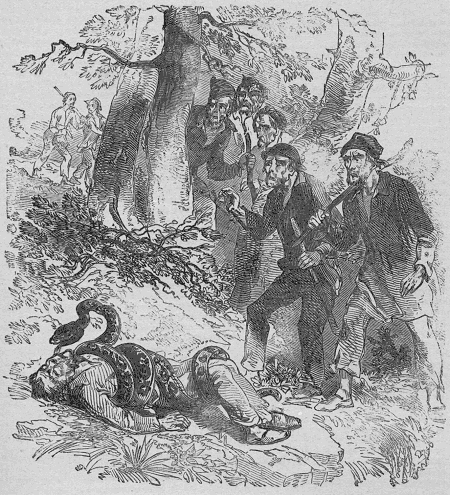
Blackley's cries had proceeded a few hours previously. His fate was that which
we had suspected: an enormous snake was coiled around the wretch's corpse — licking
it with its long tongue, to cover it with saliva for the purpose of deglutition.
We attacked the monstrous reptile, and killed it. Its huge coils had actually
squeezed our unfortunate comrade to death! Then — for the first time
for many, many years — did a religious sentiment steal into my soul;
and I murmured to myself: 'Surely this was the judgement of God upon a man
who had meditated murder.'
"That same day Stephens and myself gave our
companions the slip, and struck into another direction together. We were
fortunate enough to kill a kangaroo; and we made a hearty meal upon a portion of
its flesh. Then how did we rejoice that we had withstood the temptation of the
cannibal banquet! Stephens fell upon his knees and prayed aloud: I imitated his
example — I joined in his thanksgiving. We husbanded our resources
as much as possible; and God was merciful to us. We succeeded in killing another
kangaroo, even before the first was entirely consumed; and this new supply
enabled us to reach a settlement without further experiencing the pangs of
hunger. Prudence now compelled us to separate; for though we had rid ourselves
of our chains, we were still in our convict garb; and it was evident that two
persons so clad were more likely to attract unpleasant notice, than one
individual skulking about by himself. We accordingly parted; and from that
moment I have never heard of Stephens. Whether he succeeded in escaping from the
colony altogether, or whether he took to the bush again and perished, I know
not: — that he was not retaken I am sure, because, were he captured,
he would have been sent to Norfolk Island; and that he did not visit that
most horrible of all the penal settlements — at least during a
period of eighteen months after our escape from Macquarie — I am
well aware, for reasons which I shall soon explain.
"In fact, I was not long at large after I separated
with Stephens. My convict-dress betrayed me to a party of soldiers: I was
arrested, taken to Sydney, tried, and sentenced to transportation to Norfolk
Island. Before I left England in 1836, and since my return towards the end of
1939, I have heard a great many persons talk about Norfolk Island; but no one
seemed to know much about it. I will therefore tell you something concerning it
now.
"A thousand miles to the eastward of Sydney there
are three islands close together. As you advance towards them in a ship from
Sydney, Philip Island, which is very high land, and has a bold peak to the
south, comes in view: close beyond it the lower hills of Norfolk Island, crowned
with lofty pines, appear in sight; and between those two islands is a small and
sterile speck called Nepean Island. Norfolk Island is six miles and a half long,
and four broad — a miserable dot in the ocean compared to the vast
tract of Australia. The soil is chiefly basaltic, and rises into hills covered
with grass and forest. Mount Pitt — the loftiest eminence in the
island — is twelve hundred feet above the level of the sea. The
Norfolk Island pine shoots to a height of a hundred feet, — sometimes
growing in clumps, elsewhere singly, on the grassy parts of the island, even to
the very verge of the shore, where its roots are washed by the sea at high
water. The apple-fruited guava, the lemon, grapes, figs, coffee, olives,
pomegranates, strawberries, and melons have been introduced, and are cultivated
successfully. The island is every where inaccessible, save at an opening in a
low reef fronting the little bay; and that is the point where the settlement is
situated. The Prisoners' Barracks are pretty much upon the same plan as those at
Sydney, and which I described to you just now. There is a room, called the
Court-House, where the Protestant prisoners meet on Sunday to hear prayers; and
there is another, called the Lumber-Yard room, for the Roman Catholics. The
prayers in both places are read by prisoners. The principal buildings in the
settlement are the Commandant's Residence, the Military Barracks, the
Penitentiary, the Gaol, and the Hospital. The convicts are principally employed
in quarrying stone; and as no gun powder is used in blasting the rocks, and the
stone is raised by means of levers, the labour is even more crushing than that
of wood-felling at Port Mac-[-183-]quarie. The
prisoners, moreover, have to work in irons; and the food is not only
insufficient, but bad — consisting only of dry maize bread and hard
salt meat. Were it not for the supply of wild fruits in the island, the scurvy
would rage like a pestilence. Between Macquarie Harbour and Norfolk Island I can
only draw this distinction — that the former is Purgatory,
and the latter Hell!
"There is no attempt to reform the prisoners in
Norfolk Island, beyond prayer-reading — and this is of scarcely any
benefit. The convicts are too depraved to be amended by mere moral lessons: they
want education; they require to be treated like human beings,
instead of brute beasts, criminal though they are; they need a sufficiency of
wholesome food, to enable them to toil with something approaching a good
will; they ought to be protected against the tyranny of overseers, who
send them to gaol for the most trivial offences, or on the slightest suspicions:
they should not be forced to labour in chains which gall their ankles almost
to the bone, when a guard with loaded muskets is ever near, and seeing that
shackles on the legs would not prevent violence with the hands were they
inclined to have recourse to it; nor should they be constantly treated as if
they were merely wild beasts whom it is impossible to tame save by means of
privation, heart-breaking toil, and the constant sense of utter degradation.
How can men be redeemed — reclaimed — reformed by such
treatment as this! Let punishment be terrible — not horrible. It is
monstrous to endeavour to render the criminal more obstinate — to
make the dangerous one more ferocious — to crush in the soul every
inducement to amend — to convert vice into hardened recklessness.
The tortures of semi-starvation and overwhelming toil, and the system of
retaining men's minds in a state of moral abasement and degradation in their own
eyes, will never lead to reform. When at Macquarie Harbour, or at Norfolk
Island, I have often thought how comparatively easy it would be to reclaim even
the very worst among the convicts. Teach them practically that while
there is life there is hope, — that it is never too late to
repent, — that man can show mercy to the greatest sinner, even
as God does, — that the most degraded mind may rise from the depths
of its abasement, — that society seeks reformation and prevention in
respect to crime, and not vengeance, — that the Christian religion,
in a word, exists in the heart as well as in a book. But what sentiments do the
convicts entertain! They are taught, by oppressive treatment, to lose sight of
their own turpitude, and therefore to consider that all mankind is bent on
inflicting a demoniac vengeance upon them; — they look upon the
authorities as their persecutors; — they begin to fancy that they
are worms which are justified in turning on those who tread them under
foot; — they swear, and blaspheme, and talk obscenely, merely
because there is no earthly solace left them save in hardening their own hearts
against all kindly sympathies and emotions; — they receive the
Word of God with suspicion, because man does not practically help them to a
belief in the divine assurance relative to the efficacy of repentance; — they
are compelled by terrific and unceasing hardships to look upon the tears of a
contrite heart as the proof of mortal weakness: — and, in a word,
they study how to avoid reflections which can lead, so far as they can see, to
no beneficial end. They therefore welcome hardness of heart, obstinacy, and
recklessness of disposition as an actual means of escape from thoughts which
would, under favourable circumstances, lead to moral amendment and reformation.
"You may be surprised to hear such ideas from my
lips; but I have pondered much and often upon this subject. And if ever these
words which I am now uttering to you, Henry Holford, should find their way into
print, — if ever my narrative, with its various reflections, should
go forth to the world be you well assured that these ideas will set people
thinking on the grand point — whether society punishes to prevent
crime and to reclaim the offender, or merely to avenge itself upon him?
"My own prospects were gloomy enough. My life was
to be passed in exile, misery, and torture. I loathed my associates. They took
all possible pains to tease and annoy each other. They converted a beautiful
spot — one of the loveliest islands in the world — into
a perfect hell upon earth; — and seemed determined to supply any
deficiency which the authorities had left in the sum of our unhappiness. They
concocted various schemes of mischief, and then the most hardened would betray
their comrades merely for the pleasure of seeing them flogged! I never shall
forget a convict saying to me one day, 'I doubt the existence of a God; but I
wish, if there is one, that he would take away my life, for I am so very
miserable. I have only six years more to serve; and I am determined either to
escape, or to murder some one and get hanged for it.' — This man's
name was Anson; and from that moment he and I had frequent conversations
together relative to an escape from the Island. But how few were our hopes!
Surrounded by the ocean — pent up in so narrow a space, as it were -
so distant from all other lands - fearful to confide in our companions — and
unable to carry our scheme into effect without assistance, we were frequently
induced to give it up in despair.
"Not very far from the Commandant's house was a
singular little cave, hollowed in the rugged limestone that forms two low
hills, — the flat and the reef on the south of the island. This cave
was near a lime-kiln, and was concealed by a stone drawn over its mouth. I had
been nearly eighteen months on the island, (during which time, as I before said,
Stephens was not sent to join the gangs; and therefore I concluded that he
either perished in Australia, or effected his escape to Europe,) — eighteen
months, I say, had elapsed, when Anson and I were one day at work in the
lime-kiln, with a small gang. When the mid-day meal-time came, he and I strolled
apart from the rest; and none of the sentries took any notice of us, because
escape from that point in the broad day-light was impossible. As we were walking
along and conversing, we discovered the cave. This circumstance gave a new
impulse to our ideas, and to our hopes of an escape; and a few days afterwards,
we put our plan into execution. We enlisted two other convicts in the
scheme, — two men in whom we imagined that more confidence was to be
placed than in any of the rest. By their aid we contrived to purloin at dusk a
sack of biscuits; and this we conveyed to the cave. On the next night one of our
new accomplices contrived to rob a small house of entertainment for seamen, of
three suits of sailors' clothes; and these were conveyed to the cave. Our plans
were now all matured. A small decked yacht, cutter-rigged, and belonging
to the [-184-] Commandant lay close by the shore;
and we knew that there were only a man and a boy on board at that time. Our
project was a desperate one; but the risk was worth running, seeing the result
to be gained — namely, our freedom. When our arrangements were
completed, we all four one evening absconded as we were returning home from the
day's toils, and took refuge in the cave. No time was to be lost. About
midnight, Anson and I swam off to the yacht, contrived to get on board, seized
each a windlass-bar, and, descending to the cabin, mastered the man and the boy.
We bound them in such a way that they could not leave their hammocks; and then
we fastened down the hatchway to drown their cries in case they should shout for
assistance. We next lowered the little skiff, and returned to land. Our
companions joined us, with the bag of biscuit — and the clothes, at
a point previously agreed upon; and we all succeeded in reaching the cutter in
safety. Then we set sail; and, favoured by the darkness of the night, got clear
away without having excited on shore a suspicion that the yacht had moved from
its moorings.
"As we had conjectured, there was very little
provision on board; for the Commandant never used the yacht for more than a few
hours' trip at a time. We had therefore done wisely to provide the biscuit; but
there was not two days' supply of meat on board. We accordingly steered for the
back of Philip Island, which we knew to abound in pigs and goats, and to be
uninhabited by man. Anson and another of our companions went on shore with
fire-arms, which we had found in the cutter; and within two hours after
day-light they shot four pigs and thirteen goats. Myself and the other convict,
who remained on board to take care of the vessel and guard the seaman and the
boy, caught several king-fish and rock-cod. We were thus well provisioned; and
another trip to the shore filled our water-casks. We next proposed to the seaman
and boy either to join us, or to take the skiff and return to Norfolk Island as
best they might. They preferred the latter offer; and we accordingly suffered
them to depart, after compelling the sailor to exchange his clothes for one of
our convict suits; so that we had now a proper garb each. In their presence we
had talked of running for New Caledonia — an Island to the north of
Norfolk Island; but the moment they were gone, we set sail for New Zealand,
which is precisely in a contrary direction — being to the south of
Norfolk Island. Our craft was but little better than a cockle-boat: it was,
however, decked; fine weather prevailed; and moreover, it was better to die by
drowning than perish by the gradual tortures of a penal settlement.
"We were in sight of New Zealand, when a fearful
storm came on suddenly at an early hour on the thirteenth morning after we had
quitted Norfolk Island. A tremendous sea broke over our little craft, and washed
poor Anson over-board. The other two convicts and myself did all we could to
save the vessel, and run her into a bay which we now descried in the distance;
but our inexperience in nautical matters was put to a severe test. When our
condition was apparently hopeless, and we expected that the sea would swallow us
up, a large bark hove in sight. We made signals of distress; and the vessel
steered towards us. But a mountainous wave struck the stern of the cutter, and
stove in her timbers. She immediately began to fill. We cut away the boom, and
clung to it as to a last hope. The vessel went down; and, small as it was, it
formed a vortex which for a few moments sucked us under, spar and all. But we
rose again to the surface, clinging desperately to the boom. Suddenly one of my
comrades uttered a fearful cry — a cry of such wild agony that it
rings in my ears every time I think of that horrible incident. I glanced towards
him: the water. was for an instant tinged with blood — a shark had
bitten off one of the wretched man's legs! Oh! what an agony of fear I
experienced then. The poor creature continued to shriek in an appalling manner
for a few seconds: then he loosened his hold upon the spar, and disappeared in
the raging element. My only surviving companion and myself exchanged looks of
unutterable horror.
"We were drifting rapidly in the direction of the
bark, which on its side was advancing towards us. When within hail, it lowered a
boat. But I was destined to be the only survivor of the four convicts who had
escaped from Norfolk Island. When only a few yards from the boat, my companion
suddenly relaxed his hold upon the spar, and sank with a loud cry — to
rise no more. The water was us tinged with blood — and therefore I
do not suppose that he was attacked by a shark: most probably a sudden cramp
seized him; — but, whatever the cause, he perished! I was dragged in
an exhausted state into the boat, and was speedily safe on board the bark.
The vessel was a trading one, and bound for Hobart Town,
whence it was to sail for England. I gave so plausible an account of the
shipwrecked cutter, that the real truth was not suspected, especially as I was
attired in a sailor's dress; and as the bark was not to remain many days at
Hobart Town, where, moreover, I was not known, I entertained the most sanguine
hopes of being able to ensure my safe return to England. In three weeks, — after
encountering much bad weather — we entered the Derwent; and, taking
in a pilot, were carried safe up to Sullivan's Cove.
"Hobart Town is the capital of Van Diemen's Land,
and is beautifully placed on the banks of an estuary called the Derwent. The
streets are spacious: the houses are built of brick; and the roofs, covered with
shingles, have the appearance of being slated. Mount Wellington rises behind the
town to the height of 4000 feet, and is almost entirely clothed with forests.
There is in Hobart Town a spacious House of Correction for females: it is called
the Factory, and contained at that time about two hundred and fifty prisoners.
They were employed in picking and spinning wool, and in washing for the
Hospital, Orphan-School, and other institutions. The women were dressed in a
prison garb, and had their hair cut close, which they naturally considered a
grievous infliction of tyranny. When they misbehaved themselves, they were put
into solitary confinement; and I heard that many of them had gone raving mad
while enduring that horrible mental torture. I saw a chain-gang of a hundred and
ten convicts, employed in raising a causeway across a muddy flat in the Derwent:
they looked miserably unhealthy, pale, and emaciated, being half-starved,
over-worked, and compelled to drink very bad water. The Government-House is a
fine building, on the banks of the Derwent. and about a mile from the town. The
Penitentiary at Hobart Town contains [-185-]
about
six hundred prisoners, and is the principal receptacle for newly-arrived
convicts. They are sent out in gangs, under overseers and guards, to work on the
roads, or as carpenters, builders, sawyers, or masons, in the various
departments.
"After remaining almost a fortnight at Hobart Town,
the bark sailed for England, by way of Cape Horn; and I was now relieved from
all fears of detection — at least for the present. As I have spoken
of the condition of the female convicts in Hobart Town, I may as well give you
some account of how transportation affects women; for you may be sure that I
heard enough of that subject both at Sydney and at Maquarie Harbour. A
female-convict ship is fitted up on precisely the same plan as that of the men,
with the addition of shelves whereon to stow away the tea-crockery. The women's
rations are the same as the men's, with the extra comforts of tea and sugar.
This they have for breakfast, and oatmeal for supper. No guard of soldiers is
required on board: nor is there a bulk-head across the upper deck in midships.
Instead of captains of the vessel, there are matrons appointed by the
surgeon to take care of the morals of the rest; and these matrons are
usually old brothel-keepers or procuresses, who know how to feign a sanctity
which produces a favourable impression in their behalf. Women convicts are
dreadfully quarrelsome; and their language is said to be more disgusting and
filthy than that of the men. However vigilant the surgeon may be, it is
impossible altogether to prevent intercourse between the females and the
sailors; and it often happens that some of the fair ones, on their
arrival in the colony, are in a way to increase the Australian population.
Perhaps the surgeon himself may take a fancy to one or two of the best-looking;
and these are sure to obtain great indulgences — such as being
appointed nurses to the rest, or being permitted to remain on the sick-list
throughout the voyage, which is an excuse for allowing them wine and other
little comforts. The women always speak to and of each other as ladies;
and the old procuresses, when chosen as matrons, are treated with the respectful
Mrs. Thus it is always, 'Ladies, come for'ard for your pork;' or 'Ladies,
come up for your biscuit:' or 'Ladies, the [-186-]
puddings are cooked.' Of an evening they dance or sing, — and as
often quarrel and fight. This cannot be wondered at, when it is remembered that
there is no attempt at classification; and women who may have been chaste in
person, though criminal in other respects, are compelled to herd with
prostitutes of all degrees, from the lowest trull that skulks in the courts
leading out of Fleet Street to the fashionable nymph who displays her charms at
the theatre. The very chastity of a woman who has been sentenced perhaps for
robbing furnished lodgings, or plundering her master in her capacity of servant,
or for committing a forgery, is made a reproach to her by the prostitutes and
old procuresses; and her life is miserable. Moreover, it is next to impossible
that she can escape a contamination which prepares her for a life of profligacy
when she reaches the colony.
"Before the female convict-ship leaves the Thames,
numbers of old procuresses and brothel-keepers go on board to take leave of the
girls with whom they are acquainted. These hags, dressed out in their gayest
garb, and pretending to be overwhelmed with grief (while they really are with
gin), represent themselves to be the mothers or aunts of the 'poor dear
creatures' who have got into trouble, and assure the surgeon that their
so-called daughters or nieces were most excellent girls and bore exemplary
characters previous to their present 'misfortunes.' The surgeon — if
a novice, or a humane man — believes the tale, and is sure to treat
with kindness the 'poor creatures' thus recommended to him. About twenty years
ago a Religious Society in London sent out, in an emigrant ship, twelve 'reclaimed
unfortunate girls,' with the hope that they might form good matrimonial
connexions among the free settlers in the colony; there always having been — especially
at first — a great dearth of European females in Australia. These
girls were called the Twelve Apostles; and all England rang with the good
work which had been accomplished by the Religious Society. But on the arrival of
the Twelve Apostles at Sydney, seven of them were found to be in the family way
by the sailors; and the others immediately entered on a course of unbounded
licentiousness.* [*Fact.]
"A few days before the female convict-vessel
arrives at Sydney, the women — old and young — busy
themselves in getting ready their finery for landing. The debarkation of female
convicts always takes place with great effect. The prostitutes appear in their
most flaunting attire; and many of them have gold ornaments about them. They are
then sent to the Paramatta Factory. This establishment cannot be looked on as a
place of punishment — nor as a place of reformation. The inmates are
well fed, and are put to no labour. There is an extensive garden, in which they
can walk at pleasure. Some of them are allotted to free settlers requiring
servants; but the grand hope of the female convict is to marry. This prospect is
materially aided by the fact that both free settlers and ticket-of-leave
convicts are allowed to seek for help-mates in the Factory. When they call for
that purpose, the fair penitents are drawn up in a row; and the wife-seeking
individual inspects them as a general does his army, or a butcher his sheep in
Smithfield Market. If he fancies one of the candidates, he beckons her from the
rank, and they retire to a distance to converse. Should a matrimonial
arrangement be made, the business is soon finished by the aid of a
clergyman; but if no amicable understanding is come to, the nymph returns
to the rank, and the swain chooses another — and so on, until the
object of his visit is accomplished. So anxious are the unmarried free settlers
or the ticket-of-leave convicts to change their single state of blessedness, and
so ready are the fair sex to meet their wishes, that few women whose husbands
die remain widows a couple of days; some not more than four-and-twenty hours. A
few years before I was in the colony, an old settler saw a convict-girl
performing penance on a market-day, with her gown-tail drawn over her head, for
drunkenness and disorderly conduct in the Factory. He walked straight up to
her — regardless of the hootings of the crowd — and
proposed marriage. She was candid enough to confess to him that she was five
months gone in the family way by a master to whom she had been allotted ere she
returned to the Factory; but the amorous swain, who was nearly sixty, was so
much struck by her black eyes and plump shape, that he expressed his readiness
to take her 'for better or worse;' and she had not left the place of punishment
an hour, ere she was married to one of the richest settlers in the colony.
"I will tell you one more anecdote relative to
Australian marriages. A very handsome woman was transported for
shop-lifting — her third offence of the kind. She left a husband
behind her in England. On her arrival at Sydney she was allotted to an elderly
gentleman, a free settler, and who, being a bachelor, sought to make her his
mistress. She, however, resisted his overtures, hoping that he would make her
his wife, as he was not aware that she had a husband in her native country. Time
wore on, he urgent-she obstinate, — he declining matrimonial bonds.
At length she received a black-edged letter from her mother in England; and,
upon being questioned by her master, she stated 'that its contents made a
great alteration in her circumstances.' More she would not tell him. He was
afraid of losing his handsome servant; and agreed to marry her. They were united
accordingly. When the nuptial knot was indissolubly tied, he begged his beloved
wife to explain the nature of the black-edged letter. 'There is now no need
for any further mystery,' she said, 'The truth is, I could not marry you
before, because had a husband living in England. That black-edged letter
conveyed to me the welcome news that he was hanged five months ago at the Old
Bailey, and thus nothing now stands in the way of our happiness.' — And
that woman made the rich settler a most exemplary wife.
"I have now given you an insight into the morals of
the female, as well as those of the male convicts; and you may also perceive
that while transportation is actually a means of pleasing variety of scene and
habits to the woman, it is an earthly hell to the man. I know that
transportation is spoken of as something very light — a mere change
of climate — amongst those thieves in England who have never yet
crossed the water; but they are woefully mistaken! Transportation was once a
trivial punishment, when all convicts were allotted to settlers, and money would
purchase tickets-of-leave; or when a convict's wife, if he had one, might go out
in the next ship with all the swag which his crime. had produced, and on her
arrival in the colony ap-[-187-]ply for her husband
to be allotted to her as her servant, by which step he became a free man, opened
a public-house or some kind of shop, and made a fortune. Those were glorious
times for convicts: but all that system has been changed. Now you have
Road-Gangs, and Hulk-Gangs, and Quarrying-Gangs — men who work in
chains, and who cannot obtain a sufficiency of food! There is also Norfolk
Island — a Garden of Eden in natural loveliness, rendered an earthly
hell by human occupation. Oh! let not the opinion prevail that transportation is
no punishment; let not those who are young in the ways of iniquity, pursue their
career under the impression that exile to Australia is nothing more than a
pleasant change of scene! They will too soon discover how miserably they are
mistaken; and when they feel the galling chain upon their ankles, — when
they find themselves toiling amidst the incessant damps of Macquarie, or on the
hard roads of Van Diemen's Land, or in the quarries of Norfolk island, — when
they are labouring in forests where every step may arouse a venomous snake whose
bite is death, or where a failing tree may crush them beneath its weight, — when
they are exposed to the brutality of overseers, or the still more intolerable
cruelty of their companions, — when they sleep in constant dread of
being murdered by their fellow-convicts, and awake only to the dull monotony of
a life of intense and heart-breaking labour, — then will they loathe
their very existence, and dare all the perils of starvation, or the horrors of
cannibalism, in order to escape from those scenes of ineffable misery!
"But I need say no more upon this subject. The
bark, in which I worked my passage to Europe, reached England in safety; and I
was once more at large in my native country. Yes — I was free to go
whithersoever I would — and to avenge myself on him who had betrayed
me to justice! The hope of some day consummating that vengeance had never
deserted me from the moment I was sentenced in the Central Criminal Court. It
had animated me throughout all the miseries, the toils, and the hardships which
I have related to you. It inspired me with courage to dare the dangers of an
escape from Macquarie: its effect was the same when I resolved upon quitting
Norfolk Island. I have once had my mortal foe within my reach; but my hand dealt
not the blow with sufficient force. It will not fail next time. I know that
vengeance is a crime; but I cannot subdue those feelings which prompt me to
punish the man whose perfidy sent me into exile. In all other respects I am
reformed — completely reformed. Not that the authorities in
Australia or Norfolk Island have in any way contributed to this moral change
which has come over me: no — my own meditations and reflections have
induced me to toil in order to earn an honest livelihood. I will never steal
again: I will die sooner. I would also rather die by my own hand than return to
the horrors of Macquarie or Norfolk Island. But my vengeance — oh! I
must gratify my vengeance; — and I care not what may become of me
afterwards!"
Crankey Jem then related as much of his adventures with
the gipsies as did not involve a betrayal of any of their secrets, and concluded
his recital by a concise account of his sudden meeting with, and attack upon,
the Resurrection Man at a certain house in St. Giles's.
< previous chapter < | THE MYSTERIES OF LONDON [Vol. II] | > next chapter >