< previous chapter < | THE MYSTERIES OF LONDON [Vol. II] | > next chapter >
[-255-]
CHAPTER CCXIV.
THE DUELLISTS.
WHEN
Lady Ravensworth descended to the breakfast parlour, she summoned her husband's
principal valet, Quentin, to her presence, and desired him to hasten and inform
his lordship that the morning meal was served up.
Quentin bowed and retired.
But both Lady Ravensworth and the valet were well aware
that this was a mere idle ceremonial which would only lead to the same
ineffectual result as on the six preceding mornings — indeed, ever
since the arrival of Lydia Hutchinson at the Hall. At the same time, the servant
was very far from suspecting how large a share the new lady's-maid enjoyed in
the relapse of his master and the increasing sorrows of his mistress.
In a few minutes Quentin returned.
"His lordship requests you, my lady, to excuse his
absence," was the message which he delivered — a message as
formal as the one that had evoked it.
"How is your lord this morning!" asked
Adeline, with a profound sigh.
"His lordship does not appear to be improving, my
lady," was the answer.
Adeline sighed once more, and remained silent.
The valet withdrew; and the unhappy lady endeavoured to
eat a morsel of food: but she had no appetite — her stomach seemed
to loathe all solid nourishment; and she pushed her plate from her.
She then endeavoured to while [-sic-]
away an hour or two with the most recently published novel and the morning's
newspapers; but she found her imagination ever wandering to other and sadly
painful topics.
It was about mid-day, when, as she was standing
listlessly at the window, which commanded a view of the park, she suddenly
caught sight of a carriage that was advancing rapidly towards the mansion.
The livery of the servants belonging to it was unknown
to her; and she hastily summoned a domestic to instruct him that "she was
not at home to any visitors."
The vehicle drove up to the principal entrance of
Ravensworth Hall; and although the domestic delivered the answer commanded by
his mistress, it did not seem sufficient to cause the departure of the carriage.
There was some conversation between the servant who gave
that answer and the occupants of the vehicle; — but Lady Ravensworth
could not overhear a word that was said.
[-256-] In a few minutes,
however, the domestic returned to Adeline's presence.
"Please your ladyship," be said, "there
is a gentleman below who has just been dangerously wounded in a duel; and his
companions earnestly request — "
"I understand you," interrupted Lady
Ravensworth. "This is quite another consideration. You must admit them by
all means."
The domestic once snore hurried away; and Adeline
shortly beheld, from the window, two gentlemen alight from the carriage, and
then carefully remove a third, who appeared to be in a helpless condition. She
did not, however, catch a glimpse of either of their faces.
Lady Ravensworth now felt herself to be in a most
unpleasant situation. Her husband, she knew, would not come forth from his
private cabinet to do the honours of his mansion; and delicacy prevented her
from hastening to receive persons who — might be total strangers to
her, and who arrived under such extraordinary circumstances.
She did not, however, long hesitate how to act. Ringing
the bell, and summoning Quentin to her presence, she said to him, "You must
make a fitting excuse for the non-appearance of Lord Ravensworth, and see that
the wounded gentleman be conveyed to a chamber. Then assure his friends that
they may command every thing they require in this house; and state that I shall
be happy to receive them in the drawing-room in half an hour."
Quentin retired to execute this commission. He had the
wounded man borne to a bed-room, and offered to send a messenger on horseback to
procure medical assistance, from the nearest village; but one of the other two
gentlemen proved to be a surgeon whose services had been engaged in the usual
manner by the duellists.
In the meantime, Lady Ravensworth repaired to her
boudoir, to change her dress.
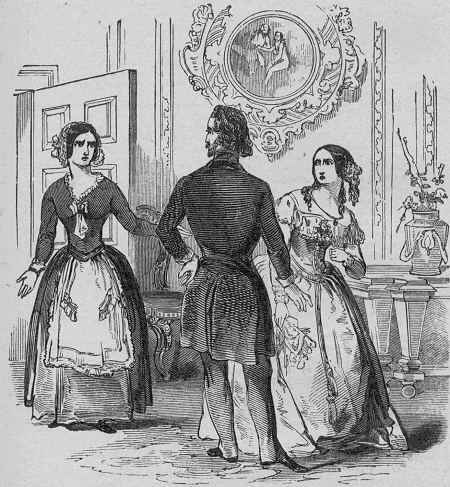
She was immediately followed thither by Lydia
Hutchinson.
"I do not require your attendance," said
Adeline, with a visible shudder, as the lady's-maid closed the door behind her.
"I care not for your wishes or aversions,"
returned Lydia. "Appearances compel me to wait upon you — or to
have the semblance of waiting upon you; — and, moreover, I have
something important to communicate. Oh! I feel such pleasure in being the bearer
of good news to you!"
"What new torture have you in store for me,
horrible woman?" cried Lady Ravensworth, affrighted by the malignant
bitterness with which these last words were uttered.
"Know you to whom your princely mansion has just
afforded its hospitality?" demanded Lydia.
"To a wounded duellist and his friends,"
replied Adeline. "Is the circumstance to be in any way rendered available
to your fearful purposes of torture in respect to me?"
"And that wounded duellist and one of his
companions are well known to you," said Lydia, impressively.
"Known to me!" ejaculated Adeline, who felt
convinced that some fresh cause of anguish to herself lurked in the mysterious
language of her torturess.
"Oh! yes — known too well to yourself
and to me also!" said Lydia, as if shuddering with concentrated rage.
"Ah! my God — it would require but that
to drive me to desperation!" exclaimed Adeline, a terrible suspicion
darting across her mind.
'Then despair must be your lot," said Lydia, fixing
her eyes with malignant joy upon her mistress: "for — as sure
as you are called Lady Ravensworth — Lord Dunstable and Colonel
Cholmondeley are inmates of this mansion!"
"May God have mercy upon me!" murmured
Adeline, in a low but solemn tone.
And she sank almost insensible upon the sofa.
"Yes," continued the unrelenting Lydia, "he
to whom you gave your honour, as one child might a give a toy of little value to
another — and he who stole my honour as a vile thief plunders
the defenceless traveller upon the highway, — those two men are
beneath this roof! The villain who ruined me and slew my brother, is now lying
upon a bed from which he may never more be removed save to the coffin. His
second was the gay seducer who rioted awhile upon your charms, and then threw
you aside, — yes, you — the daughter of one of England's
proudest peers — as he would a flower that had garnished his
button-hole for an hour, and then failed to please any longer. These two men are
beneath your roof!"
"Oh! if my errors have been great, surely — surely
my punishment is more than commensurate!" murmured Adeline, in the
bitterness of her heart.
"Your punishment seems only to have just
begun," retorted Lydia, ever ready to plunge a fresh a dagger into the soul
of the unhappy lady.
"My God! you speak but too truly!" ejaculated
Adeline, clasping her hands together. "Oh! that I could pass the latter
half of my life over again — Oh! that I could recall the years that
have fled!"
"The years that have fled have prepared a terrible
doom for those that are to come," said Lydia. "But hasten, my
lady, — this time I will aid you to change your dress,"
she added sneeringly; "for I long to see your meeting with Colonel
Cholmondeley."
"See our meeting! — you!"
cried Lady Ravensworth, springing from the sofa in alarm.
"Yes — I shall contrive that pleasure
for myself," observed Lydia, calmly.
Adeline made no reply: she felt convinced that all
remonstrance would be useless.
She accordingly addressed herself to the toilet, Lydia
assisting her in that ceremony for the first time.
"I have chosen the attire that best becomes
you — and I have arranged your hair in the most attractive
manner," said Lydia; "for I should be vexed were you not to appear to
advantage in the presence of him who made you his mistress during
pleasure."
"Wretch! "cried Adeline, turning sharply round
upon Lydia, whose bitter taunt touched the most sensitive fibre of her heart.
"If I be a wretch, it, is you who made me so,"
said Lydia, with imperturbable coolness.
Adeline bit her lips almost till the blood came, to
suppress the rage that rose as it were into her throat.
She then hastily left the boudoir, followed at a short
distance by Lydia Hutchinson.
Lady Ravensworth knew that her torturess was behind
her, — knew also that It was vain to reason [-257-]
with
he in respect to any particular line of conduct that she might choose to adopt.
As the unhappy lady proceeded towards the drawing-room,
she endeavoured to compose both her countenance and her mind as much as
possible: but she felt herself blushing at one moment and turning pale the
next, — now with a face that seemed to be on fire — then
with an icy coldness at the heart.
Since she was at school at Belvidere House she had never
met Colonel Cholmondeley. He had been much abroad; and, when he was in London,
accident had so willed it that he did not once encounter the partner of his
temporary amour.
But that same chance was not for ever to be favourable
to Adeline in this respect; and now she was at length about to meet that man of
all the species in whose presence she had most cause to blush.
Such an encounter was however necessary, for the sake of
appearances. What would her servants think if she remained in the solitude of
her own chamber while visitors were at the mansion! what would the surgeon, who
attended the wounded duellist conjecture if she refused the common courtesy
which became the mistress of the mansion The total retirement of Lord
Ravensworth was already a sufficient reason to provoke strange surmises on the
part of the newly-arrived guests, although the existence of his extraordinary
and unaccountable malady was well known in the fashionable world: but if to that
fact were superadded the circumstance of a similar seclusion on the part of Lady
Ravensworth, the most unpleasant rumours might arise. Thus was Adeline
imperatively forced to do the honours of her house on this occasion.
And now she has reached the door of the drawing-room.
She pauses for a moment: how violently beats her heart!
"This is foolish!" she murmurs to herself:
"the ordeal must be passed; — better to enter upon it at
once!"
And she entered the drawing-room.
One only of the guests was there; and he had his back
towards the door at the moment.
But full well did she recognise that tall, graceful, and
well-knit frame.
The sound of light footsteps upon the thick car-[-258-]pet
caused him to turn hastily round; — and then Adeline and her seducer
were face to face.
"Lady Ravensworth," said the Colonel, rather
averting his glance as he spoke, for he experienced the full embarrassment of
this encounter, "necessity, and not my wish, has compelled me to intrude
upon your hospitality. My friend Lord Dunstable and another officer in the same
regiment had an altercation last evening, which would permit of none other than
a hostile settlement. The choice of time and place, fell, by the laws of honour,
to Lord Dunstable's opponent; and the vicinity of your abode was unfortunately
fixed upon as the spot for meeting. My friend was grievously wounded with the
first shot; and I had no alternative but to convey him to the nearest habitation
where hospitality might be hoped for. Your ladyship can now understand the
nature of that combination of circumstances which has brought me hither."
"I deeply regret that Lord Ravensworth should be
too much indisposed to do the honours of his house in person," said
Adeline, with her eyes fixed upon the ground, and a deep blush upon her cheeks.
"Is your friend's wound dangerous?"
"Mr. Graham, a surgeon of known skill, is now with
him," answered the Colonel; "and entertains great hopes of being
enabled to extract the ball, which has lodged in the right side. It is true that
I incur some risk by remaining in the neighbourhood of the metropolis; but I
cannot consent to abandon my friend until I am convinced that he is beyond
danger."
"It is the fashion in the aristocratic world to
adhere to a friend, but to abandon the seduced girl when she no longer
pleases," said Lydia Hutchinson, who had entered the room unperceived by
either Colonel Cholmondeley or Lady Ravensworth, and who now advanced slowly
towards them.
The Colonel stared at Lydia for a few moments: but
evidently not recognising her, he turned a rapid glance of inquiry upon Adeline,
who only hung down her head, and remained silent.
"I see that you do not know me, sir,"
continued Lydia, approaching close to Colonel Cholmondeley: then, fixing her
eyes intently upon him, she said, "Do you remember me now!"
"My good young woman," replied the Colonel,
with a mixture of hauteur and bantering jocularity, "I really do not think
that you have served in any family which I have had the honour to visit: and,
even if you had, I must candidly confess that my memory is not capacious enough
to retain the image of every lady's-maid whom I may happen to see."
"And yet it is not every lady's-maid," said
Lydia, with a scornful glance towards Adeline, who, pale and trembling, had sunk
upon a seat — "it is not every lady's-maid that can venture to
talk thus openly — thus familiarly in the presence of her
mistress."
While she was yet speaking, a light broke upon the
Colonel's mind. Who but one acquainted with Lady Ravensworth's secret could be
capable of such extraordinary conduct! This idea led him to survey Lydia
Hutchinson's countenance more attentively than before; — and,
although it was much altered, — although it no longer bore the
blooming freshness which had characterised it when he first knew her, — still
the expression and the features enabled him to recognise the young woman who had
become the victim of his friend Lord Dunstable.
"Ah! you know me now," continued Lydia,
perceiving by a sudden gesture on the part of the Colonel that he had at length
remembered her.
"Think you that I have no reproaches to hurl at,
you sir? Was it not at your house that my ruin was consummated? and were you no
party to the infamous treachery which gave me to the arms of your friend? But
you have no shame: you are a fashionable gentleman — a roué — one
who considers seduction an aristocratic amusement, as well as wrenching off
knockers. What to such as you are the tears of deceived and lost girls? what to
you are the broken hearts of fond parents? Nothing — nothing: I know
it well! And therefore: it were vain for me to say another word — unless
it be that I shall now leave you to make your peace as best you may with your
cast-off mistress there!"
And pointing disdainfully at Adeline, who uttered a low
scream and covered her face with her hands as those terrible words fell upon her
ears, Lydia slowly quitted the room.
Frightfully painful was now the situation of Lady
Ravensworth and Colonel Cholmondeley.
The former was crushed by the terrible indignity cast
upon her: the latter was so astounded and at the same time so hurt by all that
had just occurred, that he knew not how to act.
He felt that any attempt to console Lady Ravensworth
would be an insult; and yet he experienced an equal inability to permit the
scene to pass with out some comment.
Fortunately for them both, Mr. Graham, the surgeon,
entered the room at this juncture.
Adeline composed herself by one of those extraordinary
efforts which she had lately been so often compelled to exert; and Cholmondeley,
with the ease of a man of fashion (who must necessarily be a thorough
hypocrite), instantly assumed a manner that would even have disarmed suspicion,
had any been excited.
Having uttered a few ceremonial phrases upon his
introduction to Lady Ravensworth, Mr. Graham said, "I am happy to state
that Lord Dunstable is in as favourable a state as under the circumstances could
be expected. I have succeeded in extracting the ball — and he now
sleeps."
"Thank God!" exclaimed Cholmondeley, — not
with any real piety, but merely using that common phrase as expressive of his
joy to think that the matter was not more serious than it now appeared to [-sic-]
"I am, however, afraid," continued the
surgeon, turning towards Adeline, "that my patient will be compelled to
trespass for some few days upon the kind hospitality of your ladyship."
"In which case Lord Dunstable shall receive every
attention that can be here afforded him," observed Adeline. "It would
be but an idle compliment to you, sir, under the circumstances, to say that
Ravensworth Hall will be honoured by your presence so long as you may see fit to
make it your abode."
The surgeon bowed in acknowledgment of this courteous
intimation.
"For my part," Colonel Cholmondeley hastened
to say, "I shall not trespass upon her ladyship's hospitality; for — since
I am assured that my friend is no longer in danger — I must attend
to certain pressing business which calls me elsewhere."
[-259-] Adeline threw a
glance of gratitude upon the Colonel for this expression of his intention to
relieve her from the embarrassment of his presence; and accordingly, after
partaking of some luncheon, Cholmondeley took his departure.
But ere he left, Lydia Hutchinson had secretly placed a
letter, containing a key, upon the seat of the carriage which bore him
away.
< previous chapter < | THE MYSTERIES OF LONDON [Vol. II] | > next chapter >