< previous chapter < | THE MYSTERIES OF LONDON [Vol. II] | > next chapter >
[-350-]
CHAPTER CCXLI.
CROCKFORD'S.
SIR
RUPERT HARBOROUGH, Mr. Albert Egerton, and Mr. Arthur Chichester were walking
am-in-arm, and smoking cigars, along the West Strand about ten minutes after the
little incident which closed the preceding chapter, when they were met by two
tall and fashionable-looking gentlemen, who immediately recognised the baronet
and Chichester.
Both parties stopped; and the two gentlemen were in due
course introduced to Mr. Egerton as Lord Dunstable and the Honourable Colonel
Cholmondeley.
By the significant tone and manner of the baronet — a
sort of freemasonry known only to the initiated, — both Dunstable
and the Colonel were given to understand that a flat had been caught in the
person of Mr. Albert Egerton; and they immediately received their cue as
completely as if they had been prompted by half an hour's explanation.
"What have you been doing with yourselves,
gentlemen, this evening?" inquired Dunstable, as they all now proceeded
together through Trafalgar Square.
"My friends and myself have been supping at the
Paradise," answered the baronet, carelessly.
Mr. Egerton drew himself up an inch higher immediately,
although somewhat top-heavy with the champagne and cigars; — but he
felt quite proud — quite another man, indeed — at being
numbered amongst Sir Rupert Harborough's friends, and at walking familiarly in
the company of a real lord.
"Cholmondeley and I were thinking of looking in at
Crockford's before we encountered you," observed Dunstable, forgetting at
the moment that himself and friend were proceeding in quite a contrary direction
when the meeting alluded to took place. "What say you? shall we all go to
Crockford's?"
Egerton noticed not the little oversight. The word
"Crockford's" perfectly electrified him. He had often passed by the
great pandemonium in St. James's Street, and looked with wistful eyes at its
portals — marvelling whether they would ever unfold to give
admission to him; and now that there seemed a scintillation of a chance of that
golden wish, which he had so often shadowed forth, being substantially
gratified, he could scarcely believe that he was in truth Albert Egerton, the
son of an outfitter, and having a very respectable widowed aunt engaged in the
haberdashery line on [-351-] Finsbury
Pavement; — but it appeared as if he had suddenly received a
transfusion of that aristocracy in whose company he found himself.
Already did he make up his mind to cut the good old aunt
and the half-dozen of fair cousins — her daughters — for
ever: — already did he vow never to be seen east of Temple Bar
again. But then he thought how pleasant it would be to drop in at Finsbury
Pavement on some Sunday — just at the hour of dinner, which he could
make his lunch — and then astound his relatives with the mention of
his aristocratic acquaintances, — no, his friends, — Lord
Dunstable, Sir Rupert Harborough the Honourable Colonel Cholmondeley, and the
Honourable Arthur Chichester!
And what glorious names, too: — nothing
plebeian about them — nothing lower than an Honourable!
Had he known how cheaply Mr. Chichester held his titular
decoration, Albert Egerton would have perhaps assumed one himself: but he did
not entertain the least suspicion concerning the matter, and therefore envied
the pawnbroker's son almost as much as either of the others.
But to return.
Lord Dunstable had said, "Shall we all go to
Crockford's?"
Deep was the suspense of Mr. Egerton until Sir Rupert
Harborough replied, "With much pleasure. It would be the very thing to
teach our young friend Egerton here a little of life."
"But I am not a member" he murmured, in a
disconsolate tone.
"We are all members, however," said
Lord Dunstable; "and can pass you in with ease. Let me and Harborough take
charge of you."
This arrangement was rendered necessary by the fact that
Mr. Chichester was not a member of Crockford's, and would, therefore, require to
be introduced by Colonel Cholmondeley. Dunstable, Harborough, and Egerton
accordingly walked on together; while the Colonel and Chichester followed at
some little distance, as it was not thought worth while to allow the young flat
to perceive that the Honourable Arthur Chichester must be smuggled in, as it
were, as well as himself.
In this manner the two parties repaired to the
celebrated — or rather notorious — Saint James's Club;
and Egerton's wildest dream was realized — the acme of his ambition
was reached — the portals of Crockford's were darkened by his
plebeian shadow!
Although excited by wine and by the novelty of his
situation, he nevertheless maintained his self-possession so far as to avoid any
display of vulgar wonderment at the brilliant scene upon which he now entered.
Leaning on the arms of Lord Dunstable and Sir Rupert Harborough, he passed
through the marble hall, amid was conducted to the coffee-room on the right-hand
side.
There they waited for a few minutes until Cholmondeley
and Chichester joined them; and Egerton had leisure to admire the superb
pier-glasses, the magnificent chandeliers, the handsome side-boards, the costly
plate, and the other features of that gorgeous apartment.
When the Colonel and Chichester made their appearance,
the party proceeded to the supper-room. There Egerton's eyes were completely
dazzled by the brilliant looking-glasses, all set in splendid frames with
curious designs — the crystal chandeliers — the elegant
sconces — the superb mouldings — the massive plate — and
the immense quantities of cut glasses and decanters. The curtains were of the
richest damask silk; the walls were hung with choice pictures; and the whole
magic scene was brilliantly lighted up with innumerable wax candles, the lustre
of which was reflected in the immense mirrors. In a word, the voluptuousness and
luxury of that apartment surpassed any thing of the kind that young Egerton had
ever before witnessed.
Seated near one of the fire-places in conversation with
an elderly gentleman, was an old man, somewhat inclined to stoutness, and very
slovenly in his costume. His clothes were good; but they appeared to have been
tossed upon him with a pitch-fork. His coat hung in large loose wrinkles over
his rounded shoulders: his trousers appeared to hitch up about the thighs, as if
through some defect in their cut; two or three of his waistcoat buttons had
escaped from their holes, or else had not been fastened in them at all; his
cravat was limp; and his shirt-frill was tumbled. His countenance was pale and
sickly, and totally inexpressive of that natural astuteness and sharpness which
had raised him from the most obscure position to be the companion of the noblest
peers in the realm. His eyes were of that lack-lustre species which usually
predicate mental dullness and moral feebleness, but which was at variance with
the general rule in this instance. In a word, his entire appearance bespoke an
individual whose health was wasted by long vigils and the want of needful repose
and rest.
When Lord Dunstable's party entered the room, there were
already three or four groups occupying supper-tables, on which the French
dishes, prepared in Ude's best style steamed, with delicious odour.
"Will you take supper, Mr. Egerton?" inquired
Lord Dunstable.
"No, I thank you, my lord," was the reply.
"I believe Sir Rupert Harborough informed you that we had already been
feeding together."
It was not true that Egerton had supped with the baronet
and Chichester, as the reader knows; but Sir Rupert had already said so of his
own accord, and Mr. Egerton was not the young man to contradict a statement
which seemed to place him upon a certain degree of intimacy with the aforesaid
baronet.
"Vot, no supper, my lord?" cried the stout
gentleman, rising from his seat near the fire, and accosting Dunstable.
"Yes — your lordship and your lordship's friends vill do that
honour to Mosseer Ude's good things."
"No, I thank you," said Dunstable, coolly:
"we shall not take any supper. We mean to step into the next room and amuse
ourselves for an hour or so — eh, Mr. Egerton?"
And a significant glance, rapid as lightning, from Lord
Dunstable's eyes, conveyed his meaning to the stout elderly gentleman with the
sickly face.
"Wery good, my lord. I'll send some nice cool
claret in; and the groom-porters is there. Valk that vay, my lord: valk that my,
gentlemen; — valk that vay, sir."
These last words were addressed to Egerton, and were
accompanied by a very low bow.
Dunstable took the young man's arm, and led him into the
next apartment, where there was a French hazard table.
[-352-] "Who is the
good-natured old gentleman that spoke so very politely, my lord?" inquired
Egerton, in a whisper, when they had passed from the supper-room.
"That good-natured old gentleman!" cried
Dunstable, aloud, and bursting out into a fit of laughter so hearty that the
tears ran down his cheeks: "why — that's Crockford!"
"Crockford!" repeated Egerton, in
astonishment; for, although he had denominated the presiding genius of the place
"a good-natured old gentleman," he had not failed to observe the
execrable English which he spoke, and was overwhelmed with surprise to learn
that the friend of nobles was at such open hostilities with grammar.
"Yes — that is no other than the great
Crockford," continued Lord Dunstable, in an under tone. "He once kept
a small fishmonger's shop near Temple Bar; and he is now rich enough to buy up
all the fishmongers' shops in London, Billingsgate to boot. But let us see what
is going on here."
There were only three or four persons lounging about in
the Hazard-Room, previously to the entrance of Dunstable, Egerton, Harborough,
Cholmondeley, and Chichester; and no play was going on. The moment, however,
those gentlemen made their appearance, the loungers to whom we have just
alluded, and who were decoy-ducks connected with the establishment, repaired to
the table and called for dice, while his croupiers took their seats. and the
groom-porter instantly mounted upon his stool.
"What does he get up there for?" asked Egerton,
in a whisper.
"To announce the main and chance,"
replied Lord Dunstable. "But don't you play hazard?"
"No, nev — that is, not often — not
very often," said the foolish young man, afraid of being deemed
unfashionable in the eyes of his new acquaintances if he admitted that he never
yet handled a dice-box in his life.
"Oh! no — not often — of
course not!,' exclaimed Dunstable, who saw through the artifice: "neither
do I. But here comes Crockey with the bank."
And, as he spoke, Mr. Crockford made his appearance,
holding in his hands an elegant rosewood case, which he placed upon the table,
and behind which, he immediately seated himself.
The dice-box was now taken by Lord Dunstable, who set
ten sovereigns, called "five" as a main, and threw seven.
"Seven to five!" exclaimed the groom-porter.
"Three to two are the odds," said Sir Rupert
Harborough to Egerton: "I'll take them of you in fifties?"
"Done," cried Egerton; and in another moment
he had the pleasure of handing over his money to the baronet.
After Lord Dunstable had thrown out, Mr. Chichester took
the box, and Cholmondeley in his turn ensnared Egerton into a private bet, which
the young man of course lost. But he parted from his bank-notes with a very good
grace; for, although considerably sobered by the soda-water which he had drunk
at the Paradise, yet what with the wine and the idea of being at that moment
beneath Crockford's roof, he was sufficiently intoxicated to be totally reckless
of his financial affairs.
Thus, after having lost a bet to each of his friends, he
was easily persuaded to take the box, and dispense a little more of his cash for
the especial benefit of Mr. Crockford.
"I'll set a hundred pounds," cried Egerton
"and call five the main."
He then threw ten.
"Ten to five!" cried the groom-porter.
"Put down three fifties," said Dunstable;
"and you have four fifties to three. That's right. Now go on."
Egerton threw.
"Five — trois, deuce — out!"
cried the groom-porter.
And the young man's money was swept towards the bank in
a moment.
"Try a back, Egerton," exclaimed
Chichester.
"Well — I don't mind," was the
reply — for the waiter had just handed round goblets of the most
delicious claret, and the lights began to dance somewhat confusedly before the
young victim's eyes. "I'll set myself again in two hundred; and five's the
main."
"Five's the main," cried the groom-porter:
"deuce, ace — out."
And away went the bank-notes to the rosewood case at the
head of the table.
Colonel Cholmondeley now took the box.
"Will you set me a pony, Egerton?" he said.
"I should not mind," was the reply, given with
a stammer and a blush; "but — to tell you the truth — I
have no more money about me. If my cheque will do — "
Dunstable nodded significantly to Crockford.
"Oh! my dear sir," said the old hell-keeper,
rising from his seat and shuffling towards Egerton, whom he drew partially
aside; "I means no offence, but if you vants monies, I shall be werry 'appy
to lend you a thousand or two, I 'm sure."
"Take a thousand, Egerton," whispered Lord
Dunstable. "You'll have better luck, perhaps -with old Crockey's
money — there's spell about it."
"I — I," hesitated the young man
for a moment as the thought of his previous losses flashed to his mind, even
amidst the dazzling influence of Crockford's club and his aristocratic
acquaintances. "I — "
"Glass of claret, sir?" said the waiter,
approaching him with a massive silver salver on which stood the crystal goblets
of ruby wine.
"Thank you;" — and Egerton quaffed
the aromatic juice to drown the unpleasant ideas which had just intruded
themselves upon him: then, as he replaced the glass upon the salver, he said,
"Well, give me a thousand — and I'll have another throw."
Sir Rupert Harborough took the box, set himself in ten
pounds, and cried, "Nine's the main."
He then threw.
"Six to nine!" exclaimed the groom-porter.
"Five to four in favour of the caster,"
observed Colonel Cholmondeley.
"I'll bet the odds," cried Egerton.
"'Gainst the rules, sir," said the pompous
groom. porter: "you 're not a setter this time."
"Pooh, pooh!" cried Crockford, affecting a
jocular chuckle. "The gentleman has lost — let the gentleman
have a chance of recovering his-self. Take the hodds of the gentleman."
"Then I bet five hundred to four in favour of the
caster," said Egerton, now growing interested in the play as he began to
understand it better.
[-353-]
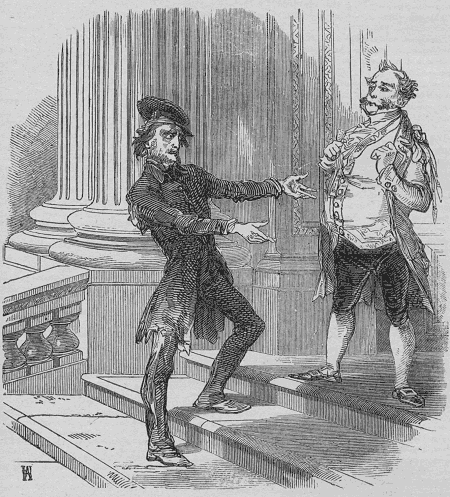
Sir
Rupert throw a few times, and at last turned up six and three.
"Nine — six, trois — out!"
cried the groom-porter.
Egerton now insisted upon taking the box again; and in a
few minutes he had not a fraction left of the thousand pounds which he had
borrowed.
He turned away from the table, and sighed deeply.
"Glass of claret, sir?" said the waiter, as
composedly as if he wore offering the wine through civility and not for the
systematic purpose of washing away a remorse.
Egerton greedily swallowed the contents of a goblet; and
when he looked again towards the table, he was astounded to find another bundle
of Bank notes thrust into his hand by the obliging Mr. Crockford, who said, in
his blandest tones, "I think you vas vaiting, sir, for more monies."
"Take it — take it, old chap,"
whispered Dunstable; "you can turn that second thousand into ten."
"Or into nothing — like the
first," murmured Egerton, with a sickly smile; but still he took the money.
He then played rapidly — wildly — desperately — drinking
wine after each new loss, and inwardly cursing his unlucky stars.
The second thousand pounds were soon gone; and Dunstable
whispered to Crockford, "That's enough for to-night. We must make him a
member in a day or two — and then you'll give me back the little IOU
you hold of mine."
"Certainly — certainly," answered
the hell-keeper "But mind you doesn't fail to bring him again."
"Never fear," returned Dunstable; — then
turning towards his party, he said, aloud, "Well, I think it is pretty
nearly time to be off."
"So do I, my lord — hic,"
stammered Egerton, catching joyfully at the chance of an immediate escape from
the place where fortunes were so speedily engulphed; — for tipsy as
he now was again, the idea of his losses was uppermost in his mind.
"Well, my lord — well, gentlemen,"
said Crockford," bowing deferentially; "I wishes you all a wery good
night — or rather morning. But perhaps your friend, my lord, would
just give me his little IOU — "
"Oh certainly, he will," interrupted Dunstable.
[-354-] "Here, Egerton, my boy — give
your IOU for the two thousand."
"I'd ra-a-ther — his — give
my draft," returned the young man.
But, as his hand trembled and his visual faculties were
duplicated for the time, he was ten minutes ere he could fill up a printed
cheque in a proper manner.
The business was, however, accomplished at last, and the
party withdrew, amidst the bows of decoy-ducks, croupiers, waiters,
groom-porters. door-porters, and all the menials of the establishment.
***
William
Crockford was the founder of the Club which so long bore his name, and which was
only broken up a short time ago.
He began life as a fishmonger; and when he closed his
shop of an evening, was accustomed to repair to some of the West End hells,
where he staked the earnings of the day. Naturally of a shrewd and far-seeing
disposition, he was well qualified to make those calculations which taught him
the precise chances of the hazard-table; and a lucky bet upon the St. Leger
suddenly helped him to a considerable sum of ready money, with which he was
enabled to extend his ventures at the gaming-house.
In due time he gave up the fish-shop, and joined some
hellites in partnership at the West End. Fortune continued to favour him; and he
was at length in a condition to open No. 50, St. James's Street, as a Club.
The moment the establishment was ready for the a
reception of members, announcements of the design were made in the proper
quarters; and it was advertised that all persons belonging to other Clubs were
eligible to have their names enrolled without ballot as members of the
St. James's. The scheme succeeded beyond even the most sanguine hopes of
Crockford himself; and hundreds of peers, nobles, and gentlemen, who were fond
of play, but who dared not frequent the common gaming-houses, gladly became
supporters and patrons of the new Club.
In the course of a short time No. 51 was added to the
establishment; and No. 52 was subsequently annexed. The rules and regulations
were made more stringent, because several notorious black-legs had obtained
admission; but, until the very last, any member was permitted to introduce a
stranger for one evening only, with the understanding that such visitor should
be balloted for in due course. The entrance-fee was fixed at twenty guineas a
year; and an annual payment of ten guineas was required from every member.
The three houses, thrown into one, were soon found to be
too small for the accommodation of the members: they were accordingly pulled
down, and the present magnificent building was erected on their site. It is
impossible to say how much money was expended upon this princely structure; but
we can assert upon undoubted authority that the internal decorations alone cost
ninety-four thousand pounds!
The real nature of this most scandalous and abominable
establishment soon transpired. Hundreds of young men, who entered upon life with
fortune and every brilliant prospect to cheer them, were immolated upon the
infernal altar of that aristocratic pandemonium. Many of them committed
suicide: — others perpetrated forgeries, to obtain the means of
endeavouring to regain what they had lost, and ended their days upon the
scaffold; — and not a few became decoy-ducks and bonnets in the
service of the Arch-demon himself. Even noblemen of high rank did not hesitate
to fill these ignominious offices; and for every flat whom they took to the
house, they received a recompense proportionate to the spoil that was obtained.
To keep up appearances with their follow members, these reined lacqueys of the
great hellite actually paid their subscriptions with the funds which he
furnished them for the purpose.
So infamous became the reputation of Crockford's, that
it was deemed necessary to devise means to place the establishment apparently
upon the same footing with other Clubs. A committee of noblemen and gentlemen
(what precious noblemen and gentlemen, good reader!) was formed to
administer the affairs of the institution; but this proceeding, was a mere
blind. The Committee's jurisdiction extended only to the laws affecting the
introduction of new members, the expulsion of unruly ones, and the choice of the
wines laid in for the use of the Club. The French Hazard Bank and all matters
relating to the gambling-rooms were under the sole control of Crockford, who
reaped enormous advantages from that position.
Thus was it that a vulgar and illiterate man — a
professed gambler — a wretch who lived upon the ruin of the
inexperienced and unwary, as well as on the vices of the hoary sinner, — thus
was he enabled to make noble lords and high-born gentlemen his vile tools, and
thrust them forward as the ostensible managers of a damnable institution, the
infamous profit of which went into his own purse.*
[-*So far back as 1824, The Times newspaper thus directed attention to the atrocious nature of Crockford's, Club, —
'"Fishmongers' Hall,' or the Crock-odile Mart for gudgeons, flat-fish, and pigeons (which additional title that 'Hell' has acquired from the nature of its 'dealings') has recently closed for the season. The opening and closing of this wholesale place of plunder and robbery are events which have assumed a degree of importance not on account of the two or three unprincipled knaves to whom it belongs, and who are collecting by it vast fortunes incalculably fast, but for the rank, character, and fortunes of the many who are weak enough to be inveigled and fleeced there. The profits for the last season, over and above expenses, which cannot be less than £100 a day, are stated to be full £150,000. It is wholly impossible, however, to come at the exact sum, unless we could get a peep at the Black Ledger of accounts of each day's gain at this Pandemonium. which, though, of course omits to name of whom, as that might prove awkward, if at any time the book fell into other hands. A few statements from the sufferers themselves would be worth a thousand speculative opinions on the subject, however they might be near the fact, and they would be rendering themselves, and others, a vital benefit were they to make them. Yet some idea can be formed of what has been sacked, by the simple fact that one thousand pounds was given at the close of the season to be divided among the waiters alone, besides the Guy Fawkes of the place, a head servant, having half that sum presented to him last January for a New Year's gift. A visitor informed me, that one night there was such immense play, he was convinced a million of money was, to use a tradesman's phrase, turned on that occasion. This sum, thrown over six hours play of sixty events per hour, 360 events the night, will give an average stake of £2777 odd to each event. This will not appear very large when it is considered that £10,000 or more were occasionally down upon single events, belonging to many persons of great fortunes.
"Allowing only one such stake to fall upon the points of the game in favour of the bank per hour, full £16000 [-355-] were thus sacrificed; half of which, at least, was hard cash from the pockets of the players, exclusively of what they lost besides.
"Now that there is a little cessation to the satanic work, the frequenters to this den of robbers would do well to make a few common reflections; — that it is their money alone which pays the rent and superb embellishments of the house — the good feeding and the fashionable clothing in which are disguised the knaves about it — the refreshments and wine with which they are regaled, and which are served with no sparing hand, in order' to bewilder the senses to prevent from being seen what may be going forward, but which will not be at their service, they may rest well assured, longer than they have money to be plucked of; and above all, it is for the most part their money, of which are composed the enormous fortunes the two or three keepers have amassed, and which will increase them prodigiously while they are still blind enough to go. To endeavour to gain back any part of the lost money, fortunes will be further wasted in the futile attempt, as the same nefarious and diabolical practices by which the first sums were raised, are still pursued to multiply them. One of these 'Hellites' commenced his career by pandering to the fatal and uncontrollable appetites for gambling of far humbler game than he is now hunting down, whose losses and ruin have enabled him to a. bedeck this place with every intoxicating fascination and incitement, and to throw out a bait of a large sum of money, well hooked, to catch the largest fortunes, which are assure to be netted as the smaller ones were. Sum up the amount of your losses, my lords and gentlemen, when, if you are still sceptical, you must be convinced of these things. Those noblemen and gentlemen, just springing into life and large property, should be ever watchful of themselves, as there are two or three persons of some rank, who themselves have been ruined by similar means, and now condescend to become 'Procurers' to this foul establishment, kept by a 'ci-devant' fishmonger's man, and who are rewarded for their services in the ratio of the losses sustained by the victims whom they allure to it.
"They wish to give the place the character of a subscription club, pretending that none are admitted but those whose names are first submitted for approval to a committee, and then are balloted for. All this is false. In the first place, the members of different clubs at once are considered eligible; and in the next, all persons are readily admitted who are 'well' introduced, have money to lose, and whose forbearance under losses can be safely relied upon. Let the visitors pay a subscription — let them call themselves a club, or whatever they choose — still the house having a bank put down from day to day by the same persons to be played against, and which has points of the games in its favour, is nothing but a common gaming-house, and indictable as such by the statutes; and in the eye of the law, the visitors are 'rogues and vagabonds.' Were it otherwise — why don't the members of this club be seen at the large plate-glass windows of the bow front, as well as at the windows of reputable club-houses! No one is ever there but the 'creatures of the hell,' dressed out and bedizened with gold ornaments (most probably formerly belonging to unhappy and ruined players), to show off at them, and who look like so many jackdaws in borrowed plumes; the players, ashamed of being seen by the passers by, sneak in and out like cats who have burnt their tails. Some of the members of the different clubs will soon begin to play the real character of this infernal place — those who will ultimately be found to forsake their respectable club-houses, and merge into impoverished and undone frequenters to this 'hell."'
< previous chapter < | THE MYSTERIES OF LONDON [Vol. II] | > next chapter >