< previous chapter < | THE MYSTERIES OF LONDON | > next chapter >
[-182-]
CHAPTER LIX.
THE ROYAL LOVERS.
HOLFORD awoke with a start.
At that moment the time-piece upon the mantel struck five. It
was still quite dark.
The young man felt cold and nervous. He had dreamt that he
was discovered and ejected from the palace amidst the jeers and taunts of the
servants. He now suddenly recollected that the domestics would most probably
soon arrive to cleanse and arrange the apartment; and detection in that case
must be certain.
It struck him that he had better endeavour to escape at once
from the royal dwelling. Then he thought and fondly flattered himself that the
same good fortune which had hitherto attended him in this adventure would still
follow him. This idea has caused many a hesitating mind to decide upon pursuing
a career of crime, or folly, or peril. So was it with Holford; and he resolved
to remain in the palace at least a short time longer.
But he perceived the absolute necessity of seeking out a
secure place of concealment; and it struck [-183-] him that the highest storeys of the building were those best
calculated for this purpose. Leaving the apartment in which he had availed
himself of the friendly sofa, and which, as before stated, was in the immediate
vicinity of the Sculpture Gallery upon the ground-floor, he passed through the
Library, and returned to the great hall. Ascending a magnificent marble
staircase, he reached the Picture Gallery. Every here and there lamps were
burning, and thus be was enabled to inspect all the scenes of magnificence and
splendour through which he passed.
The Picture Gallery in Buckingham Palace is immediately over
the Sculpture Gallery, and forms a wide-passage separating the Green Drawing
Room, the Throne Room, and other state apartments from the Roman, the Yellow,
and the little drawing rooms. The Yellow Drawing Room is the largest and most
splendid of the suite. The furniture is all richly carved, and is overlaid with
burnished gilding and covered with yellow satin. The wall is surrounded by
polished pillars of syenite marble; and on each panel is painted a portrait of
some royal personage.
The Dining Room also leads out of the Picture Gallery. This
gallery itself is decorated and adorned upon classic models. The frames of the
pictures are very plain, but neat, and appropriated to the style of the
architecture. There is nothing gorgeous in this gallery every thing is in good
taste; and yet the mouldings and fret-work of the ceiling are of the most
elaborate description. The pictures in the gallery are all originals by eminent
masters, and are the private property of the sovereign.
It may be here observed that the queen is passionately
attached to the Fine Arts, in which, indeed, the is a proficient. In every room
of the palace there are some excellent paintings; and in each apartment
occupied by the queen, with the exception of the Throne Room, there is a grand
pianoforte.
With a lamp in his hand, Henry Holford proceeded through
those magnificent apartments which communicated with the Picture Gallery. He was
astonished at the assemblage of wealth and splendour that met his eyes on every
side. From time to time he seated himself upon the softest ottomans, and in the
gilded chairs - in every place where he deemed it probable that the queen might
have rested. At length eh reached the Throne Room. The imperial seat itself was
covered over with a velvet cloth, to protect it against the dust. Holford
removed the cloth; and the splendours of the throne were revealed to him.
He hesitated for a moment: he felt as if he were committing a
species of sacrilege ;- then triumphing over this feeling - a feeling which had
appeared like a remorse - he ascended the steps of the throne ;- he placed himself
in the seat of England's monarch.
Had the sceptre been there he would have grasped it
;- had
the crown been within his reach, he would have placed it upon his head!
But time pressed; and he was compelled to leave those
apartments in which a strange and uuaccountable fascination induced him to
linger. He ascended- a staircase leading to another storey; and now he proceeded
with extreme caution, for he conceived that be must be in the immediate vicinity
of the royal sleeping apartments. He hastened up to the highest storey he could
reach, and entered several passages from which doors opened on either side. One
of these doors was ajar the light of a lamp in the passage enabled him to
ascertain that the chamber into which it led was full of old furniture,
trunks, boxes, bedding, and other lumber. This was precisely the
place which suited the adventurous pot-boy; and he hastened to conceal himself
amidst a pile of mattresses which formed a secure, warm, and comfortable berth.
Here he again fell asleep; and when he awoke the sun was
shining brightly. He partook of his provisions with a good appetite, and then
deliberated within himself what course he should pursue. He felt madly anxious
to be near the person of the queen once more: he longed to hear her voice again
;- he resolved to risk every thing to gratify these inclinations.
He began to understand that the vast extent of the palace,
and the many different ways of reaching the various floors and suites of
apartments, constituted the elements of his safety, and greatly diminished the
risk of encountering any of the inmates of the royal dwelling. He was insane
enough, moreover, to believe that some good genius or especial favour of fortune
protected him; and these impressions were sufficiently powerful to induce him to
attempt any fresh enterprise within the walls of the palace.
While he was debating within himself how he should proceed in
order to satisfy his enthusiasm curiosity, the door suddenly opened, and two
female servants of the royal household entered the lumber-room.
Holford's heart sank within him: his limbs seemed paralysed;
his breath failed him.
"The entertainment takes place in the Yellow and Roman
Drawing Rooms this evening," said one.
"The prince is expected at five o'clock,"
observed the
other. " He and his father the Duke of Saxe Coburg Gotha, are to land at
Woolwich between two and three."
"So I heard. The royal carriages have already left to
meet her Majesty's guests."
"Have you ever seen the prince?"
"Once. He was in England, I remember, a short time
previous to the accession of her Majesty."
"Is he good looking?"
"Very. Of course you believe as I do, and as every one
else does that Prince Albert of Saxe Coburg will —"
"Soon be Prince Albert of England."
"Hush! walls have ears!"
The servants having discovered the article of furniture which
was the object of their search, left the room - greatly to the relief of Henry
Holford, whose presence they never for a moment suspected.
Holford had thus accidentally learnt some information which
served to guide his plans. The evening's entertainment was to take place in the
Yellow Drawing Room - an apartment which he could not fail to recognise by the
colour, as one which he had visited before day-break that morning. He had heard
of Prince Albert, whom rumour had already mentioned as the happy being who had
attracted the queen's favour. Every circumstance now lent its aid to induce the
enthusiastic lad to resolve upon penetrating into the Yellow Drawing Room, by
some means or another, during the afternoon.
It struck the intruder that if the queen intended to receive
company in the Yellow Drawing-room in the evening, she would most probably
welcome her illustrious guests from Germany in some other apartment. He knew,
from the conversation of the two female servants, that the Grand Duke of
Saxe-Coburg Gotha and Prince Albert, were to arrive at five; he presumed that
the inmates of the palace would assemble in those points where they could
command a view of the ducal cortege; and he came [-184-]
to the conclusion that the coast would be moat clear for his purposes. at
five o'clock.
Nor was he wrong in his conjectures; for scarcely had two minutes elapsed
after the clock had proclaimed the hour of five, when Henry Holford was
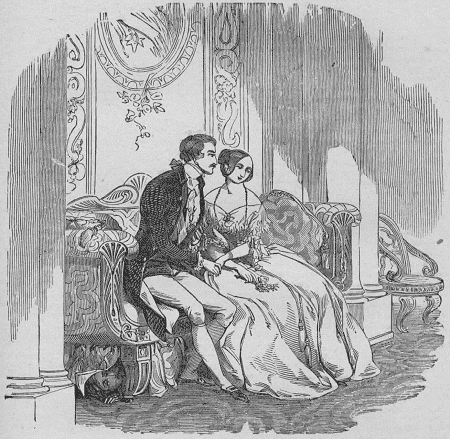
safely ensconced beneath a sofa in the Yellow Drawing Room.
At eight o'clock the servants entered and lighted the lamps. The colour of
the paper and the satin of the furniture enhanced the splendour of the effulgence thus created in that magnificent saloon.
At half-past nine the door opened again and Holford's
heart beat quickly, for he now expected the appearance of the sovereign and
her guests. But, no - not yet. Two ladies attached to the court, entered the drawing-room, and seated
themselves upon the sofa beneath which Holford lay concealed.
"Well - what think you of the young prince?" said one. "Your
grace was
seated next to him."
"Very handsome - and so assuming," was the reply.
"Does your grace really believe that her Majesty Is smitten ?"
"No doubt of it. How fortunate for the family of the Grand Duke of
Saxe Coburg!"
"Yes - fortunate on the score of alliance."
"And in a pecuniary point of view."
"Not so much as your grace thinks. There has been an absurd report
in circulation that the grand duke's revenues are so small, none of his family
could venture to appear at the court of Vienna: and also, that the means of
education for the younger branches were always excessively restricted."
"And are not these reports correct, countess?"
"By no means. Your
grace probably is aware that the earl and myself visited Germany the year before last; and we remained
six weeks at Gotha. The Duke of Saxe-Coburg posesses a considerable civil list, and a large private fortune. His brother
Ferdinand espoused the wealthy Princess-Kohary of Hungary; and another brother,
Leopold, married our lamented Princess Charlotte. It has been-stated that Prince
Leopold himself was a simple major in the Austrian service, with nothing but
his pay, when he was fortunate enough to obtain the favour of the Princess
Charlotte: this is so far front being correct, that he never was in the
Austrian service at all, but was a general officer in the Russian army,
enjoying, in addition to his full pay, a princely allowance from his country."
"Your ladyship has greatly pleased me with these elucidations."
"Your grace honours me with this mark of satisfaction. Prince
Albert
was educated at Bonn, on the Rhine. His mental qualifications are said to be
of a very high order; his disposition is amiable; and he has obtained the
affections of all who know him in Germany."
"It is to be hoped that her most gracious Majesty will enjoy a long,
prosperous, and happy reign," said the duchess, in a tone of unfeigned
sincerity.
"Long and prosperous it may be," returned the countess, with a strange
solemnity of voice and manner; "but happy for her - happy for the sovereign
whom we all so much love,- no - that is impossible!"
"Alas! I know to what you allude, " observed the duchess, her tone
also changing. "Merciful heavens is there, then, no perfect happiness in
this world?"
"Where shall perfect happiness be found?" exclaimed the countess, in a voice of
deep melancholy, and with a profound sigh. " Never did any sovereign ascend
the throne under more favourable circumstances than Victoria. Enshrined in a
nation's heart - beloved by millions of human beings - wearing the proudest
diadem in the universe, and swaying the sceptre of a dominion extensive as that
of Rome, in her most glorious days,-oh! why should not Victoria be completely
happy? Alas! she can command the affections of her people by her conduct :- the
valour of her subjects, the prowess of her generals, and the dauntless courage
of her admirals, can preserve her empire from all encroachment - all peril ;
-wealth can surround her with every luxury, and all the potentates of the earth
may seek her friendship ;- but no power - no dominion - no wealth - no luxury -
no love, can exterminate the seeds —"
"Ah! countess - for Gods sake, talk not in this manner! "ejaculated the
duchess: "you make me melancholy - so melancholy, that I shall be dispirited
the entire evening."
"Pardon me, my dear friend; but I know not how our
discourse gradually
turned upon so sad a subject. And yet the transition must have been natural,
added the countess, in a mournful and plaintive, voice "for, most
assuredly, I should not have voluntarily sought to converse upon so sad a theme."
"Sad!" cried the duchess; "it is sufficient to make one's heart
bleed. To think that a young creature whom millions and millions of beings
idolize and a young creature - whose name is upon every lip - whose virtues and qualifications
are the theme of every pen - whose slightest wish amounts to a command - oh! to think that this envied
and amiable being should be haunted, day and night - alone, or when surrounded by all that is most noble or most lovely in
England's aristocracy, - haunted
by that dread fear - that appalling alarm - that dismal apprehension ;- oh! it
is intolerable!"
"Alas!" said the countess; "what poor - what miserable creatures
are we! The hand of the Deity mingles gall with the cup of nectar which is drunk by his elect! There is no situation in life without its
vexations."
"Yes - vexations of all kinds!" echoed the duchess; "for those
annoyances which are mere trifles to the lower classes, are grievous afflictions
to us. But —"
At that moment the time-piece upon the mantel proclaimed the half-hour after
ten; and the two ladies rose from the sofa, observing to each other, that it was
time to hasten to attend upon the person of their royal mistress. They then
withdrew.
It may be supposed that Holford had not lost one word of the above
conversation. He had greedily drunk in every .word ;- but the concluding portion
of it had filled him with the most anxious curiosity, and with wonder. To what
did those dark, mysterious hints bear reference? And how could the happiness
of the sovereign be incomplete? Those two noble ladies had detailed all the
elements of felicity which formed the basis of the queen's position; and
surely sufficient had been enumerated to prove the perfection of her happiness.
And yet, allusion was made to one source of perpetual fear - one cause of
unmixed alarm - one object of ever-present dread, by which the queen was haunted
on all
occasions. What could this be? Conjecture was vain - imagination could suggest
nothing calculated to explain this strange mystery.
Shortly after eleven o'clock the doors were thrown open, and the royal train
made its appearance. On [-185-]
the
queen's right hand walked Prince Albert, the sovereign leaning gently upon his
arm. He was dressed in a court-garb, and wore a foreign order upon his breast.
Of slight form and slender make, his figure was wanting in manliness; but his
deportment was graceful. His eyes beamed kindness; and there was something
peculiarly sweet and pleasant in his smile. His countenance was expressive of
intellect; his conversation was amusing. He was evidently a very pleasant
companion; and when Victoria and Albert walked down the saloon together, there
appeared a certain fitness in their union which was calculated to strike the
most common beholder.
The queen and the prince seated themselves upon the sofa
beneath which the pot-boy was concealed; and their conversation was plainly
overheard by him. The noble and beauteous guests - the lords and the ladies of
the court - withdrew to a distance; and the royal lovers - for such
already were Victoria and Albert - enjoyed the pleasures of a tete-à-tete. We
shall not record any portion of their discourse -animated, interesting,
and tender though it were: suffice it to say, that for a short time they seemed
to forget their high rank, and to throw aside the trammels of court etiquette, in
order to give vent to those natural feelings which the sovereign has in common
with the peasant.
This tete-a-tete lasted for nearly an hour; music and
dancing then ensued; and the entertainment continued until two o'clock in the
morning.
The company retired - the lights were extinguished in the
state apartments - and profound silence once more reigned throughout the palace.
Holford paid another visit to the larder, and then retraced
his steps unobserved to the lumber-room, where he slept until a late hour in the
morning.
< previous chapter < | THE MYSTERIES OF LONDON | > next chapter >