< previous chapter < | THE MYSTERIES OF LONDON | > next chapter >
[-207-]
CHAPTER LXVII.
SCENES IN FASHIONABLE LIFE.
Two months elapsed from the date of the preceding event.
It was now the commencement of March; and bleak winds had
succeeded the hoary snows of winter.
The scene changes to the house of Sir Rupert Harborough, in
Tavistock Square.
It was about one o'clock in the afternoon. The baronet was
pacing the drawing-room with uneven steps, while Lady Cecilia lounged upon the
sofa, turning over the pages of a new novel.
"Now this is most provoking, Cecilia," exclaimed
the baronet: "I never was so much in want of money in my life; and you
refuse to adopt the only means which —"
"Yes, Sir Rupert," interrupted the lady impatiently;
"I refuse to give you my diamonds to pledge again - and all your arguments
shall never persuade me to do so."
"Your heart is too good, Cecilia —"
"Oh! yes - you may try what coaxing will do; but I can
assure you that I am proof against both honied and bitter words. Neither will
serve your turn now."
"And yet, somehow or another, you have the command of
money, Cecilia," resumed the baronet, after a pause. "You paid all the
tradesmen's bills and servants' wages about two months ago: you found out -
though
God only knows how - that Greenwood had the duplicate of your diamonds;- you redeemed the ticket from
him, and the jewels themselves from V—'s; and from that moment you have never
seemed embarrassed for a five-pound note."
"All that is perfectly true, Sir Rupert," said Lady Cecilia, blushing
slightly, and yet smiling archly, - and never did she seem more beautiful than
when the glow of shame thus mantled her cheek and poured a flood of light into
those eyes that were so expressive of a voluptuous and sensual mature.
"Well, then," continued the baronet, "if you can thus obtain supplies for
yourself, surely you can do something in the same way for me."
"I have no ready money at present," said Ledy
Cecilia; "and I have
determined not to part with my jewels. There!"
"Perhaps you think that I am fool enough to me the dupe of your
miserable and flimsy artifice, Cecilia?" cried the baronet impatiently:
"but I can tell you that I have seen through them all along."
"You!" ejaculated the lady, starting uneasily while her heart palpitated
violently, and she felt that her cheeks were crimson.
"Yes - I, Lady Cecilia," answered the baronet.
"I am not quite such a fool
as you take me for."
"My God, Sir Rupert! what - how - who -" stammered the
guilty wife, a cold tremor pervading every limb, although her cheeks appeared to
be on fire.
"There! you see that all my suspicions are confirmed," cried the baronet;
"your confusion proves it "
"You cannot say that - that - I have ever given you any cause, Sir Rupert
—"
"What? to doubt your word? Oh! no - I can't say that you are in the habit
of telling falsehoods generally; but —"
"Sir Rupert!"
"Nay - I will speak out! The fact is, you pretend to have quarrelled with
Lady Tremordyn; and it is all nonsense. Your mother supplies you with as much
money as you require - and that is the secret! "
"Oh! Sir Rupert - Sir Rupert!" exclaimed Lady Cecilia, suddenly
relieved from a most painful state of apprehension, and now comprehending the
error under which he was labouring.
"You cannot deny what I affirm, Cecilia. And now that I bethink
me, it
is most probable that Greenwood himself told Lord Tremordyn (with whom be was
intimate at that time, although they have since quarrelled, God only knows what
about) of my having placed the duplicate of the diamonds in his hands, and so
your father arranged that matter with Greenwood. It is a gross system of duplicity,
Cecilia - a gross system; a pretended quarrel merely to prevent me
from visiting at the house of my father-in-law. But, by God! I will stand it no
longer!"
"What will you do, then?" demanded Lady Cecilia, ironically.
"What will I do? I will go straight off to Lord and Lady Tremordyn, and
tell them my mind."
"And Lord and Lady Tremordyn will tell you theirs in return."
"And what can they say, madam, against me?"
"Nay - Sir Rupert, rather
ask what they can say for you."
"Oh! you wish to irritate me, madam - you are anxious to quarrel with me,"
cried the baronet. - "Well - be it so! As for your father and mother I will
tell them that they do not act honourably, nor [-208-] even prudently, in allowing their son-in-law to live by his
wits and be compelled to raise money where he can."
"And they will tell you in reply, that you did not act
honourably nor prudently to squander the large sum they gave you when you
married their daughter."
"The devil they will!" exclaimed the baronet. "Then,
in that case, I shall remind them of the consideration for which the large sum
you allude to was given."
"Monster - coward!" cried Lady Cecilia: "do you
dare to throw in my teeth the weakness of which I was guilty through excess of
love for you?"
"I am sure you need not be so fastidious, Cecilia. To
talk of love now, between a man of the world like me and a woman of the world
like you, is an absurdity ;- and as for the little weakness of which you speak, I
repaired it."
"Yes, " said the lady, bitterly. "When you saw me
kneeling in despair at your feet - and when my mother implored you to save her
daughter's honour, you turned a deaf ear to our entreaties - you scorned our
prayers: but when my father offered a golden argument —"
"Lady Cecilia - silence, I command you!"
"When he offered a golden argument," I say, continued the
lady, with withering scorn, "- when he produced his cheque-book, Sir Rupert
Harborough pretended to yield to my entreaties; and as he raised me from the
ground - condescendingly - raised me - me, the daughter of a peer - with one
hand, - with the other he clutched the bribe! Ah! Sir Rupert - you spoilt a good
heart - you trampled a confiding disposition in the dust - when you would not allow
yourself to be purchased by my love, but still consented to sell yourself to me
for my father's gold! Oh! it was the vile instance of a man prostituting himself
for gain, as poor weak woman has so often been doomed to do!"
"Lady Cecilia - I am astonished. - I am amazed at the terms
in which you allow yourself to address me!" said Sir Rupert Harborough,
humiliated and put to shame by these words of keenly cutting satire.
"And now," continued the indignant lady, - "now you
solicit me to ruin myself for you - to part with my very ornaments to supply your
extravagances, - you, who had no pity upon my tears, no feeling for my anguish, no
respect for my honour! No, Sir Rupert Harborough: I have assisted you once -
assisted you twice - assisted you thrice - assisted you a hundred times
already; and what return have you made me? When you are penniless, you
remain at home: when you are in the possession of funds, you remain absent for
weeks and weeks together. You may love me no longer, it is true; - and, with regard to myself, I confess that your conduct has
long-long ago destroyed all the romance of affection in my bosom. Still a woman
cannot endure neglect - at least I thought so a few months ago ;- but now -
now," she
added emphatically, as her thoughts wandered to Greenwood, " I am
indifferent alike as to your attention or your neglect!"
"At least, Lady Cecilia, you are candid and
explicit,"
said Sir Rupert, biting his lips. " But perhaps you have something more to
observe."
"No-nothing," answered the lady coldly; and, with these
words, she rose and left the room.
Not many minutes had elapsed since the termination of this
"scene," when Mr. Chichester was announced.
"Well, what news with the old man?" demanded the
baronet hastily.
"My father will not advance me another shilling until
June," answered
Chichester, throwing himself upon the sofa; "and as for your bill - he won't
look at it. Any thing good with you?"
"Nothing. Lady Cecilia positively refuses to part with the jewels again,"
said the baronet, stamping his foot with rage.
"And can't you —"
"Can't I what?"
"Can't you help yourself to them in spite of her?" demanded Chichester.
"Impossible!" returned Harborough. " She keeps them under lock and
key in her own room; and the door of that room she always locks when she goes
out."
"How provoking! If we only had some ready money at this moment,"
observed Chichester, " we might make a little fortune."
"Yes - town is full - and such opportunities at we might have! By Jove, we
must raise the wind somewhere."
"You do not think that Greenwood—"
"Oh! no - not for a moment! " cried the baronet,
turning very pale as the idea of the forged acceptance of Lord Tremordyn, which
would be due in another month, flashed across his mind: "no - I cannot apply
to Greenwood for a shilling."
"And after all the pains I have taken in perfecting you
in the new dodges with the cards and dice, ready for this season," said Mr.
Chichester, in a most lachrymose tone; then, taking a small parcel from his
pocket, he continued, "Here are the implements we want, too: every thing
prepared - except the money."
"Ah! " exclaimed the baronet, "you have got
the things, then, at last?"
"Yes, returned Chichester, opening the parcel and
displaying its contents upon the table. " Here are the scratched dice, you
see. These must be
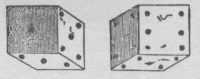
used upon a bare table, because it is necessary to judge by
the sound of the dice in the box whether they are on the scratched side or not.
You understand that a hole has been drilled in the centre pip of the five in
this die, and in the ace of the other: a piece of ebony is then inserted, with a very small portion
projecting. These dice cannot, therefore, fall perfectly fiat, when the five
side of the one and the ace of the other are underneath on the table; and it is
very easy for the thrower just to move the box the least thing before he lifts
it, so that the sound may tell him whether the scratched side is down or not.
But you are to recollect that a man must be very drunk when you can use them
with any degree of safety."
"I
should think so, indeed," said Sir Rupert.
"I can assure you that no
implements of our craft are, on certain occasions, more destructive than these," observed
Chichester.
"And what is the use of these slight scratches upon the dice? "
"To assist the eye in manipulating them. But here," continued Chichester,
holding up a dice-box, and surveying it with a species of paternal admiration, -
"here is a famous antidote to fair dice. [-209-]
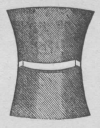
Don't you see that when fair dice are used, you must introduce an unfair
box,  Many a greenhorn may have heard of loaded dice, and so on; but very few
know that there is such a thing as the Doctor Dice-box. Honour to the man, say
I, who invented it. If
you judge by the outside of this box, it is a very fair-looking one; but just
put, your finger into it, and you will feel that no less than three-quarters
of the inside are filled up, so that there is now only just space enough left in
the middle for the dice to fit in. Towards the top the sides grow larger and
smoother. The dice, you see, rattle by rising up and down, when shaken briskly,
but do not change their position. All that you have to do is to put them in, in the first
instance, with a view to the way in which you want them to come up."
Many a greenhorn may have heard of loaded dice, and so on; but very few
know that there is such a thing as the Doctor Dice-box. Honour to the man, say
I, who invented it. If
you judge by the outside of this box, it is a very fair-looking one; but just
put, your finger into it, and you will feel that no less than three-quarters
of the inside are filled up, so that there is now only just space enough left in
the middle for the dice to fit in. Towards the top the sides grow larger and
smoother. The dice, you see, rattle by rising up and down, when shaken briskly,
but do not change their position. All that you have to do is to put them in, in the first
instance, with a view to the way in which you want them to come up."
 "So that if you want to throw a six and a five, put the dice
into the box with the ace and the two uppermost," said the baronet.
"So that if you want to throw a six and a five, put the dice
into the box with the ace and the two uppermost," said the baronet.
"Precisely,"
answered Chichester. "A fair box, you know as well as I do, has one or more rims
inside, against which the dice must turn in coming out."
"By the bye," said the baronet, "what is the Gradus,
Chichester? you promised to show me a great many
times, and have forgotten it; but now that we are upon the subject, you may as well enlighten me."
"Certainly, my dear fellow,2 returned this very
complacent Mentor; then, taking up a pack of cards, he said, "nothing is
more easy than the Gradus, or Step. It is often much safer than Bridging, too.
Bridging is known by every snob about town who pretends to set up for a Greek.
[-210-] All that you have to do for the Gradus is to let any
particular card you fancy project a little in this way,

so as to make sure .that your opponent will turn it up, at
whist or ecarté , as the case may be."
" Excellent! I like the plan better than any other you
ever yet showed me for effecting the same object."
"Palming may sometimes be done successfully," continued
Chichester: "but you must have the small French cards to do it. There
- all
that there is to do is to secrete a particular card under the palm and partially
up the sleeve till it is required. When your opponent is well primed, you can
easily introduce a fifth king, or fifth ace, in this way. There is a great deal
of art, too, in shuffling, or Weaving. At ecarté or whist, always watch which
tricks taken up have the best cards; then, when you take up all the cards to
shuffle them again, weave in the good tricks to suit your purposes."
"I heard a gentleman say the other night," observed the
baronet, "that he had been most gloriously fleeced by a fellow who used
pricked cards."
"Ah! they are capital weapons," exclaimed Chichester.
"Just lay the high cards flat on their backs, and then prick them with a
very fine needle, - so as to raise the slightest possible pimple in the world
upon the backs down in one of the corners; but mind, the cards are not to be
punctured quite through. The fellow who told me how to do this dodge, used some
chemical preparation to the ball of his thumb, which made that part almost raw,
and consequently so very sensitive that he could feel the smallest possible
pimple on the card with the greatest ease."
"And what have you got there?" demanded Sir Rupert,
pointing to a pack of cards which Chichester had just taken from his parcel.
"These are Reflectors," replied the Mentor. "They
are French cards, you perceive, and are only manufactured in France. They cost
two guineas a stack ; but then - only think of their utility! Look at the backs
of these cards: instead of being plain, they are figured. Now this to a common
observer is nothing, most of the French cards being, you know, variegated with
flowers or other designs at the back. But to the initiated, the lines upon these
cards are every thing. Mark how their run. All the high cards

have semicircles in the corners, while all the low cards have
the ends of the lines meeting in the corners. Then, by a more minute study still
of these cards, it is easy to know kings, queens, knaves, and aces, by the
manner in which the lines run upon the back. I hope these weapons are dangerous
enough for you?"
"They are decidedly the most efficient I have yet seen,"
answered the baronet. "I think we now know all the mysteries of the gaming
world and considering how many that there are in London and the watering places,
it would be astonishing indeed if we could not pick up a handsome living."
"Of course it would," said Mr. Chichester. "The mania for
play is most extraordinary. The moment a young man enters upon life, he fancies
that it is very fine to frequent gambling-houses or lose his loose
gold at private play: indeed he imagines that he cannot be a man of the world without it. There is our
advantage. That anxiety to be looked upon as a fine dashing fellow is the real
cause of the immense increase of gaming propensities. Young men do not begin to
play in the first instance because they like it: they commence, simply to
gratify their vanity; and then they imbibe the taste and acquire the habit. What
they began through pride, they continue through love. There, again, I say, is
our pull :- there always will be flats ready to throw themselves head and
shoulders into the nets that sharps spread out for them."
"All that is very true, Chichester," said the baronet.
"But we don't want a homily on the vice of gambling this afternoon: what we
require us the needful to enable us to put our plans into execution. The old
tricks that you taught me more than three years ago in that very respectable
lodging which you occupied in Bartholomew Close, are well-nigh worn out: we have
now studied fresh ones ;- but we are totally deficient in the steam to set our
new engines in motion."
Chichester was about to reply when a carriage drove up to the
front door, and Mr. Greenwood alighted.
< previous chapter < | THE MYSTERIES OF LONDON | > next chapter >