< previous chapter < | THE MYSTERIES OF LONDON | > next chapter >
[-262-]
CHAPTER LXXXVIII.
THE FIGURANTE.
THE wonders performed by the Professor of Mesmerism produced
an immense sensation. The persons who had been admitted to the "private
exhibition," did not fail to proclaim far and wide the particulars of all
that they had witnessed; and, as a tale never loses by repetition, the narrative
of those marvels became in a very few days a perfect romance. The reporters of
the press, who had attended the exhibition, dressed up a magnificent account of
the entire proceedings, for the journals with which they were connected; and the
fame of the Professor, like that of one of the knights of the olden time, was
soon "bruited abroad through the length and breadth of the land."
At length a public lecture was given, and attended with the
most complete success. Ellen had an excellent memory; and her part was enacted
to admiration. She recollected the most minute particulars detailed to her by
the Mesmerist, relative to the interior of the houses of his friends, the
contents of letters to be read through envelopes, the subjects of prints, and
the lines of poetry or passages of prose in the books to be read when placed
behind her. Never was a deception better contrived: the most
[-263-] wary were deluded by it; and the purse of the Professor was well
filled with the gold of his dupes.
But all things have an end: and the deceit of the Mesmerist
was not an exception to the rule.
One evening, a gentleman - a friend of the Professor - was
examining Ellen, who of course was in a perfect state of coma, respecting the
interior of his library. The patient had gone through the process of questioning
uncommonly well, until at length the gentleman said to her, "Whereabouts
does the stuffed owl stand in the room you are describing?"
In the abstract there was nothing ludicrous in this query:
but, when associated with the absurdity of the part which Ellen was playing, and
entering as a link into the chain of curious ideas that occupied her mind at the
moment, it assumed a shape so truly ridiculous that her gravity was completely
overcome. She burst into an immoderate fit of laughter: her eyes opened wide -
the perfect state of coma vanished in a moment - the clairvoyance was
forgotten - the catalepsy disappeared - and the patient became unmesmerised in a
moment, in total defiance of all the prescribed rules and regulations of Animal
Magnetism!
Laughter is catching. The audience began to titter - then to
indulge in a half-suppressed cachinnation ;- and at length a chorus of hilarity
succeeded the congenial symphony which emanated from the lips of the patient.
The Professor was astounded.
He was, however, a man of great presence of mind: and he
instantaneously pronounced Ellen's conduct to be a phenomenon in Mesmerism,
which was certainly rarely illustrated, but for which he was by no means
unprepared.
But all his eloquence was useless. The risible inclination
which now animated the great majority of his audience, triumphed over the
previous prejudice in favour of Mesmerism; the charm was dissolved - the spell
was annihilated - the pitcher had gone so often to the well that it got broken
at last - the voice of the Professor had lost its power.
No sooner did the hilarity subside a little, when it was
renewed again; and even the friends and most staunch adherents of the Professor
looked at each other with suspicion depicted upon their countenances.
What reason could not do, was effected by ridicule:
Mesmerism, like the heathen mythology, ceased to be a worship.
The Professor grew distracted. Confusion ensued; the audience
rose from their seats; groupes were formed; and the proceedings of the evening
were freely discussed by the various different parties into which the company
thus split.
Ellen took advantage of the confusion to slip out of the
room; and in a few moments she left the house.
Her occupation was now once more gone; and she resolved to
pay another visit to the old hag.
Accordingly, in a few days she again sought the miserable
court in Golden Lane.
It was about three o'clock in the afternoon, when the young
lady entered the apartment in which the old hag dwelt. The wrinkled wretch was
seated at the table, working. She had bought herself a new gown with a portion
of the money which she had received from Ellen on the occasion of recommending
the latter to the Mesmerist; and the old woman's looks were joyful - as joyful
as so hideous an expression of countenance would allow them to be - for she
thought of being smart once more, even in her old age. Vanity only ceases with
the extinction of life itself.
"Well, my child," said the old woman, gaily;
"you have come back to me again. Surely you have not already finished with
your Mesmerist?"
"Yes," replied Ellen. "The bubble has burst,
and I am once more in search of employment."
"And in such search, miss, will you ever be, until you
choose to settle yourself in a manner suitable to your beauty, your
accomplishments, and your merits," said the old woman.
"In what way could I thus settle myself?"
"Do you ask me so simple a question? May you not have a
handsome house, a carriage, servants, money, rich garments, jewels, and a box at
the Opera, for the mere asking?"
"I do not require so much," answered Ellen, with a
smile. "If I can earn a guinea or two a week, I shall be contented."
"And do you not feel anxious to set of! your charms to
the greatest advantage?" demanded the old woman. "How well would
pearls become your soft and shining hair! how dazzling would your polished arms
appear when clasped by costly bracelets! how lovely would be your little ears
with brilliant pendants! how elegant would be your figure when clad in rustling
silk or rich satin! how the whiteness of your bosom would eclipse that of the
finest lace! Ah! miss, you are your own enemy - you are your own enemy!"
"You forget that I have a father," said Ellen,-
"a father who loves me, and whom I love,- a father who would die if he knew
of his daughter's disgrace."
"Fathers do not die so easily," cried the old hag.
"They habituate themselves to every thing, as well as other people. And
then - think of the luxuries and comforts with which you could surround the old
man."
"We will not talk any more upon that subject," said
Ellen firmly. "I well understand your meaning; and I am not prudish nor
false enough to affect a virtue which I do not possess. But I have my interests
to consult; and it does not suit my ideas of happiness to accept the proposal
implied by your language. In a word, can you find me any more employment?"
"I know no more Mesmerists," answered the old hag,
in a surly tone.
"Then you can do nothing for me?"
"I did not say that - I did not say that," cried
the hag. "It is true I can get you upon the stage; but perhaps that pursuit
will not please you."
"Upon the stage!" ejaculated Ellen. "In what
capacity?"
"As a figurante, or dancer in the ballet, at a
great theatre," replied the old woman.
"But I should be known - I should be recognised,"
said Ellen.
"There is no chance of that," returned the hag.
"Dressed like a sylph, with rouge upon your cheeks, and surrounded by a
blaze of light, you would be altogether a different being. Ah! it seems that I
already behold you upon the stage - the point of admiration for a thousand looks
- the object of envy and desire, and of every passion which can possibly gratify
female vanity."
For some moments Ellen remained lost in thought. The old
woman's offer pleased her: she was vain of her beauty; and she contemplated with
delight the opportunity thus presented to her of displaying it with brilliant
effect. She already dreamt of success, applause, and showers of nosegays; and
her countenance gradually expanded into a smile of pleasure.
"I accept your proposal," she said: "
but —"
[-264-] "Why do you hesitate?" demanded, the
old woman.
"Oh! I was only thinking that the introduction would be better
—"
"If it did not come from me?" added the old woman, her wrinkled face
becoming more wrinkled still with a sardonic grin. "Well, make yourself
easy upon that score. I am only aware that a celebrated manager has a
vacancy in his establishment for a figurante, and you may apply for it."
"But I am ignorant of the modes of dancing practised upon the stage,"
said Ellen.
"You will soon learn," answered the old woman. "Your beauty will
prove your principal recommendation."
"And what shall I give you for your suggestion?" asked Ellen, taking out
her purse.
When a bailiff makes a seizure in a house, he assures himself with a glance
around, whether there be sufficient property to pay at least his expenses; -
when a debtor calls upon his creditor to ask for time, the latter surveys
the former for a moment, to ascertain by his countenance if he can be trusted; -
the wholesale dealer always "takes stock," as it were, of the petty
detailer who applies to him for credit ;- and thus was it that the old woman
scrutinized with a single look the capacity of Ellen's purse, so that she
might thereby regulate her demand. And all the while she appeared intent only
on her work.
"You can give me a couple of guineas now," the old woman at length said;
"and if your engagement proves a good one, you can bring or send me three
more in the course of the month."
This arrangement was immediately complied with, and Ellen took leave of the
old hag, with the fervent hope that she should never require her aid any more.
On the following day Miss Monroe called upon the manager of the great
national theatre where a figurante was required.
She was ushered into the presence of the theatrical monarch, who received her
with much urbanity and kindness; and he was evidently pleased with her address,
appearance, and manners, as she explained to him the nature of her business.
"Dancing in a ball-room, and dancing upon the stage, are two very
different things," said the manager. "You will have to undergo a course of
training, the length of which will depend upon your skill and your
application. I have known young ladies become proficient in a month - others in a
year - many never, in spite of
all their exertions. Most of the figurantes have been brought up to their
avocation from childhood; but I see no reason why you should not learn to acquit
yourself well in a very short time."
"I shall exert myself to the utmost, at all events," observed Ellen.
"How are you circumstanced?" inquired the manager.
"Excuse the question; but my object is to ascertain if you can support
yourself during your apprenticeship, as we may term the process of study and
initiation?"
"I have a comfortable home, and am not without resources for my
present wants," answered Ellen.
"So far, so good," said the manager. "I do not seek to pry into your
secrets. You know best what motives induce you to adopt the stage: my
business is to secure the services of young, handsome, and elegant ladies, to
form my corps de ballet. It is no compliment to you to say that you will answer my purpose, provided your
studies are successful."
"With whom am I to study, sir? "
"My ballet-master will instruct you," replied the
manager. "You can attend his class. If you will come to the theatre
to-morrow morning at ten o'clock, you can take your first lesson."
Ellen assented to the proposal, and took leave o[ the
manager. They were mutually satisfied with this interview: the manager was
pleased with the idea of securing the services of a young lady of great beauty,
perfect figure, and exquisite grace ;- and, on her side, Ellen was cheered with
the prospect of embracing an avocation which, she hoped, would render her
independent of the bounty of others.
And now her training commenced. In the first. place her feet
were placed in a groove-box, heel to heel, so that they formed only one
straight line, and with the knees turned outwards. This process is called
"se tourner." At first the pain was excruciating - it was a perfect
martyrdom; but the fair student supported it without a murmur; and in a very few
days her feet accustomed themselves, as it were, to fall in dancing parallel to
each other.
The second lesson in the course of training consisted of
resting the right foot on a bar, which Ellen was compelled to hold in a
horizontal line with her left hand. Then the left foot was placed upon the bar,
which was in this case held up by the right hand. By these means the stiffness
of the feet was destroyed, and they were rendered as pliant and elastic as if
they had steel springs instead of bones. This process is denominated "se
casser."
Next, the student had to practise walking upon the extreme
points of the toes, so that the foot and the leg formed one straight line. Then
Ellen had to practise the flings, capers, caprioles, turns, whirls, leaps,
balances, borees, and all the various cuts, steps, positions, attitudes, and
movements of the dance. During the caprioles the student had to train herself to
perform four, six, and even eight steps in the air; and the fatigue produced by
these lessons was at times of the most oppressive nature.* [*The French terms for the various steps and
features of the
ballet-dance are- jetés, balances, rondos de jambes, fouettes, cabrioles,
pirouettes sur le coude-pied, sauts de basques, pas de bourrés, and entre-chats
a quatre, a six and a huit.]
When Ellen was perfected in these portions of her training, she had to
practise the tricks of the stage. At one time she was suspended to lines of wires; at another she was seated on paste-board clouds; then she learned to
disappear through traps, or to make her exit by a window. Some of these
manoeuvres were of a very dangerous nature; indeed, in some, the danseuse
actually risked her life - and all, her limbs. The awkwardness of an underling
in shifting a trap-door at the precise moment would have led her to dash her
head against a plank with fearful violence.
The art of theatrical dancing is divided into two schools, called
Ballonné and Tacqueté. The former is the branch in which Taglioni shines ; the latter
is that in which Fanny Ellsler excels. The style of the Ballonné takes its
name from the airiness of the balloon; it combines lightness with grace, and it
principally characterized by a breezy and floating appearance of the figure. The
Tacqueté is all vivacity and rapidity, distinguished by sparkling steps and
twinkling measures, executed with wonderful quickness upon the point of the
feet. In both these schools was Ellen instructed.
So intense was the application of Miss Monroe - so unwearied
was she in her practice, so quick in comprehending the instructions of the
master - so [-265-]
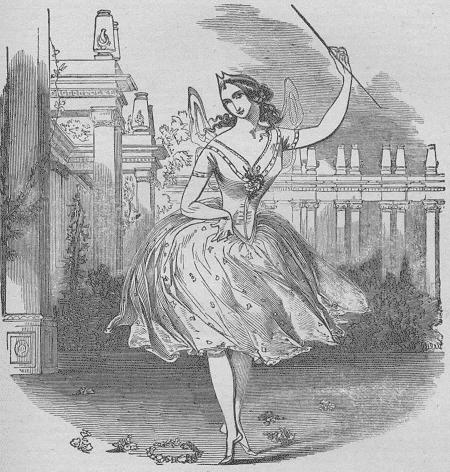
resolute in surmounting all obstacles, that in the. short
space of two months she was a beautiful dancer. The manager was perfectly
astonished at her progress; and he pronounced a most favourable opinion upon
her chance of achieving a grand triumph.
Her form became all suppleness and lightness; her powers of relaxation and abandonment of limb were
prodigious. When attired in the delicate drapery of the ballet, nothing could be
more beautiful - nothing more sylph-like, than the elastic airiness of her
rich and rounded figure. The grace of her attitudes - the charm of her dance -
the
arrangement of that drapery, which revealed or exhibited the exquisite contours
of her form - the classic loveliness of her countenance - the admirable symmetry
of her limbs - and the brilliant whiteness of her skin, formed a whole so
attractive, so ravishing, that even the envy of her sister-figurantes was
subdued by a sentiment of uncontrollable admiration.
In obedience to a suggestion from the manager, Ellen
agreed to adopt a well-sounding name. She accordingly styled herself Miss Selina
Fitzherbert. She then learned that at least two-thirds of the gentlemen and
ladies constituting the theatrical company, had changed their original
patronymics into convenient pseudonyms.
Thus Timothy Jones had become Gerald Montgomery; William Wilkins was announced
as William Plantagenet; Simon Snuffles adopted the more aristocratic
nomenclature of Emeric Gordon; Benjamin Glasscock was changed into Horatio
Mortimer; Betsy Podkins was distinguished as Lucinda Hartington; Mary Smicks was
displaced by Clara Maberly; Jane Storks was commuted into Jacintha Runnymede; and so on.
In her relations with the gentlemen and ladies of the corps. Ellen (for we
shall continue to call her by her real name) found herself in a new world.
Every thing with her present associates might be summed up in the word - egotism. To hear them
talk, one would have imagined that they were so
many princes and princesses in disguise, who had graciously condescended to
honour the public by appearing upon the stage. The gentlemen were all descended
(according to their own accounts) from the best and most ancient families in the
country; the ladies had all brothers, or cousins, or uncles highly placed in
the army or navy ;- and if any one ventured to express surprise that so many
well-connected individuals should be compelled to adopt the
[-266-] stage
as a profession, the answer was invariably the same- "I entered on this
career through preference, and have quarrelled with all my friends in consequence. Oh! if I chose," would be
added, with a toss of the head, "I might have any thing done for me; I
might ride in my carriage; but I am determined to stick to the stage."
Poor creatures! this innocent little vanity was a species of reward, a sort
of set-off, for long hours of toil, the miseries of a precarious existence, the
moments of bitter anguish produced by the coldness of an audience, and all
the thousand causes of sorrow, vexation, and distress which embitter the lives
of the actor and actress.
With all their little faults, Ellen found the members of the
theatrical company good-natured creatures, ever ready to assist each other,
hospitable and generous to a fault. In their gay moments, they were sprightly,
full of anecdote, and remarkably entertaining. Many of them were clever, and
exhibited much sound judgment in their remarks and critical observations upon
new dramas and popular works.
At length the evening arrived when Ellen was to make her first appearance
upon the stage in public. The house was well attended; and the audience was thrown into a remarkably good humour by the various performances which preceded
the ballet. Ellen was in excellent spirits, and full of confidence. As she
surveyed herself In the glass in her little dressing-room a few moments before
she appeared, a smile of triumph played upon her lips, and lent fire to her
eyes. She was indeed ravishingly beautiful.
Her success was complete. The loveliness of her person at
once produced an impression in her favour; and when she executed some of the
most difficult measures of the Ballonné school, the enthusiasm of the audience
knew no bounds. The eyes of the ancient libertines, aided by opera-glasses and lorgnettes, devoured the charms of that beautiful girl; -
the young men followed every motion, every gesture, with rapturous
attention ;- the triumph of the debutante was complete.
There was something so graceful and yet so voluptuous in her style of
dancing, - something so bewitching in her attitudes and so captivating in her
manner, that she could not have failed to please. And then she had so well
studied all those positions which set off her symmetrical form to its best
advantage, - she had paid such unwearied attention to those measures that were
chiefly calculated to invoke attention to her well-rounded, and yet light and
elastic limbs, - she had so particularly practised those pauses which afforded her
an opportunity of making the most of her fine person, that her dancing excited
pleasure in every sense - delighting the eye, - producing an effect as of a
musical and harmonious feeling in the mind, and exciting in the breasts of the
male portion of the spectators passions of rapture and desire.
She literally wantoned in the gay and voluptuous dance; at one moment all
rapidity, grace, and airiness; at another suddenly falling into a pause
expressive of a soft and languishing fatigue ;- then again becoming all energy,
activity, and animation,- representing, in all its phases, the soul - the spirit
- the very poetry of the dance!
At length the toils of her first performance ended. There was
not a dissenting voice, when she was called for before the curtain. And then, as
she came forward, led by the manager, flowers fell around her - and handkerchiefs
were waved by fair hands - and a thousand enthusiastic voices proclaimed
her success. Her hopes were gratified - her aspirations were fulfilled:- she bad
achieved a brilliant triumph!
< previous chapter < | THE MYSTERIES OF LONDON | > next chapter >