< previous chapter < | THE MYSTERIES OF LONDON | > next chapter >
[-304-]
CHAPTER XCIX.
THE BUFFER'S HISTORY.
"You are well aware that my name is really John Wicks,
although very few of my pals know me by any other title than the Buffer.
" My father and mother kept a coal and potatoe shed in
Great Suffolk Street, Borough. I was their only child; and as they were very
fond of me, they would not let me be bothered and annoyed with learning. For
decency's sake, however, they made me go to the Sunday-school, and there I just
learnt to read, and that's all.
"When I was twelve years old, I began to carry out small
quantities of coals and potatoes to the customers. We used to supply a great
many of the prisoners in the Bench; and whenever I went into that place, I
generally managed to have a game of marbles, and sometimes rackets, with the
young blackguards that lurked about the prison to pick up the racket balls, run
on messages, and so on. At length I got to play for money; and as I generally
lost, I had to take the money which I received from the customers to pay my
little gambling debts. I was obliged to tell my father and mother all kinds of
falsehoods to account for the disappearance of the money. Sometimes I said that
I had lost a few halfpence; then I declared that a beggar in the street had
snatched a sixpence out of my hand, and ran away; or else I swore that the
customers had not paid me. This last excuse led to serious misunderstandings;
for sometimes my father went himself to collect the debts owing to him; and
then, when the prisoners declared they had paid me, I stuck out that it was
false; and my father called them rogues and swindlers. At length, he began
seriously to suspect that his son was robbing him and one day be found it out in
a manner which I could not deny. I was then fourteen, and was pretty well
hardened, I can tell you. So I turned round, and told my father that he had
brought it all on himself, because he had instructed me how to cheat the
customers in weight and measure, and had therefore brought me up in wrong
principles.
"You must understand that the usual mode of doing
business in coal-sheds is this: all the weights only weigh one half of what they
are represented to weigh. For instance, the one which is used as the fifty pound
weight is hollow, and is, therefore, made as large in outward appearance as the
real fifty pound weight; whereas, in consequence of being hollow, it actually
only weighs twenty-five pounds. This is the case with all the weights; the pound
weight really weighs only half a pound, and so on. You may ask why the weights
are thus exactly one half less than they are represented to be,- neither more
nor has than one half. I will tell you: when the leet jury comes round and
points, for instance, to the weight used for fifty pounds, the answer is, 'Oh,
that is the twenty-five pound weight;' and, upon being tested, the assertion is
found to be correct. So there is never any danger of being hauled over the coals
by the leet jury; but if the weights were each an odd number of ounces or pounds
short, they could not be passed off to the jury as weights of a particular
standard, and then the warehouseman would get into a scrape. It is just the same
with the measures. The bushel contains a false bottom, and is really half a
bushel; and when the leet jury calls, it it stated to be the half bushel measure,
whereas to customers it is passed off as the bushel. This will also account to
you for the way in which costermongers in the streets are able to sell fruit
(cherries particularly) and peas, in the season, for just one half of the price
at which they can he bought at respectable dealers. The poor dupe who gives
twopence for a pound of cherries of a costermonger in the street, only
obtains half a pound; and the housewife who thinks that she can save a hundred
per cent, by buying her peas in the same way, only gets half a peck instead of a
peck.
"My father had thirty barrows, which he let out to the
costermongers at the rate of eighteen pence a day each; and some of those men
could clear eight 6r ten shillings a day by their traffic. But they are so
addicted to drinking that they spend all they get; and in the winter season they
starve. Now and then a costermonger would disappear with the barrow, for the
loan of which my father never required any security, as the poor souls had none
to give; and then my father offered a reward for the apprehension of the
absentee. He was generally caught, and my father always had him taken before the
magistrate and punished - as a warning, he said, to the rest. I used to think he
behaved very harshly in this respect, as the poor wretch whom he thus got sent
to the treadmill had most probably paid for the barrow over and over again.
"But to return to my story. When my father discovered
that I had robbed him, I threw in his teeth the use he made of false weights and
measures. He was alarmed at this, because I threatened to inform the neighbours;
and so he did not give me the thrashing which he had at first promised. He,
however, resolved to send me away from home, and in the course of a few days got
me a place at a friend's of his, who kept a sweet-stuff shop, in Friar Street,
Blackfriars. There I was initiated into all the mysteries of that trade. I found
that the white-sugar articles were all largely adulterated with plaster of
Paris; and that immediately accounted to me for the pernicious - often fatal
- effects produced by this kind of trash upon children. If parents, who really
care for their children, were only commonly prudent, they would never allow them
to eat any white-sugar sweet-stuff at all. Then I discovered that the articles
passed off as burnt almonds, really contained the kernels of fruits; for the
kitchen-maids in wealthy families and hotels collect and sell the stones of the
peaches, apricots, and nectarines, eaten at the dinner-tables of their masters,
as regularly as cooks dispose of their bones and grease. In fact, the most
deleterious ingredients enter into the composition of sweet-stuff. The
sugar-refiners sell all their scum to the sweet-stuff makers; and this scum is
composed of the lime, alum, bullock's blood, charcoal, acetate of soda, and
other things used for fining sugar. Oxide of lead is also mixed with the small
proportions of sugar used in making sweet-stuff; and thus you may perceive what
filthy and poisonous substances are given to children in the shape of
sugar-plums. I hope that I do not weary you with this description; and if you
should be surprised that I can now recollect the chemical names of the
ingredients used, I must tell you that I went so often to the sugar-refiners,
and to the chemists, for my master, that I soon became familiar with every thing
at all relating to the business.
"I now came to more interesting matters. I had been with
my master about six years, and was then going on for twenty-one, when my father
died. My mother sent for me home to help her in the business; and I now had the
command of money. The taste for gambling which I had imbibed in my boyhood,
returned with additional force and I sought [-305-]
every opportunity of gratifying my inclination in this
respect. I frequented a notorious public-house in Suffolk Street, where gaming
was carried on to a great extent; and my ill-luck seemed unvaried. My mother did
all she could to check the progress of this infatuation; but it was invincible;
and in the course of three years I had completely ruined both my mother and
myself. An execution was put into the house for rent, and my mother died of a
broken heart. I shed a few tears, and then looked round me for some occupation.
"One of the persons who frequented the public-house in
Suffolk Street offered to recommend me to a friend of his, who kept an
auction-room in the City. I gladly accepted the proposal, and was engaged as 'a
bidder,' at that establishment. I will tell you what I had to do: the auction was
carried on in an open warehouse in a great thoroughfare. The articles put up for
sale were all of the most worthless description - razors, made (like Peter
Pindar's) to sell, and not to cut; pen-knives, that would inflict no damage upon
a piece of wood; decanters, that would scarcely resist the pressure of the most
delicate lady's hand; candlesticks, made of a metal that would melt if held too
close to the fire; urns, that sprang a leak the moment hot water was poured into
them; watches, that were never know to go beyond the first four-and-twenty
hours; scissors, that would not sever a thread; snuffers, that merely crushed
without diminishing the wick; tea-pots, made of polished pewter, and warranted
as silver; in a word, every species of domestic rubbish of this kind, occupied
the counters and tables in the auction-room. Myself and three others were hired
as bidders. Our duty was to offer a price for every article put up, and buy it
in if it appeared likely to go to a stranger at too low a price - although,
indeed, few prices were too low for the articles on which they were put. Then,
when a greenhorn entered the mart, we were to puff of the articles amongst
ourselves in his hearing - never talking to him, but talking at him. The master
was perched up behind a high desk, using his hammer with exemplary alacrity, and
knocking down article after article to the flat that came in and bid. Sometimes
the dupes would come back the following day, and demand the return of their
money, as they had ascertained that the goods for which they had parted with it
were worthless: it was then our duty to hustle such obstreperous claimants,
bonnet them, or, [-306-] in extreme cases, knock
them down, and then give them into custody for creating a disturbance.
In this situation I remained for three years. The master was
very good to us, and gave us a present every time he effected large sales by our
means. One afternoon an elderly gentleman entered the mart, and stood bidding
for some cut decanters, They had been invoiced to the proprietor of the
establishment for six shillings, and the lowest price at which they were to be
knocked down was two pounds ten. The bidding was rather slow; and I retreated a
pace or two behind the old gentleman, to avoid having the appearance of being
anxious to make myself conspicuous. In that position I observed the corner of a
red pocket-book peeping out of his coat tail. I glanced around: no one noticed
me; and in a moment I abstracted the inviting object. This was the first theft I
ever committed; and bad as I already was, the moment I had that pocket-bank safe
in my possession, I would have given the world for it to have been back again in
its former place. The deed was however done; and I evaporated from the auction
mart with the rapidity of thought.
I was not such an idiot as to return to my lodgings; but I
hastened into the vicinity of Smithfield, and entered a public-house in Chick
Lane. The parlour -a little slip, with a single window looking upon the
street - was fortunately empty; and I immediately examined my treasure. And true
enough it was a treasure! It contained eight hundred pounds in Bank of England
notes, together with bills of exchange to the amount of three thousand. There
were also letters and cards of address, which showed me who the old gentleman was.
He was a rich landholder in the county of Hants. 1 enclosed the bills of
exchange and the letters in a sheet of paper, and returned them through the post
to their owner. The Bank notes I kept. But I was now at a loss how to act; for I
fancied that if the notes had been stopped, there would be danger in attempting
to pass them. After I had put the letter in the post, I returned to the
public-house in Chick Lane, and meditated-upon the best course to pursue. While
I was sitting in the parlour, over a glass of brandy and-water, pondering upon
this very difficult matter, a man entered, sate down, called for some liquor,
and got into conversation with me. By degrees we grew confidential; and he let
me know that he was a member of the swell-mob. I opened my heart to him; and he
immediately offered to take me to a place where I could change my notes.
"I thankfully accepted his proposal; and he led me into
Field Lane. There he entered a shop where they sold salt fish, herrings,
haddocks, and oysters. He asked a dirty-looking girl if Israel Moses was at
home; and, receiving an affirmative answer, led the way up a narrow, dark, and
dirty staircase, to a room where an old Jew, with a face almost completely
concealed by grisly white hair, was sitting at a table covered with papers. My
guide immediately communicated to him the object of my visit; and the old Jew
questioned me closely relative to the way in which I had obtained the Bank
notes. My companion advised me to tell him the exact truth, which I did; and the
Jew then offered me six hundred pounds in gold for my eight hundred pounds'
worth of notes. He explained to me that he should be compelled to send them to
his agents in Paris, Hamburgh, and Amsterdam, to get rid of them; and that he
could therefore afford to give me no more. I accepted his proposal, received the
gold, and departed, accompanied by my new friend, who was no other than Dick
Flairer.
"I made him a handsome present for his counsel and
assistance, and was about to part from him, when he told me that I had better
take care of myself for a few days until the hue and cry concerning the
pocket-book should be over. He asked me to accompany him to his lodgings in
Castle Street, Saffron Hill. I agreed; and there I first met his sister Mary. In
the evening Dick went out, to ascertain, as he said, 'how the wind blew.' He'
came back at a late hour, and brought me a copy of a hand-bill that had been
printed and circulated, and which gave not only a full description of the
robbery, but also a most painfully accurate account of my person. Dick assured
me that I was not safe in his lodgings, as he himself was a suspicious character
in the neighbourhood; and be advised me to hide myself in a certain house which
he knew in Chick Lane. I followed his advice, and proceeded to the Old House,
where I lay concealed is that horrid dungeon under ground for a mortal
fortnight. Mary brought me my food every other day, and gave me information of
what was going on outside. She told me that the newspapers had published an account
of the return, of the bills of exchange and letters by post; and that the same
organs stated that the old gentleman who had been robbed was unwilling to
proceed any farther on that very account. At length Dick came himself, and
assured me that I might leave the dungeon; but that it would be better for me to
remain quiet in some snug place for a few weeks. I proposed to him a trip into
the country: he agreed ; and Mary accompanied us.
"We went down to Canterbury, and took lodgings on the
Herne Bay road, close by the barracks. Dick and I used to visit all the
neighbouring towns, and see what we could pick up; but we led a jovial life,
spending much, more than we got, and thus making desperate inroads into my
funds. My old habits of gambling returned; and the gold which I had received from
the Jew was disappearing very rapidly. We had left London for upwards of eight
months, when we thought of returning to our old haunts. Mary seemed quite averse
to the proposal, and was most anxious to remain a short time longer where she
was. To this Dick agreed; and he and I came up to town. We went to the
Boozing-ken on Saffron Hill, and there took up our quarters. Dick introduced me
to Bill Bolter; and as it happened that our funds were all low, we resolved upon
adopting some means to replenish our purses. Happening to take up the Times,
I saw an advertisement, according to which a wealthy jeweller and goldsmith in
the Strand required a porter. I made a remark which led Dick Flairer to observe,
that if I chose to take the situation, he could get me a reference, as he knew
one of the largest linen-drapers in Norton Folgate, who was in the habit of
buying stolen goods of the cracksmen of Dick's gang, and would not dare refuse,
to perform the part required. The plan was settled: I applied for the situation,
gave the reference, and in two days entered the service of the rich goldsmith.
In lees than a fortnight I had obtained all the information I required; and
stepping out one evening, I hastened to the boozing-ken, where I met the pals,
and appointed the following night for the enterprise. I then returned to my
master's residence.
"On the ensuing night, precisely as the clock struck
twelve, I stole softly down from my bed-room, and entered the shop by means of a
skeleton key. I then cautiously opened the front door, and admitted Dick Flairer
and Bill Bolter.. We immediately set to work to pack up all the most valuable
and most [-307-] portable articles; in which
occupation we were engaged when a cry of 'Fire, fire!' was heard in the
street outside; and almost at the same moment a tremendous knocking at the front
door began. For an instant we were paralysed; but the noise of steps descending
the stairs hurried us into action; and, opening the doors, we darted from the
house with the speed of wild animals, leaving all the booty behind us. The cry
of 'Fire!' was instantly succeeded by that of 'Thieves!' and
several persons began to pursue us hotly. We gained Wellington Street, and
hastened towards Waterloo Bridge, intending to get into the Borough with the
least possible delay. On we went-through the great gate, without waiting to pay
the toll at the entrance of the footway - the pursuers gaining upon us. Suddenly
I recollected that the cornice along the outside of the parapet was very wide;
and without hesitating a moment I sprang over the parapet, alighted on the
cornice, and only saved myself from falling into the river by catching hold of
the gas-pipe which runs along the outer side of the bridge. Scarcely had I thus
accomplished a most dangerous feat, when I distinctly saw a man, a few yards
a-head, mount the parapet, and precipitate himself into the river. Then arose
the sounds of voices on the bridge, crying, 'He is over!' 'He has leaped in!'
'He will be drowned.' 'They have all three escaped.' 'But where the devil could
the other two have got to?' and such-like exclamations, which convinced me
that my companions were safe. There I remained, a prey to a thousand painful
reflections and horrid ideas, for upwards of an hour; till at length I grew so
dizzy that I was every moment on the point of falling into the river. The bridge
was now completely silent; and I ventured to leave my hiding- place. I passed
over the bridge to the Surrey side, without molestation, and proceeded by a
circuitous route to the Old House in Chick Lane, where, to my astonishment, I
found Bill Bolter. I then learnt that it was Dick Flairer who had leapt into the
river, and was no doubt drowned; and that Bolter had only escaped by concealing
himself in the deep shade of one of the recesses of the bridge, when totally
overcome by fatigue, until his pursuers had passed, when he retraced his steps,
and quietly gained the Strand.
"We were greatly grieved to think that our enterprise in
the jeweller's house should have failed, and that we had lost so excellent a
fellow as Flairer; but in the midst of our lamentations, the door opened and Dick
himself entered the room. Pale, dripping, and exhausted, he fell upon a seat,
and would most probably have fainted - if not died - had we not forced some
brandy down his throat. He then revived; and, having changed his clothes, was
soon completely recovered from the effects of his bath, and the desperate
exertions he had made to swim to a wharf communicating with the Commercial Road.
"We staid for the remainder of the night at the Old
House; and on the following morning Dick Flairer went up to the boozing-ken,
where he procured a newspaper. He then returned to us; and we perceived by the
journal that the curtains of the bed-room which I had occupied at the jeweller's
house had caught fire, and created the alarms which had interrupted us in the
midst of our employment in the shop. I moreover ascertained that I was of course
suspected of having admitted thieves into the premises, and that a reward was
offered for my apprehension. I was accordingly compelled to remain concealed for
some weeks in the Old House, while Bolter and Flairer, being unsuspected, were
enabled to go abroad. I did not upon this occasion conceal myself in the dungeon
of the Old House, for I could not bear the solitude of that living tomb; and as
Bolter and Flairer were constantly visiting me, the time did not hang so very
heavily on my hands. At length I left the Old House, and I and Dick returned to
Canterbury.
"When we arrived there, after an absence of two months,
we made a most unpleasant discovery - unpleasant to Dick as the brother, and to
me who was enamoured of Mary. She was in a way to become a mother; her situation
was too palpable to be concealed. Dick flew into a most ungovernable rage; and
Mary tried to deny it. But the fact was glaring, and she was obliged to confess
that she had been seduced by a serjeant of the regiment stationed at Canterbury.
Her attachment to that man, and the hope that he would do her justice, were the
reasons that had induced her to remain at Canterbury, when we went to London.
The serjeant had recently treated her with neglect and indifference, and she
longed for revenge. Dick and I swore that she should have it. She told us that
the serjeant was very fond of angling, and that every morning early he indulged
in his favourite sport in the river Stour, which flowed close by the barracks.
"Next morning Dick and I went down to the river, and
there we saw the serjeant preparing his tackle. From the description we had
received of him, we knew him to be the man we wanted but there was a large
water-mill close by, and we dared not attack him in a spot that was so
overlooked. We accordingly returned home, and consulted together how we should
proceed. At length we resolved that Mary should endeavour to get him to grant
her an interview on the banks of the river. She sent him a note, saying that she
was to leave Canterbury in a few days, and that she wished to see him once more.
She concluded by begging him to meet her that evening or the next between nine
and ten o'clock, close by the bridge of Kingsford's water-mill. He consented,
and appointed the evening of the next day for the interview.
"The hour drew nigh, and Mary want to the place agreed
upon. Dick and I followed her at a little distance. The night was dark; it was
in the month of April; and the air was very cold. As we drew near the bridge as
noiselessly as we could, we distinguished the forms of two persons standing upon
the bridge, and leaning in earnest conversation upon the low railing that
overhung the huge wheel which was revolving beneath, the torrent pouring over it
through the sluices of the dam upon the top of which the bridge stood. We
advanced closer; and could then perceive that the two forms were those of Mary
and her seducer. We proceeded to the bridge. When we reached the middle, Dick
went up to the serjeant, and said, 'This is my sister; do you mean to do her
justice ?' - 'No,' cried Mary; 'he has just told me that I need have no
hope us that respect.' 'Then there is nothing more to be said,' exclaimed
Dick Flairer; and at the same moment we precipitated ourselves upon the serjeant.
Dick Flairer pressed his hand upon his mouth; the poor wretch struggled
violently; but in an instant we hurled him over the bridge-railing. He fell upon
the wheel; the roar of the torrent, and the din of the ponderous machine drowned
his last cry of agony, and the crushing of his bones. 'Now, Mary,' said
I, 'you are revenged.' She pressed my hand convulsively, without uttering
a word; and we returned to our lodgings.
[-308-] "Next day, the body
of the serjeant was found, fearfully crushed and mutilated, a mile below the mill,
entangled in a bed of osiers. It was carried to the barracks: an inquest was
called and a verdict of 'Found Drowned' was recorded. Not a suspicion was
entertained that the man had been murdered it being evident from the surgical
examination that he had been crushed by the wheel of the mill, upon which it was
supposed he had accidentally fallen, over the bridge-railing, which was only
about three feet high.
"The moment the verdict was returned, and we saw that no
suspicion attached to any body in reference to the murder, we left Canterbury,
and repaired to London. In the course of a few weeks, Mary became the mother of
a still-born child; and in due time I assured her that I would overlook her
fault, and marry her if she would have me. She was pleased with the proposal;
and Dick readily agreed to it. But before we could be spliced, I one day met the
goldsmith of the Strand in the street; and he gave me into custody. I was taken
before the magistrates, and fully committed for an attempt to rob my employer.
While I was in Newgate, waiting for my trial, I was greatly alarmed lest the old
gentleman, whom I had robbed at the auction mart, should prefer an indictment
against me; but my fears in this respect were unfounded. At length the sessions
commenced, and I was put upon my trial. The Sheriffs had supplied me with
counsel, for I was completely without funds when I was arrested. The barrister
thus retained in my behalf, advised me to plead guilty, as I should then stand a
good chance of escaping transportation. I followed his recommendation, and
expressed my contrition for the offence. The Recorder read me a long lecture,
and condemned me to seven years' transportation, which sentence was commuted to
two years' imprisonment in Newgate.
"During that time I seriously thought of mending my
ways, when I should be once more at liberty. But I could not conceive what on
earth I should do for a livelihood if I did not steal. I knew that I should be
turned adrift without a penny in my pocket; and I had no friends but those with
whom I could only pursue my old career. When the chaplain spoke to me upon the
errors of my past life, and the necessity of reformation, I used to say to him,
'Show me, reverend sir, how I am to obtain an honest living when I leave
these walls, and I never shall sin again.' But he always gave an evasive
reply. in fact, what could he say? If he had required a man-servant - a groom -
an errand-boy - a menial scrub to black his boots and brush his clothes, would
he have taken me? No. If he had known any friend who wanted a man to take care
of his hounds - never enter his house - but sleep in the kennels along with the
dogs, would the chaplain have recommended me? No. If the governor of Newgate had
needed a man to sweep the dirt away from the front of the prison, would the
reverend gentleman have spoken a kind word in favour of me? No. Of what use,
then, is it for these gaol chaplains to preach penitence and reformation, when
by their very actions they say, 'We do not believe that you can possibly change
for the better?' Of what benefit is it for these salaried moralists to
declaim upon the advantages of a virtuous course, when they know perfectly well
that the old maxim is invariably correct, - 'Give a dog a bad name and hang
him!' Virtue must be fed; but Virtue, upon leaving the walls of a criminal
prison, can obtain no food. Must Virtue, then die of starvation? Human nature
revolts against this self-destruction - this systematic suicide; and, sooner
than submit to it, Virtue will al low itself to be changed by circumstances into
Vice. Virtue in this case has no option but to become Vice.
"I often thought, when I was in prison, that ii there
was a workshop, established by the government to receive persons whom the
criminal gaols daily vomit back upon society, many a miserable creature would in
reality reform, and be saved from a re-plunge into the sea of crime, But all
that the government does is to punish. I mentioned these thoughts to the
chaplain. And what did he say? He endeavoured to get rid of the necessity of
giving a derisive opinion, by throwing himself headlong into a mass of argument
and reasoning, half religious and half political, which I could not understand.
Thus do those men invariably extricate themselves from perplexing topics. In my
opinion there is no mockery more abominable - no hypocrisy more contemptible -
no morality more baseless than the attributes of a gaol-chaplain!
"If good and pious men attended criminal prisons of
their own free will, and talked in a plain homely manner to the inmates, - a
manner which those inmates could understand, - how much benefit might result!
But when you think that the chaplain only troubles himself about you because he
is paid, - that he doles out his doctrine in proportion to the income which he
receives, - and that he says the same to you to-day which he said to another
yesterday, and will say to a third to-morrow, - his office is mean,
contemptible, and degrading.
"It does not do for me to hold forth in this manner; I
know that: but I cannot help expressing the thoughts that occupied me when I was
in Newgate. They are often present in my memory; and, sometimes, when I am dull
and in low spirits, I console myself by the conviction that if I am bad now, it
is because there is no door open for me to be good. So a truce to these ideas.
They do not often come from my lips; and even now I scarcely wish to recall
them.
"Well - I passed my two years in Newgate; and when I was
released, I stood still by the lamp-post at the top of the Old Bailey, thinking
which way I should go. I had not a penny in my pocket; and I knew that in the
course of a few hours I should be hungry. As true as I am sitting here, tears
rolled down my cheeks as I contemplated the necessity of returning to my old
pursuits, - yes - burning tears - tears of agony - such tears as I never shed
before, and shall never shed again!
" Suddenly a thought struck me. I would go to the
workhouse. The idea consoled me; and, fearful lest my good intentions should
grow cool, I turned back past the door of Newgate again, and directed my steps
down the Old Bailey towards Blackfriars' Bridge. In the course of an hour, I
knocked at the door of the ------ Workhouse, with an order for admission from
the overseer.
"It was about twelve o'clock in the day when I entered
the Workhouse. The porter conducted me into the office, where the master took
down my name, age, &c. He then sent me to the bath-room, where I was
cleansed. When I came from the bath I put on the coarse linen, grey suit, and
thick shoes which constitute the workhouse garb - the livery of poverty. The
dress differed but little from the one I had worn in Newgate - so small is the
distinction in this blessed country between a felon and a pauper! My old clothes
were put up together in a bundle, labelled with my name, and conveyed to the
storeroom, to be returned to me when I chose to leave
[-309-] the place. As soon as 1 was dressed, I was allotted to the
able-bodied men's department of the Workhouse. The scale of food for this class
of persons was just this:-
| Bread | Gruel | Meat | Bacon | Potatoes | Soup | Cheese | Suet Pudding | |
| Oz. | Pints | Oz. | Oz. | Oz. | Pints. | Oz. | .. | |
| Monday | 14 | 1? | .. | .. | .. | 1? | 2 | .. |
| Tuesday | 21 | 1? | .. | .. | .. | .. | 4 | .. |
| Wednesday | 14 | 1? | .. | .. | .. | 1? | 2 | .. |
| Thursday | 14 | 1? | .. | 4 | 8 | .. | 2 | .. |
| Friday | 14 | 1? | .. | .. | .. | .. | 2 | 14 |
| Saturday | 14 | 1? | .. | .. | .. | 1? | 2 | .. |
| Sunday | 14 | 1? | 5 | .. | 8 | 1? | .. | .. |
| Total Weekly Allowance | 105 | 10? | 5 | 4 | 16 | 6 | 14 | 14 |
So you see that we had only five ounces of cooked meat and
five ounces of bacon, in the shape of animal food, in the course of each week!
And yet we had to work-to keep the grounds in order, to do various lobs in the
establishment, and to pick four pounds of oakum each, every day, the Sabbath
excepted. Felons are better off ; for in the prison one has more meat, more
bread, and more gruel. (which is certainly nourishing) than in the workhouse!
"We had nothing to drink with our dinners and suppers
but water - and of that they could not very well stint us, because it cost
nothing. The able-bodied women had much less than the able-bodied men. The
infirm paupers had each one ounce of tea and seven ounces of sugar weekly,
instead of gruel, for breakfast! Fancy one ounce of tea for seven meals!
"We were divided into messes, or tables of ten each ;
and each mess elected a carver. The duty of the carver was to go to the kitchen
and fetch the provision allotted to the individuals at his particular table, and
then to distribute it in equal proportions. What fighting and wrangling always
took place at meal times! On meat days, one had too much fat, and another's
morsel was too under-done:- on bacon days, one had too much lean, and another
had the rind given to him. Then one declared that he had been cheated out of a
potatoe; and so on. It was a scene of perpetual selfishness - of human beings
quarrelling for a crumb! But who can wonder? A potatoe or a cubic inch of bread
was a considerable portion of a meal; and where all were ravenous, who could
afford to lose even a potatoe or a crumb ?*
[* The Dietary Table of Clerkenwell New Prison, already quoted at page 190, is as follows
| Soup | Gruel | Meat | Bread | |
| Pints. | Pints. | Ounces | Ounces | |
| Monday | .. | 2? | .. | 20 |
| Tuesday | .. | 1? | 6 | 20 |
| Wednesday | .. | 2? | .. | 20 |
| Thursday | .. | 2? | .. | 20 |
| Friday | 1 | 1? | .. | 20 |
| Saturday | .. | 1? | 6 | 20 |
| Sunday | 1 | 1? | .. | 20 |
| Total Weekly Allowance | 2 | 13? | 12 | 140 |
It is too frequently the habit to throw the blame of the diabolical nature of some of the clauses of the New Poor Law upon the masters of workhouses; whereas the whole vituperation should be levelled against the guardians who issue the dietary-tables, from the conditions of which the masters dare not deviate. We have no doubt that there are many masters of workhouses who are humane and kind-hearted men. Indeed, having inspected several of those establishments for the purpose of collecting information to aid us in the episode to which this note is appended, we have been enabled to ascertain that such is really the fact. Amongst others, we must signalize the Edmonton and Tottenham Union House, the master of which is Mr. Barraclough. This gentleman is a man of a most benevolent heart, and exerts himself In every way to ameliorate the condition of those entrusted to his charge. The guardians of that particular Union are, moreover, worthy, liberal-minded and considerate men, who sanction and encourage Mr. Barraclough in his humane endeavours to make the inmates of the workhouse as little sensible of their degraded condition as possible. Would that all boards of guardians merited the same encomium.]
"Neither of you have ever been in a
workhouse, I know ; and therefore you cannot imagine the change it produces in
its inmates. They grow discontented with the world, and look upon theft
superiors with abhorrence. An army of able-bodied men, recruited from all the
Unions in the kingdom, would make the finest republican soldiers imaginable.
They would proceed with a good heart to level throne, aristocracy, and every
institution which they believed oppressive to the industrious classes.
"But that is no business of mine - and I care nothing
for politics of any kind. Of an evening, we used to gather round the fire till
bed-time, and talk of our past lives. Many - many of my companions had, like
myself, seen better days; and it actually made one's heart ache to hear them
compare their former positions with their present ones. And after all, what can
be more inhuman - what more cruel, than the very principles of the workhouse
system? Old couples, who have lived together for years and years, are separated
when they go to the workhouse. Mothers are debarred from the society of their
little ones :- no ties of kindred are respected there!
"I remember one man - he was about sixty, and much
better behaved than the rest - who had been a writer, or something of that kind,
in his time. The men used to get him now and then, when he was in the humour to
recite poems - some of which he had composed in better days, and others since he
had been in the Union. Those of his palmy years were all about love, and
friendship, and sweet spring, and moonlight scenes, and so on ;-but from the moment
that he set foot in the workhouse, he bade farewell to love and friendship; and
he never more was destined to know the enjoyments or charming seasons and
tranquil hours! One of his late poems made such an impression on me, that I
learnt it by heart. It was a workhouse scene. I remember it now; and will repeat
it:-
"THE SONG OF THE WORKHOUSE.
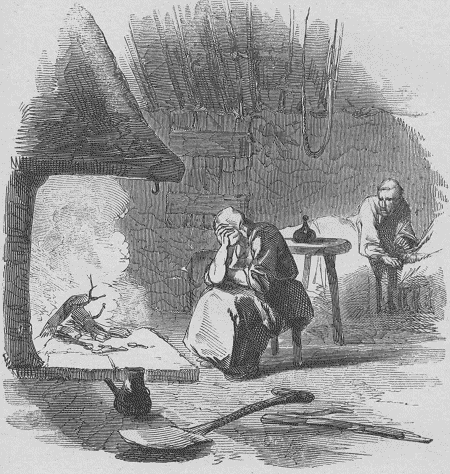
"Stooping over the ample grate,
Where burnt an ounce of fuel,
That cheered not the gloom
Of the workhouse room.
An aged and shivering female sate,
Sipping a pint of gruel:
And as she sopped a morsel of bread
In that liquid thin and poor.
With anguish she shook her aching head,
And thought of the days that were o'er
"Through the deep mists of years gone by
Her mental glances wandered;
And the warm blood ran
To her features Wan;
And fire for a moment lighted her eye,
As o'er the past she pondered.
[-310-] For she had once tripped the meadow
green
With a heart as blithe as May;
And she had been crowned the village-queen
In times that were far away!
She'd been the pride of parents dear.
And plenty banished sorrow;
And her love she gave
To a yeoman brave;
And a smiling offspring rose to cheer
Hearts that feared not for the morrow
Oh! why should they fear? In the sweat of their brow
They ate their daily bread;
And they thought, 'The earth will o'er yield as now
The fruits whereon we're fed!'
"But when their hair grew silvery white,
Sorrow their cot invaded,
And ravaged it then
As armies of men
Sack the defenceless town by night:-
Thus all Hope's blossoms faded!
From their little farm the stock was swept
By the owner of their land;
And the very bed on which they slept,
Was snatched by the bailiff's hand.
"One hope - one fond hope now was all
Each tender heart dared cherish-
That they might remain
Still linked by one chain,
And midst the sorrows that might befal,
Together live or perish.
But Want drove them on to the workhouse gate;
And when the door was pass'd
They found themselves doomed to separate-
To separate at last.
"And he fell sick:- she prayed in vain
To be where he was lying;
She poured forth her moan
Unto hearts of stone;
Never admittance she could gain
the room where he was dying!
Then into her brain the sad thoughts stole
That brain with anguish reeling-
That the great ones, judging by their own soul.
Think that paupers have no feeling.
"So, thus before the cheerless grate,
Watching the flick'ring ember
She rocked to and fro,
Her heart full of woe
For into that heart the arrow of fate
Pierced like the cold of December.
And though she sapped a morsel of bread,
She could not eat for crying;
Twas hard that she might not support the head
Of her much-lov'd husband dying!
"I stayed in the workhouse six weeks; and could stand it no longer. I had to labour, and was half-starved. So one morning I went to the Master, demanded my clothes, and was speedily retracing my steps towards my old haunts. That evening I supped with Dick Flairer at the boozing-ken on Saffron Hill ; and the same night we broke into a watchmaker's shop in the City. We got seventeen pounds in money, and a dozen watches and other trinkets, which we sold to the 'fence' in Field Lane for thirty guineas. That was a good bargain for him! I then went and took up my quarters with Dick Flairer at his lodgings; and in a few weeks I married his sister Mary. Six or eight months afterwards poor Dick was killed; and —"
< previous chapter < | THE MYSTERIES OF LONDON | > next chapter >