< previous chapter < | THE MYSTERIES OF LONDON | > next chapter >
[-216-]
CHAPTER LXX.
THE IMAGE, THE PICTURE, AND THE STATUE.
UPON the sofa in Mr. Greenwood's elegantly-furnished
drawing-room was seated the young lady who so anxiously sought an interview with
the owner of that princely mansion.
Her face was very pale: a profound melancholy reigned upon
her countenance, and was even discernible in her drooping attitude; her eyes
expressed a sorrow bordering upon anguish; and yet, through that veil of dark
foreboding, the acute observer might have seen a ray - a feeble ray of hope
gleaming faintly, so faintly, that it appeared a flickering lamp burning at the
end of a long and gloomy cavern.
Her elbow rested upon one end of the sofa, and her forehead
was supported upon her band, when Greenwood entered the room.
The doors of that luxurious dwelling moved so noiselessly
upon their hinges, and the carpets spread upon the floors were so thick, that
not a sound, either of door or footstep, announced to that pale and mournful
girl the approach of the man whom she so deeply longed to see.
He was close by her ere she was aware of his presence.
With a start, she raised her head, and gazed steadfastly up
into his countenance; but her tongue clave to the roof of her mouth, and refused
utterance to the name which she would have spoken.
"Ellen! " ejaculated Greenwood, as his eyes met
hers.- "What has brought you hither?"
"Can you not imagine it possible that I should wish to
see you again?" answered Miss Monroe - for she was Mr. Greenwood's visitor
upon the present occasion.
"But why so much mystery, Ellen? why refuse to give the
servant your name? why adopt a course which cannot fail to render your visit a
matter of suspicion to my household?" said Greenwood, somewhat impatiently.
"Forgive me - forgive me, if I have done wrong,"
exclaimed Ellen, the tears gushing to her eyes. "Alas! misfortunes have
rendered me so suspicious of human nature, that I feared - I feared lest you
should refuse to see me - that you would consider me importunate —"
"Well - well, Ellen : do not cry - that is foolish! I am not angry now; so cheer up, and tell me in what I can
serve thee?"
As Greenwood uttered these words, he seated himself upon the
sofa by the side of the young lady, and took her hand. We cannot say that her
tears had moved him - for his was a heart that was moved by nothing regarding
another : but she had looked pretty as she wept, and as her eyes glanced through
their tears towards him; and the apparent kindness of his manner was the
mechanical impulse of the libertine.
"Oh! if you would only smile thus upon me - now and then
-" murmured Ellen, gazing tenderly upon him,- "how much of the sorrow of this life
would disappear from before my eyes."
"How can one gifted with such charms as you be unhappy?"
exclaimed Greenwood.
"What! do you imagine that beauty constitutes felicity?" cried Ellen, in an impassioned tone. "Are not
the loveliest flowers exposed to the nipping frosts, as well as the rank and
poisonous weed? Do not clouds obscure the brightest stars, as well as those of
a pale and sickly lustre ? You ask me if I can be unhappy? Alas! it is now long
- long since I knew what perfect happiness was! I need not tell you - you -
how my father's fortune was swept away ;- but I may detail to you the miseries
which the loss of it raised up around him and me- and chiefly me!"
"But why dwell upon so sad a theme, Ellen? Did you come
hither to divert me with a narrative of sorrows which must now be past, since -
according to what I have heard - your father and yourself have found an asylum —"
"At Markham Place!" added Miss Monroe, emphatically.
"Yes - we have found an asylum there - there, in the house of the individual
whom my father's speculations and your agency —"
"Speak not of that - speak not of that, I conjure you! "
lustily exclaimed Greenwood. "Tell me, Ellen - tell me, you have not
breathed a word to your father, nor to that young man —"
"No - not for worlds!" cried Ellen, with a shudder: then,
after a pause, during which she appeared to reflect deeply, she said, "But
you ask me why I wish to narrate to you the history of all the miseries I have
endured for two long years, and upwards: you demand of me why I would dwell upon so sad a theme. I
will tell you presently. You shall hear me first. But pray, be not impatient: I
shall not detain you long ;- and, surely - surely, you can spare an hour to one who
is so very - very miserable."
"Speak, Ellen - speak!"
"The loss of our fortune plunged us into the most
frightful poverty. We were not let down gradually from affluenceto penury ;- but
we fell - as one falls from a height - abruptly, suddenly, and precipitately into
the
depths of want and starvation. The tree of our happiness lost not its foliage
leaf by leaf: it was blighted in an hour. This made the sting so much more sharp
- the heavy weight of misfortune so much less tolerable. Nevertheless, I
worked, and worked with my needle until my energies were wasted, my eyes grew
dim, and my health was sinking fast. Oh! my God, I only asked for work ;- and
yet, at length, I lost even that resource! Then commenced a strange kind of
life for me.
"A strange kind of life, Ellen - what mean you?" exclaimed
Greenwood, now interested in the recital.
"I sold myself in detail," answered Ellen, in a
tone of
the deepest and most touching melancholy.
"I cannot understand you," cried Greenwood. "Surely
- surely your
mind is not wandering!"
"No: all I tell you is unhappily too true," returned the
poor girl, shaking her head; then, as if suddenly recollecting herself, she
started from her thoughtful mood, and said, " You have a plaster of Paris
image as large as life, in the window of you: staircase?"
"Yes - it is a Diana, and holds a lamp which is lighted
at night, observed Greenwood. "But what means that strange question - so
irrelevant to the subject of our discourse?"
"More - more than you can imagine," answered Ellen,
bitterly "That statue explains one phase in my chequered life ; "-
then, sinking her tone almost to a whisper, grasping Greenwood's hand
convulsively, and regarding him fixedly in the countenance, while her own eyes
were suddenly lighted up with a strange wildness of expression, she added
"The face of your beautiful Diana is my own!"
[-217-]
Greenwood gazed upon her In speechless
astonishment: he
fancied that her reason was unhinged; and - he knew not why - he was afraid!
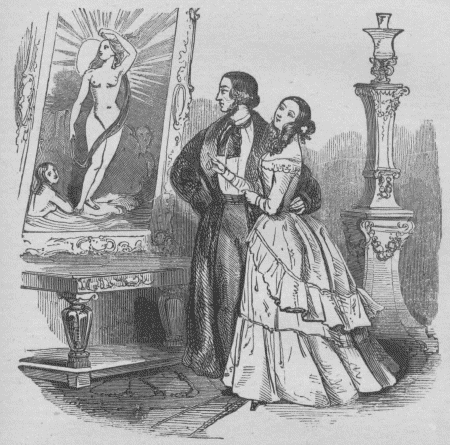
Ellen glanced around, and her eyes rested upon a magnificent
picture that hung against the wall. The subject of this painting, which had no
doubt struck her upon first entering that room, was a mythological scene.
Taking Greenwood by the hand, Ellen led him towards the
picture.
"Do you see any thing that strikes you strangely there?"
she said, pointing towards the work of art.
"The scene is Venus rising from the ocean, surrounded by
nereids and nymphs," answered Greenwood.
"And you admire that picture much?"
"Yes - much; or else I should not have purchased
it."
"Then have you unwittingly admired me," exclaimed Ellen;
"for the face of your Venus is my own!"
Greenwood gazed earnestly upon the picture for a few moments;
then, turning towards Ellen, he cried, "True - it is true! There are your eyes -
your mouth - your smile - your forehead - your very hair! How strange that I never noticed this before.
But - no - it
is a dream: it is a mere coincidence. Tell me - how could this have taken place
;- speak - is it not a mere delusion - an accidental resemblance which
you noticed on entering this room?"
"Come with me," said Ellen in a soft and melancholy tone.
Still retaining him by the hand, she led him into the landing
place communicating with the drawing-room and leading to the stairs.
A magnificent marble statue of a female, as large as life,
stood in one corner. The model was naked down to the waist, one hand gracefully
sustaining the drapery which enveloped the lower part of the form.
"Whence did you obtain that statue!" demanded Ellen,
pointing towards the object of her inquiry.
"The ruin of a family long reputed rich, caused the sale
of all their effects," answered Greenwood; "and I purchased that statue,
amongst other objects of value which were sold, for a mere trifle."
"The lady has paid dearly for her vanity!" cried
Ellen: "her fate - or rather the fate of her statue is a just reward for the
contempt, the scorn - the withering scorn with which she treated me, when I
implored her to take me into her service."
[-218-] "What do you mean, Ellen?"
"I mean that the bust of your marble statue is my own,"
answered the
young lady, casting down her eyes, and blushing deeply.
"Another enigma! " cried Greenwood.
They returned to the drawing-room, and resumed their seats upon the sofa.
A long pause ensued.
"Will you tell me, Ellen," at length exclaimed Greenwood, deeply struck
by all he had heard and seen within the last half hour,- "will you tell me,
Ellen, whether you have lost your reason, or I am dreaming?"
"Lost my reason!" repeated Ellen, with fearful bitterness of
tone ; "no - that were perhaps a blessing; and naught save misery awaits
me!"
" But the image - the picture - and the statue?" exclaimed Greenwood
impatiently.
"They are emblems of phases in my life," answered Ellen. "1 told
you ere now that my father and myself were reduced to the very lowest depths of
poverty. And yet we could not die ;- at least I could not see that poor,
white-haired, tottering old man perish by inches - die the death of starvation.
Oh! no -that was too horrible. I cried for bread - bread - bread!
And there was one - an old hag you know her —"
"Go on - go on."
"Who offered me bread - bread for myself, bread for my
father - upon
strange and wild conditions. In a word I sold myself in detail."
"Again that strange phrase!" ejaculated Greenwood. "What
mean
you, Ellen?"
" I mean that I sold my face to the statuary - my likeness to the
artist - my bust to the sculptor - my whole form to the photographer - and —"
"And —" repeated Greenwood, strangely excited.
"And my virtue to you!" added the young woman, whose tone, as she
enumerated these sacrifices, had gradually risen from a low whisper to the
wildness of despair.
"Ah! now I understand," said Greenwood, whose iron heart was for a
moment touched: "how horrible!"
"Horrible indeed!" ejaculated Ellen. "But what other women sell first, I
sold last: what others give in a moment of delirium, and in an excess of
burning, ardent passion, I coolly and deliberately exchanged for the price of
bread! But you know this sad - this saddest episode in my strange history!
Maddened by the sight of my father's sufferings, I flew to the accursed old hag:
I said, 'Give me bread, and do with me as thou wilt!' She took me with her. I
accompanied her, reckless of the way we went, to a house where I was shown into
a chamber that was darkened; there I remained an hour alone, a prey to all the
horrible ideas that ever yet combined to drive poor mortal mad, and still failed
to accomplish their dread aim ;- the hour passed - a man came - you know the
rest!"
"Say no more, Ellen, on that head: but tell me, to what does all this
tend?"
"One word more. Hours passed away, as you are well aware: you would not
let me go. At length I returned home. My God! my poor father was happy! He had
met an angel, while I had encountered a devil —"
"Ellen! Ellen!"
"He had gold - he was happy, I say! He had purchased a succulent
repast - he had spread it with his own hand - he had heaped up his luxuries, his
humble way, to greet the return of his dear - his darling child. Heavens! how did I survive that moment?
how dared I stand in the presence of that old man - that good, that kind old man
- whose hair was so white with many winters, and whose brow was so wrinkled
with many sorrows? I cannot say how passed the few hours that followed my return! Flower after flower had dropped from the garland of my
purity - that purity in
which he - the kind old man - had nurtured me! And then there was the dread -
the
crushing-the overwhelming conviction that had I retained my faith in God for a
few hours more - had I only exercised my patience until the evening of that fatal
day, I had been spared that final guilt - that crowning infamy!"
Ellen covered her face with her hands, and burst into an
agony of tears. Deep sobs convulsed her bosom; she groaned in spirit; and never
had the libertine by her side beheld female anguish so fearfully
exemplified before.
Oh! when fair woman loses the star from her brow, and yet
retains the sense of shame, where shall she seek for comfort? whither shall she
fly to find consolation?
Greenwood was really alarmed at the violence of the poor
girl's grief.
"Ellen, what can I do for you? what would you have with
me?" he said, passing his arm around her waist.
She drew hastily away from his embrace, and turning upon him
her tearful eyes, exclaimed, "If you touch me under the influence of the
sentiment that made you purchase my only jewel, lay not a finger on me - defile me
not - let my sorrows make my person sacred! But if you entertain one spark of
feeling - one single idea of honour, do me justice - resign me not to despair!"
"Do you justice, Ellen?"
"Yes - do me justice; for I was pure and spotless till
want and misery threw me into your arms," continued Ellen, in an impassioned
tone; "and if I sinned - if I surrendered myself up to him who offered me a
price - it was only that I might obtain bread - bread for my poor father!"
"Ellen, what would you have me do?"
"What would I have you do!" she repeated bitterly:
"oh! cannot you comprehend what I would have you do to save my honour? It
is in your power to restore me to happiness ;- it is you who this day - this
hour - must decide my doom. You ask me what I would have you do? Here, upon my knees I
answer you - here, at your feet I implore you, by all your hopes of. prosperity in
the world and salvation in the next - by all you hole dear; solemn, and sacred -
I
implore you to bestow a father's honourable name upon the child which I hear in
my womb!"
She had thrown herself before him - she grasped his hands -
she bedewed them with her tears - she pressed them against her bosom that was
convulsed with anguish.
"Rise, Ellen - rise," exclaimed Greenwood : "some one may
come - some one may —"
"Never will I rise from this position until your tongue
pronounces my fate!"
"You do not - you cannot mean —"
"That you should marry me!" exclaimed Ellen.
"Yes - that is the prayer which I now offer to you! Oh I if you will but
restore me to the path of honour, I will be your slave. If my presence be an
annoyance to you, I will never see you more from the moment when we quit the
altar: but if you will admit me to your confidence - if you will make me the
partner of your hopes and fears, your joy [-219-] and sorrows, I will smile when you
smile - I will console you
when you weep. I will serve you - upon my knees will I serve you ;- I will never
weary of doing your bidding. But - O God! do not, do not refuse me the only prayer
which I have now to offer to mortal man!"
"Ellen, this is impossible! My position - my interest -
my
plans render marriage - at present - a venture in which I cannot embark."
"You reject my supplication - you throw me back into
disgrace and despair," cried Ellen: "Oh! reflect well upon what you are
doing!"
"Listen to me," said Mr. Greenwood. "Ask me any
thing that money can purchase, and you shall have it, Say the word, and you
shall have a house - a home - furnished in all imaginable splendour; and measures
shall be taken to conceal your situation from the world."
"No - this
is not what I ask," returned Ellen. "The wealth of the universe cannot recompense me if I am
to pass as Mr. Greenwood's pensioned mistress!"
"Then what, in the name of heaven, do you now require of
me?" demanded the Member of Parliament impatiently.
"That you should do me justice," was the reply, while
Ellen still remained upon her knees.
"Do you justice!" repeated Greenwood: "and how have
I wronged you? If I deliberately set to work to seduce you - if, by art and
treachery, I wiled you away from the paths of duty - if, by false promises, I
allured you from a prosperous and happy sphere,- then might you talk to me of
justice. But no: I knew not whom I was about to meet when the old hag came to me
that day, and said —"
"Enough! enough! I understand you," cried Ellen, rising
from her suppliant position, and clasping her hands despairingly together.
"You consider that you purchased me as you would have bought any poor girl
who, through motives of vanity, gain, or lust, would have sold her person to the
highest bidder! Oh - now I understand you! But, one word, Mr. Greenwood! If there
were no such voluptuaries - such heartless libertines as you in this world,
would there be so many poor unhappy creatures like me? In an access of despair -
of folly - and of madness, I rushed upon a path which men like you
alone open to women placed as I then was! Perhaps you consider that I am not
worthy to become your wife? Fool that I was to seek redress - to hope for
consolation at your hands! Your conduct to others - to my father - to —"
"Ellen! I command you to be silent! Remember our solemn
compact on that day when we met in so strange and mysterious a manner ;-
remember
that we pledged ourselves to mutual silence - silence with respect to all we know
of each other! Do you wish to break that compact?"
"No - no," ejaculated Ellen, convulsively clasping her
hands together: "I would not have you publish my disgrace! Happily I have
yet friends who will - but no matter. Sir, I now leave you: I have your answer. You refuse to give a father's some to the
child which I bear? You may live to repent your decision. For the present,
farewell."
And having condensed all her agonising feelings to a moment
of unnatural coolness - the awful calmness of despair - Ellen slowly left the room.
But Mr. Greenwood did not breathe freely until so heard the
front door close behind her.
< previous chapter < | THE MYSTERIES OF LONDON | > next chapter >